
The Characteristics of the Augustan Age in English Literature reflect one of the most influential phases of the Neoclassical Period. This era emphasised reason, order, and discipline and followed classical ideals. Generally dated from approximately 1700 to 1745, the Augustan Age witnessed significant intellectual, cultural, and literary developments shaped by the ideals of the Enlightenment. Writers valued rational thinking over emotional excess and sought to produce literature that was balanced, refined, and morally instructive. Instead of celebrating individual imagination, they looked to the literary contributions of ancient Greece and Rome as enduring models of artistic excellence.
The literature of this era also reflected the social and political changes taking place in eighteenth-century Britain. The growth of an educated middle class, the rise of coffeehouse culture, and the expansion of newspapers and periodicals encouraged writers to engage with contemporary society in new and meaningful ways. Wit, satire, and clarity became defining features of literary expression, while strict literary conventions ensured that works maintained elegance and decorum.
This article depicts the defining features of the Augustan Age, explaining how they emerged, why they mattered, and how they shaped English literary history. Whether you are a student, researcher, competitive examination candidate, or literature enthusiast, this guide provides a comprehensive understanding of the distinctive features that define this remarkable literary age.
What Is the Augustan Age in English Literature?
The Augustan Age refers to a distinct literary era in early eighteenth-century England, known for its pursuit of artistic refinement, intellectual culture, and disciplined literary expression. Rather than encouraging radical innovation, writers sought excellence by adhering to established standards of taste, craftsmanship, and critical judgment. Literature increasingly engages educated readers by addressing contemporary society through polished language and carefully structured ideas.
The term “Augustan Age” was adopted by eighteenth-century English writers in reference to the reign of the Roman Emperor Augustus Caesar (27 BCE–14 CE), a period traditionally regarded as the golden age of Latin literature. During Augustus’s rule, celebrated authors such as Virgil, Horace, and Ovid produced works that later generations admired for their elegance, balance, and artistic achievement. English writers invoked this historical parallel to express their ambition to cultivate a literary culture as distinguished as the one they admired.
The Augustan Age developed within the broader Neoclassical framework, which encouraged writers to look to classical antiquity for artistic inspiration. It also reflected the intellectual climate of the Enlightenment, when reason, observation, and critical inquiry were increasingly valued in literature, philosophy, and public life. These influences shaped the literary standards of the period and gave Augustan literature its distinctive identity.
Because of its lasting contributions to literary criticism, prose style, and poetic craftsmanship, the Augustan Age remains one of the most influential periods in the history of English literature. It continues to be studied as a defining stage in the development of the English literary tradition.
Historical Background of the Augustan Age
Understanding the Characteristics of the Augustan Age in English Literature requires an appreciation of the historical circumstances that shaped the period. The early eighteenth century was marked by political stability, expanding commerce, intellectual progress, and growing public participation in cultural life. These developments created an environment in which literature increasingly reflected rational thought, social observation, and public discourse.
Following the political upheavals of the seventeenth century, including the English Civil War and the Glorious Revolution of 1688, Britain entered a comparatively stable constitutional era. Although political rivalries continued, the establishment of a constitutional monarchy encouraged greater confidence in public institutions and fostered an atmosphere conducive to intellectual and literary activity. This stability allowed writers to focus more on social criticism, ethical questions, and the improvement of public life.
Economic growth also contributed significantly to literary development. The expansion of trade and commerce strengthened the middle class, whose increasing literacy created a larger reading public. Unlike earlier periods dominated primarily by aristocratic patronage, writers now addressed merchants, professionals, and educated citizens whose interests extended beyond courtly entertainment to moral instruction and contemporary social issues.
Another defining feature of the period was the emergence of coffeehouses as important centres of intellectual exchange. These establishments served as meeting places where politicians, merchants, scholars, journalists, and writers gathered to discuss literature, philosophy, science, and current affairs. The lively debates held in coffeehouses encouraged critical thinking and informed public opinion, both of which strongly influenced literary culture.
The eighteenth century also witnessed a remarkable expansion of print culture. Improvements in printing technology, together with the growing demand for books, newspapers, magazines, and pamphlets, made literature more accessible than ever before. Periodical publications reached a wide audience and transformed reading into a regular part of everyday life. Writers increasingly produced works intended not only to entertain but also to educate and shape public values.
Above all, the Enlightenment profoundly influenced the intellectual climate of the Augustan Age. Philosophers and thinkers promoted reason, observation, and logical inquiry as the foundations of knowledge. These ideals encouraged writers to value clarity, moderation, order, and critical judgment—qualities that became central characteristics of Augustan literature.
Characteristics of the Augustan Age in English Literature
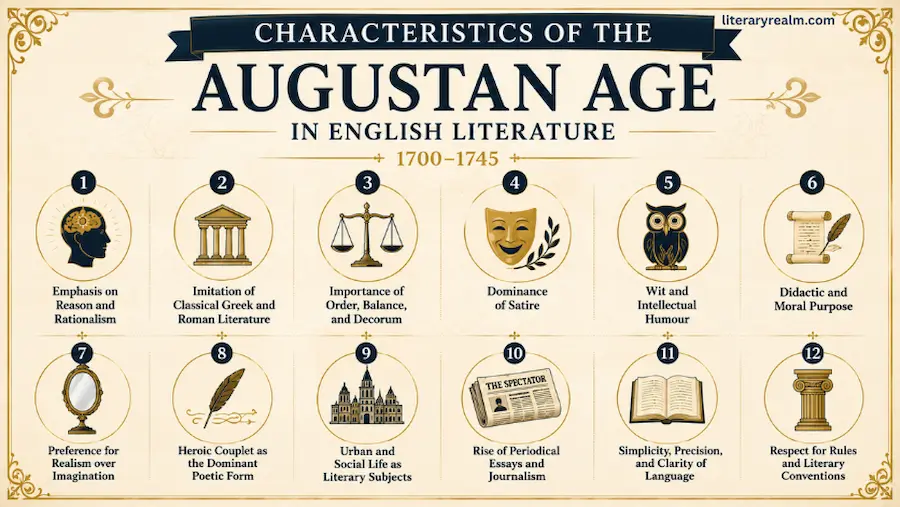
The Characteristics of the Augustan Age in English Literature distinguish this period as one of the most disciplined, intellectually driven, and classically inspired eras in English literary history. Unlike the Renaissance, which celebrated human potential and creativity, or the Romantic Age, which emphasised imagination and emotion, the Augustan Age valued reason, order, restraint, and social responsibility. Writers believed that literature should not merely entertain but also educate, correct human behaviour, and uphold moral standards.
The following characteristics collectively define the literary identity of the Augustan Age.
Emphasis on Reason and Rationalism
One of the most defining Characteristics of the Augustan Age in English Literature is its strong emphasis on reason and rationalism. Influenced by the Enlightenment, Augustan writers believed that human reason was the most reliable guide to truth, morality, and artistic excellence. They viewed literature as a means of expressing logical thought rather than uncontrolled emotion or personal imagination.
Instead of celebrating emotional spontaneity, writers preferred careful analysis, balanced arguments, and intellectual discipline. Literary works were expected to reflect common sense, moderation, and sound judgment. Excessive sentiment, extravagant fantasy, and irrational behaviour were often criticised as contrary to the principles of good taste.
Reason also shaped literary criticism. Critics evaluated works according to established standards derived from classical literature rather than personal preference. Writers believed that universal truths could be discovered through observation and logical thinking, making literature both intellectually satisfying and socially beneficial.
This rational outlook influenced nearly every aspect of Augustan literature and laid the foundation for many of its other defining characteristics.
Imitation of Classical Greek and Roman Literature
Another hallmark of the Augustan Age was the deliberate imitation of classical Greek and Roman literature. Neoclassical writers regarded ancient authors as models of artistic perfection whose works embodied timeless principles of beauty, balance, and discipline.
Rather than seeking complete originality, Augustan writers believed that excellence could be achieved by studying and adapting the techniques of classical masters. They admired the elegance of Virgil, the satirical wit of Horace, and the critical principles discussed by Aristotle and later Roman critics.
This imitation did not involve simple copying. Instead, writers adapted classical ideas to contemporary English society while preserving their emphasis on harmony, proportion, and refined expression. Classical mythology, historical references, and literary conventions frequently appeared in their works, connecting modern literature to a respected intellectual tradition.
As a result, the literature of the Augustan Age reflects a conscious effort to preserve classical ideals while addressing the social and moral concerns of eighteenth-century Britain.
Importance of Order, Balance, and Decorum
The pursuit of order, balance, and decorum formed another essential characteristic of Augustan literature. Writers believed that beauty resulted from harmony rather than excess and that every literary work should exhibit careful organisation and proportion.
The order referred to the logical structure and coherent presentation of ideas. Literary compositions were expected to progress systematically, allowing readers to follow arguments with clarity and ease. Disorder, confusion, or unnecessary complexity was generally avoided.
Balance was equally important. Writers sought moderation in language, thought, and emotion. They rejected extremes and preferred measured expression that reflected intellectual control.
Decorum, a key Neoclassical principle, required that style, subject matter, and character behaviour remain appropriate to one another. Elevated subjects demanded dignified language, while ordinary subjects required simpler expression. This concern for suitability ensured consistency and artistic unity throughout literary works.
These principles helped establish the polished style for which Augustan literature is widely recognised.
Dominance of Satire
Satire became one of the most influential literary characteristics of the Augustan Age because writers regarded literature as a powerful instrument for exposing human weaknesses and improving society.
Rather than attacking individuals solely for personal criticism, Augustan satire generally targeted broader social problems such as hypocrisy, corruption, vanity, greed, political dishonesty, and intellectual pretension. By revealing these flaws through irony, humour, exaggeration, and ridicule, writers hoped to encourage moral reform.
Unlike purely humorous writing, Augustan satire carried a serious ethical purpose. Its objective was not merely to amuse readers but to inspire reflection and promote better conduct. This combination of entertainment and moral instruction made satire one of the defining features of eighteenth-century literature.
Although satire appeared in various literary forms, it reflected the broader Augustan belief that literature should contribute positively to society by correcting vice and encouraging virtue.
Wit and Intellectual Humour
Closely connected with satire was the Augustan appreciation of wit and intellectual humour. Wit referred to the ability to express ideas with cleverness, precision, and unexpected insight rather than relying on simple jokes or emotional appeal.
Augustan writers admired language that demonstrated intelligence and rhetorical skill. They often used concise observations, paradoxes, analogies, and irony to engage readers intellectually. Humour was expected to stimulate thought as much as laughter.
This intellectual style reflected the educated audience of the period, many of whom participated in coffeehouse discussions, literary clubs, and public debates. Readers appreciated works that challenged their reasoning and rewarded careful interpretation.
As a result, wit became a symbol of cultural refinement and literary excellence during the Augustan Age.
Didactic and Moral Purpose
Literature of the Augustan Age was expected to serve a didactic, or instructional, purpose. Writers believed that literature should educate readers, strengthen moral values, and contribute to the improvement of society.
This educational function reflected the Neoclassical principle that literature should both delight and instruct, an idea inherited from classical criticism. Entertainment alone was considered insufficient if it failed to provide ethical insight or practical wisdom.
Consequently, literary works frequently explored questions of virtue, justice, moderation, honesty, and responsible citizenship. Rather than presenting morality through emotional preaching, writers often communicated lessons through reasoned arguments, satire, or carefully constructed narratives.
The didactic nature of Augustan literature demonstrates the close relationship between literary art and social responsibility during the eighteenth century.
Preference for Realism over Imagination
Unlike the Romantic writers who later celebrated imagination as the highest creative power, Augustan authors generally preferred realism grounded in observation and experience.
Their literature focused on ordinary human behaviour, recognisable social situations, and everyday life rather than on supernatural events, intense personal emotions, or highly imaginative fantasy. Writers believed that literature should accurately represent universal aspects of human nature that readers could observe in the real world.
This realistic approach encouraged careful examination of society, manners, political institutions, and ethical conduct. Characters were often portrayed as typical humans rather than as extraordinary or highly emotional figures.
By emphasising reality over fantasy, Augustan literature reflected the Enlightenment belief that knowledge should be grounded in observation, reason, and practical experience.
Heroic Couplet as the Dominant Poetic Form
Among the formal characteristics of the Augustan Age, the heroic couplet occupied a position of exceptional importance. A heroic couplet consists of two rhymed lines written in iambic pentameter, often expressing a complete thought with balance and precision.
This poetic form is perfectly suited to Augustan ideals because its regular rhythm and symmetrical structure reflect order, discipline, and clarity. Writers used heroic couplets to present arguments, moral reflections, satire, and philosophical observations with remarkable elegance.
The concise nature of the heroic couplet also encouraged precision of language. Every line was carefully crafted, allowing writers to express complex ideas in a polished, memorable way.
Its widespread use made the heroic couplet one of the most recognisable literary features of the Augustan Age.
Urban and Social Life as Literary Subjects
Augustan literature increasingly shifted its attention from heroic legends and medieval romance to the realities of urban and social life. As London developed into a major political, commercial, and cultural centre, writers found abundant material in the everyday experiences of city life.
Literary works examined social customs, public behaviour, fashion, education, politics, commerce, and interpersonal relationships. Writers observed how individuals interacted within society and frequently commented on changing manners and public values.
This focus reflected the expanding influence of the middle class and the growing importance of civic life during the eighteenth century. Rather than escaping from reality, literature became closely connected with the social environment in which readers lived.
The emphasis on urban society helped make Augustan literature both relevant and accessible to its contemporary audience.
Rise of Periodical Essays and Journalism
The Augustan Age witnessed a remarkable growth in periodical essays and journalism, largely because of expanding print culture, which created new opportunities for communication with an increasingly literate public.
Newspapers and literary periodicals became popular sources of information, education, and entertainment. Essays published in these periodicals discussed topics such as morality, manners, education, politics, and everyday social life in a clear and engaging style.
This development encouraged writers to address a broader readership rather than limiting their work to aristocratic patrons. Literature became more closely connected with public opinion, intellectual debate, and civic responsibility.
The popularity of periodical writing also strengthened prose as an important vehicle for communicating ideas, reflecting the age’s practical, rational spirit.
Simplicity, Precision, and Clarity of Language
Another defining characteristic of Augustan literature was its commitment to clear, precise, and elegant language. Writers avoided unnecessary ornamentation and excessive emotional expression, preferring language that communicated ideas accurately and effectively.
Sentences were generally well organised, vocabulary carefully chosen, and arguments logically developed. Every word served a purpose, contributing to the work’s overall clarity.
This preference for simplicity did not imply a lack of sophistication. Instead, it reflected the belief that true literary excellence lay in expressing complex ideas with grace, accuracy, and restraint.
The emphasis on clarity made Augustan literature accessible to educated readers while maintaining high artistic standards.
Respect for Rules and Literary Conventions
The most comprehensive characteristic of the Augustan Age was its deep respect for rules and established literary conventions. Writers believed that artistic excellence depended upon disciplined craftsmanship rather than unrestricted creativity.
Classical principles provided standards for structure, style, characterisation, and literary decorum. Authors carefully observed these conventions because they believed they reflected universal truths about beauty and artistic harmony.
Innovation was welcomed only when it remained consistent with established principles. Excessive experimentation or rejection of literary tradition was generally viewed with suspicion because it threatened order and balance.
This respect for rules distinguished the Augustan Age from later literary movements, particularly Romanticism, which celebrated originality, emotional freedom, and individual imagination.
These characteristics collectively define the Augustan Age as a period committed to intellectual discipline, classical refinement, moral responsibility, and literary craftsmanship. Together, they shaped one of the most influential chapters in the history of English literature.
Why Are These Characteristics Important?
The Characteristics of the Augustan Age in English Literature are important because they shaped the literary ideals of the early eighteenth century and established standards that influenced English literature for generations. By emphasizing reason, order, clarity, and moral purpose, Augustan writers transformed literature into a medium for intellectual discussion, ethical reflection, and social criticism rather than mere entertainment.
These characteristics were closely aligned with the principles of the Enlightenment, which promoted rational inquiry, empirical observation, and confidence in human reason. As a result, literary works reflected contemporary concerns about politics, society, education, and human behaviour while encouraging readers to think critically about the world around them. The emphasis on discipline, balance, and classical models also contributed to the development of polished literary craftsmanship and rigorous standards of criticism.
Although later literary movements, particularly Romanticism, challenged many Augustan ideals by celebrating imagination and emotion, they did so in direct response to the literary conventions established during the Augustan Age. Understanding these characteristics, therefore, helps readers appreciate not only Augustan literature itself but also the evolution of English literary history.
Today, these defining features remain an essential part of English literature curricula worldwide. Students, researchers, and competitive examination candidates study them to understand the historical development of literary theory, Neoclassical aesthetics, and the intellectual foundations of eighteenth-century literature.
Conclusion
The Characteristics of the Augustan Age in English Literature reveal a literary period shaped by intellectual discipline, classical influence, and the ideals of the Enlightenment. Writers emphasized reason over emotion, valued order and decorum, employed satire and wit to examine society, and sought to produce literature that was both instructive and artistically refined. Their commitment to realism, clarity of language, and established literary conventions distinguished the Augustan Age from both the Restoration that preceded it and the Romantic movement that followed.
Although literary tastes evolved, the principles developed during this period left a lasting mark on English literature. They influenced literary criticism, poetic style, prose writing, and the broader understanding of literature’s social and moral responsibilities. Learning about the Augustan Age in English Literature not only deepens our understanding of the Neoclassical tradition but also provides valuable insight into the historical development of English literary thought.