
The Neoclassical Period (1660–1798) is one of the most influential eras in English literature. Emerging after the Restoration of the monarchy in England, this period was characterized by a renewed admiration for the ideals of ancient Greek and Roman civilization. Writers of the time emphasized reason, logic, order, discipline, and moral responsibility, believing that literature should reflect human intelligence rather than uncontrolled emotions or imagination.
The Neoclassical Period is commonly known as the Age of Reason because it coincided with the Enlightenment, an intellectual movement that encouraged people to question traditional beliefs and rely on rational thinking, scientific inquiry, and empirical evidence. Philosophers, scientists, and literary figures believed that reason was the most reliable path to truth, progress, and social improvement.
These Enlightenment ideals profoundly shaped English literature. Authors focused on clarity, balance, wit, and moral instruction instead of emotional excess or supernatural themes. Their works sought to educate readers while entertaining them, reflecting a belief that literature should serve society.
This article explains why the Neoclassical Period is called the Age of Reason, explores the influence of the Enlightenment, discusses the era’s defining characteristics, examines its impact on English literature, and highlights the major writers who embodied its ideals.
What Does the Term “Age of Reason” Mean?
The Age of Reason refers to an intellectual and cultural movement during the seventeenth and eighteenth centuries in which reason, logic, and scientific thinking became the primary means of understanding the world. Instead of accepting ideas solely because they were supported by tradition, religious authority, or superstition, people increasingly believed that knowledge should be based on observation, evidence, and rational inquiry.
The phrase is closely associated with the Enlightenment, a European intellectual movement that transformed philosophy, politics, science, and literature. Enlightenment thinkers argued that human beings possess the capacity to improve society through education, critical thinking, and the application of reason. Their ideas encouraged intellectual freedom, challenged long-held assumptions, and inspired reforms in many areas of life.
This shift in thinking marked a significant departure from earlier periods, when religious doctrine and inherited customs often determined how people interpreted the world. During the Age of Reason, philosophers and writers promoted skepticism toward unsupported beliefs and emphasized logical analysis over unquestioning acceptance.
In literature, these principles encouraged authors to write with clarity, precision, and purpose. Literary works were expected not only to entertain readers but also to educate them by presenting moral lessons, social observations, and practical wisdom. Emotion was not rejected entirely, but it was expected to remain under the guidance of reason.
For this reason, the term Age of Reason perfectly describes the intellectual climate of the Neoclassical Period, when rational thought became the foundation of literary expression, cultural values, and intellectual progress.
Why Is the Neoclassical Period Called the Age of Reason?
The Influence of the Enlightenment
The Neoclassical Period earned the title Age of Reason largely because it developed alongside the Enlightenment, one of the most transformative intellectual movements in European history. Enlightenment thinkers believed that human progress depended on reason rather than on blind faith, superstition, or inherited customs. They argued that every belief should be tested through observation, evidence, and logical analysis.
These ideas significantly influenced English writers. Literature became a medium through which authors explored human nature, criticized social problems, and encouraged moral improvement. Instead of celebrating myths or supernatural events, many writers focused on realistic situations and universal truths that readers could understand through reason.
The influence of philosophers such as John Locke, who emphasized empirical knowledge and rational inquiry, further strengthened the belief that individuals could shape a better society through education and critical thinking. As a result, literature reflected the Enlightenment’s confidence in human intelligence and its commitment to intellectual progress, making reason the defining principle of the age.
Emphasis on Logic and Rational Thinking
Another major reason the Neoclassical Period is called the Age of Reason is its strong emphasis on logic and rational thinking. Writers believed that clear reasoning should guide both artistic creation and everyday life. Rather than relying on emotional impulses, they valued careful judgment, disciplined thought, and intellectual restraint.
Literary works from this period were written with precision and clarity. Authors avoided unnecessary ornamentation and emotional exaggeration, preferring arguments supported by observation and logical structure. Essays, poems, and literary criticism often presented ideas systematically, making them accessible and persuasive to readers.
Reason was also considered essential for understanding human behaviour and improving society. Writers believed that people could overcome ignorance and social problems by applying intelligence and critical thinking. Literature, therefore, became an instrument for encouraging readers to examine their beliefs, question irrational customs, and adopt more reasonable attitudes.
This commitment to evidence-based reasoning distinguished Neoclassical literature from earlier traditions that often emphasized mystery, supernatural elements, or emotional intensity.
Preference for Order, Balance, and Harmony
The Neoclassical Period admired the artistic principles of ancient Greece and Rome, where order, proportion, and harmony were considered signs of excellence. Writers believed that beauty in literature resulted from careful organization, balanced expression, and adherence to established artistic rules.
Poetry frequently followed regular meter and rhyme, while prose emphasized logical progression and coherent structure. Authors avoided excessive complexity and aimed for elegance through simplicity and control. Their works reflected the belief that disciplined craftsmanship produced more lasting value than spontaneous inspiration.
This preference for order extended beyond literary form. Neoclassical writers also believed that society itself should be governed by reason, moderation, and ethical principles. Balance became both an artistic ideal and a moral value, reinforcing the era’s reputation as the Age of Reason.
Literature as a Tool for Education
Neoclassical writers believed that literature should serve a higher purpose than mere entertainment. Inspired by the classical principle of “to instruct and delight,” they sought to educate readers while also engaging them with wit, satire, and elegant language.
Many literary works presented moral lessons, encouraged virtuous behaviour, and criticized social flaws. Essays offered practical advice, poems reflected on ethical conduct, and satirical works exposed hypocrisy, corruption, and human foolishness. Authors believed that readers could become wiser and more responsible citizens through thoughtful literature.
This educational mission reflected the Enlightenment conviction that knowledge and reason could improve individuals and society. Literature became an effective means of spreading rational ideas and encouraging intellectual development.
By combining artistic excellence with moral instruction, Neoclassical writers demonstrated that literature could contribute to social progress, thereby further justifying the period’s description as the Age of Reason.
Rejection of Superstition and Excessive Emotion
One of the defining features of the Neoclassical Period was its rejection of superstition, irrational beliefs, and excessive emotional expression. Enlightenment thinkers encouraged people to question ideas that lacked logical or empirical support, and literary authors adopted the same approach in their works.
Rather than portraying supernatural events as unquestionable truths, many writers emphasized realistic situations and human experiences that could be understood through observation and reason. They criticized blind faith, ignorance, and prejudice, believing that rational inquiry offered a more reliable path to knowledge.
The period also differed from the later Romantic Age in its treatment of emotion. While Neoclassical writers acknowledged human feelings, they believed emotions should remain balanced and guided by reason rather than dominate decision-making. Moderation, self-control, and intellectual discipline were regarded as essential virtues.
This commitment to rationality, moderation, and skepticism toward irrational beliefs explains why the Neoclassical Period has long been recognized as the Age of Reason. It was an era in which writers consistently placed logic above impulse, evidence above superstition, and intellectual order above emotional excess, leaving a lasting influence on English literature and Western thought.
Key Characteristics of the Age of Reason
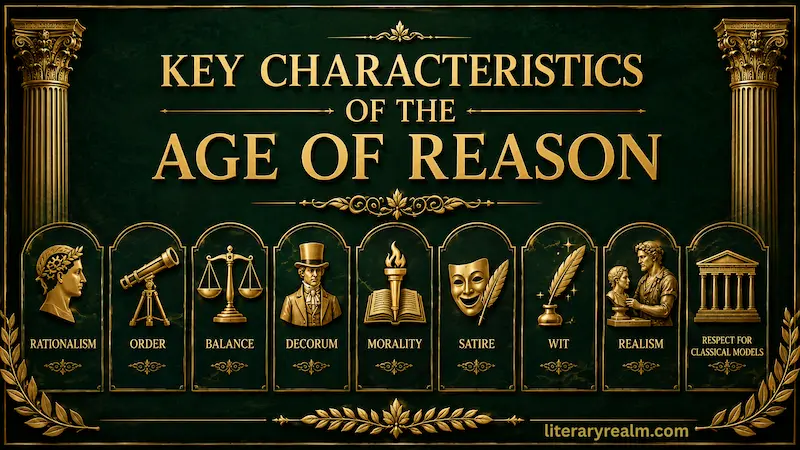
The Age of Reason is distinguished by a set of literary and intellectual principles that shaped the Neoclassical Period. Influenced by the Enlightenment and the classical traditions of Greece and Rome, writers valued discipline, rationality, and moral responsibility over emotional excess or imaginative extravagance. These characteristics are evident in the literature, philosophy, and social criticism of the 17th and 18th centuries.
Rationalism
The most important characteristic of the Age of Reason was rationalism. Writers believed that reason was the highest human faculty and the best means of discovering truth. They trusted observation, logic, and critical thinking rather than superstition or blind faith. Literary works often presented arguments supported by evidence and appealed to readers’ intellect rather than their emotions.
Order
Neoclassical authors admired order in both society and literature. They believed that every literary work should have a clear structure, logical progression, and well-organised ideas. This preference for order reflected their belief that the universe itself operated according to rational principles.
Balance
Balance was another defining feature of the period. Writers sought harmony between form and content, imagination and reason, and entertainment and instruction. They avoided exaggeration and maintained moderation in language, style, and subject matter.
Decorum
The principle of decorum required that literary style, language, and characters be appropriate to the subject. Heroes, kings, and noble figures were expected to speak and behave with dignity, while comic characters were portrayed in ways suited to their social positions. Maintaining propriety and consistency was considered essential to good writing.
Morality
Neoclassical literature emphasized moral values and ethical conduct. Authors believed that literature should improve readers by teaching virtues such as honesty, moderation, wisdom, and responsibility. Many poems, essays, and plays encouraged readers to reflect on their actions and improve toward moral excellence.
Satire
Satire became one of the most popular literary forms during the Age of Reason. Instead of merely entertaining audiences, satirists exposed human weaknesses, political corruption, social hypocrisy, and intellectual ignorance through humour, irony, and exaggeration. Their goal was not simply to ridicule but to encourage reform and improvement.
Wit
Neoclassical writers greatly valued wit, which referred to cleverness, intellectual sharpness, and the skilful use of language. Rather than relying on emotional expression, they impressed readers with concise arguments, memorable aphorisms, and sophisticated humour. Wit demonstrated both literary craftsmanship and intellectual ability.
Realism
Although not identical to nineteenth-century literary realism, Neoclassical literature focused on realistic observations of human behaviour and society. Writers explored universal aspects of human nature and everyday life instead of fantasy or supernatural adventures. Their characters often represented common human virtues and flaws.
Respect for Classical Models
The writers of the Age of Reason regarded ancient Greek and Roman authors as models of literary excellence. They studied classical works to learn the principles of structure, proportion, clarity, and artistic discipline. Rather than copying classical literature directly, they adapted its ideals to address contemporary issues, producing works that combined timeless values with modern relevance.
Together, these characteristics explain why the Neoclassical Period is remembered as the Age of Reason. Its literature reflects a deep commitment to logic, order, morality, and intellectual excellence, all of which were inspired by the ideals of the Enlightenment.
How the Age of Reason Influenced English Literature
The Age of Reason transformed English literature by introducing a stronger emphasis on rational thought, artistic discipline, and moral purpose. During the Neoclassical Period, writers viewed literature as more than a source of entertainment; they believed it should educate readers, encourage ethical behaviour, and contribute to social improvement. This philosophy influenced every major literary genre.
In poetry, authors favoured clarity, balance, and polished craftsmanship over emotional spontaneity. The heroic couplet became the dominant poetic form because its regular rhythm and rhyme reflected the Neoclassical ideals of order and precision. Poems often explored moral themes, human nature, and philosophical ideas through wit and logical argument.
The period also witnessed the remarkable growth of the essay. Essayists used concise and elegant prose to discuss politics, morality, education, and everyday life. Their writings aimed to inform readers while encouraging critical thinking and rational judgment. Essays became an important medium for spreading Enlightenment ideas among educated audiences.
Satire flourished as one of the defining literary forms of the Age of Reason. Writers employed irony, humour, and exaggeration to criticise corruption, vanity, hypocrisy, and social injustice. Rather than attacking individuals alone, satire sought to expose broader human weaknesses and inspire moral reform.
In drama, playwrights emphasized realism, decorum, and carefully structured plots. Comedies frequently portrayed contemporary society, highlighting the manners, customs, and follies of the upper classes. Characters were expected to behave consistently according to their social roles, reflecting the Neoclassical concern for order and propriety.
The period also saw significant developments in prose, including biographies, travel writing, journalism, and the early English novel. The authors adopted a clear, direct style that prioritized accuracy and logical organization. This approach made literature more accessible to a growing reading public.
Another major contribution of the Age of Reason was the rise of literary criticism. Critics evaluated works according to established standards of taste, reason, and classical principles. They emphasized clarity, unity, and artistic discipline, helping to shape literary theory for generations.
Overall, the influence of the Age of Reason gave English literature a distinctive style characterized by clarity, elegance, restraint, wit, and intellectual depth. These qualities continue to influence literary writing and criticism today.
Major Writers Who Represent the Age of Reason
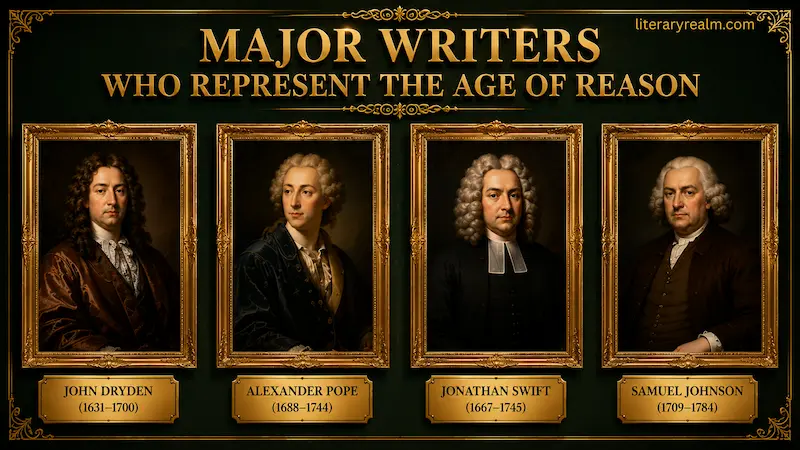
Several outstanding writers embodied the ideals of the Age of Reason through their commitment to logic, wit, moral instruction, and literary discipline. Their works continue to be studied as some of the finest achievements of the Neoclassical Period.
John Dryden
Often regarded as the father of English literary criticism, John Dryden played a crucial role in establishing Neoclassical principles in English literature. His poetry, plays, and critical essays emphasized order, clarity, and artistic balance. Dryden believed that literature should follow classical standards while remaining relevant to contemporary society.
His critical work, particularly An Essay of Dramatic Poesy, helped define the principles of English literary criticism. Through his writings, Dryden demonstrated that reason and careful judgment were essential qualities of both authors and readers.
Alexander Pope
Alexander Pope is one of the renowned poets of the Neoclassical Age and a master of the heroic couplet. His poetry combines intellectual precision, elegant language, and brilliant wit with moral reflection.
Works such as An Essay on Criticism, The Rape of the Lock, and An Essay on Man illustrate his belief that literature should entertain while teaching important truths about human nature and society. Pope admired classical authors and frequently adapted their principles to contemporary issues, making him a perfect representative of the Age of Reason.
Jonathan Swift
Jonathan Swift was the leading satirist of the Neoclassical Period. Through sharp irony and imaginative storytelling, he criticized political corruption, social injustice, religious conflict, and human pride.
His masterpiece, Gulliver’s Travels, uses fictional voyages to expose the weaknesses and absurdities of human society. Another famous work, A Modest Proposal, employs powerful satire to highlight the suffering of the poor in Ireland and criticize ineffective government policies. Swift’s writings demonstrate how reason could be used to challenge irrational beliefs and promote social reform.
Samuel Johnson
Samuel Johnson stands as one of the most influential literary figures of the eighteenth century. He was a distinguished essayist, critic, lexicographer, and moral philosopher whose works emphasized intellectual discipline and ethical responsibility.
Johnson’s A Dictionary of the English Language became a landmark achievement in English lexicography, while The Rambler essays offered thoughtful reflections on morality, literature, and everyday life. His Lives of the Poets established important standards for literary criticism by combining careful analysis with historical perspective.
Johnson believed that literature should cultivate wisdom, virtue, and sound judgment. His lifelong dedication to reason, scholarship, and moral philosophy firmly established him as one of the greatest representatives of the Age of Reason.
Age of Reason vs Romantic Age
Although both the Age of Reason and the Romantic Age are significant periods in English literature, they differ greatly in their ideas, themes, and literary values. The Neoclassical Period emphasized reason, logic, order, and adherence to classical principles, while the Romantic Age emphasized emotion, imagination, individuality, and the beauty of nature. These opposing philosophies shaped the literature of each era and influenced generations of writers.
| Age of Reason (Neoclassical Period) | Romantic Age |
| Emphasized reason as the primary guide to truth. | Emphasized emotion and personal feelings. |
| Valued logic, rational inquiry, and intellectual discipline. | Valued imagination, intuition, and creativity. |
| Preferred order, balance, and harmony in literary form. | Favored freedom, spontaneity, and originality. |
| Followed classical rules inspired by ancient Greek and Roman literature. | Rejected rigid classical conventions in favor of individual expression. |
| Focused on society, morality, and universal human nature. | Focused on the individual, personal experience, and self-expression. |
| Admired moderation and restraint in thought and emotion. | Celebrated intense emotions, passion, and emotional depth. |
| Literature aimed to instruct and entertain readers. | Literature sought to inspire, move, and awaken the imagination. |
| Common genres included satire, essays, literary criticism, and heroic couplets. | Common genres included lyrical poetry, nature poetry, odes, and personal narratives. |
| Nature was often viewed through the lens of reason and order. | Nature was regarded as a source of inspiration, spirituality, and emotional healing. |
| Major writers include John Dryden, Alexander Pope, Jonathan Swift, and Samuel Johnson. | Major writers include William Wordsworth, Samuel Taylor Coleridge, Percy Bysshe Shelley, John Keats, and Lord Byron. |
The transition from the Age of Reason to the Romantic Age marked a profound shift in literary history. While Neoclassical writers believed that literature should be governed by reason and classical discipline, Romantic writers argued that imagination and emotion were equally essential to understanding human life. Together, these two periods represent distinct approaches that have shaped the development of English literature.
Why the Age of Reason Still Matters Today
Although the Age of Reason ended more than two centuries ago, its influence continues to shape modern education, literature, science, and democratic societies. The Enlightenment ideals that inspired the Neoclassical Period remain central to how people seek knowledge and solve problems today.
One of the most enduring contributions of the Age of Reason is its emphasis on critical thinking. Modern education encourages students to analyse evidence, question assumptions, and develop logical arguments rather than accept information without examination. These principles reflect the intellectual spirit of the Enlightenment.
The Age of Reason also strengthened the scientific mindset by promoting observation, experimentation, and rational inquiry. These values contributed to advances in science, medicine, technology, and political philosophy, laying the foundation for many aspects of contemporary society.
In literature, Neoclassical ideals such as clarity, coherence, balance, and effective argument continue to influence writers, scholars, and critics. Essays, academic writing, journalism, and literary criticism still value precision, logical organization, and persuasive reasoning.
Moreover, the works of writers such as John Dryden, Alexander Pope, Jonathan Swift, and Samuel Johnson remain important parts of literary education. Their exploration of morality, satire, and human nature continues to offer valuable insights into society and human behaviour.
For these reasons, the Age of Reason remains a lasting symbol of intellectual curiosity, disciplined thought, and the belief that knowledge can improve both individuals and society.
Conclusion
The Neoclassical Period is called the Age of Reason because it was defined by an unwavering belief in the power of reason, logic, and rational inquiry. Inspired by the Enlightenment, writers and thinkers rejected superstition, challenged unquestioned traditions, and promoted critical thinking as the most reliable path to knowledge and progress. They admired the classical ideals of order, balance, harmony, and discipline, believing that literature should combine artistic excellence with moral purpose.
These principles shaped every aspect of Neoclassical literature. Poetry emphasized precision and wit, essays encouraged thoughtful reflection, satire exposed social and political flaws, and literary criticism established standards based on clarity and sound judgment. Authors viewed literature not merely as entertainment but as a means of educating readers and improving society.
The influence of the Age of Reason extends far beyond the eighteenth century. Its commitment to evidence-based thinking, ethical responsibility, and intellectual discipline continues to shape modern education, scientific inquiry, democratic values, and literary criticism. Even as later movements such as Romanticism challenged its emphasis on reason, the Neoclassical Period remained a crucial foundation for the development of English literature.
Ultimately, the Neoclassical Period earned the title “Age of Reason” because it placed human intelligence at the centre of intellectual and artistic life. Its enduring legacy demonstrates that reason, when combined with creativity and moral purpose, remains one of the most powerful forces in literature and civilization.
Frequently Asked Questions
Why is the Neoclassical Period called the Age of Reason?
The Neoclassical Period is called the Age of Reason because it emphasized reason, logic, rational inquiry, order, and intellectual discipline. Influenced by the Enlightenment, writers believed that human reason, rather than superstition or uncontrolled emotion, was an important means of understanding society, morality, and human behaviour.
What does the term Age of Reason mean in English literature?
The Age of Reason refers to the intellectual and cultural climate of the seventeenth and eighteenth centuries in which reason, logic, scientific thinking, and rational inquiry were strongly valued. In English literature, these ideas influenced writers to favour clarity, order, moral instruction, and disciplined literary expression.
How did the Enlightenment influence the Neoclassical Period?
The Enlightenment encouraged the use of reason, critical thinking, observation, and rational inquiry. These principles strongly influenced Neoclassical writers, who used literature to examine human behaviour, criticize social problems, promote moral improvement, and communicate ideas with clarity and logical structure.
What are the main characteristics of the Age of Reason?
The main characteristics of the Age of Reason include rationalism, order, balance, decorum, morality, satire, wit, realism, and respect for classical Greek and Roman models. Neoclassical writers also valued clarity, intellectual discipline, and literature’s educational and moral purpose.
How is the Age of Reason different from the Romantic Age?
The Age of Reason emphasized reason, logic, order, classical rules, restraint, and moral instruction, while the Romantic Age placed greater emphasis on emotion, imagination, individuality, nature, and personal experience. The two periods therefore represent contrasting approaches to literature and human experience.