
The Neoclassical Period in English literature was a significant literary era that emphasized reason, order, balance, and intellectual discipline. Spanning approximately 1660 to 1798, it followed the Renaissance and preceded the Romantic Age. This period is commonly known as the Age of Reason because writers believed that human reason, logic, and rational thinking were the most reliable guides for understanding society, morality, and human behaviour. Rather than celebrating intense emotions or imaginative freedom, Neoclassical authors valued clarity, restraint, and adherence to established literary principles inspired by the ancient civilizations of Greece and Rome.
The Neoclassical Period emerged during a time of political stability, scientific progress, and philosophical inquiry. Influenced by the Enlightenment, writers sought to promote wisdom, morality, and social responsibility through literature. Poetry, prose, drama, and satire flourished as authors used their works to educate readers, criticize social flaws, and uphold ethical values. Literary forms became more structured, polished, and governed by rules that reflected harmony and proportion.
The importance of the Neoclassical age in English literary history lies in its lasting influence on literary criticism, poetic style, and dramatic conventions. Many of its principles continue to shape modern literary studies. In this comprehensive article, you will find out the meaning of the Neoclassical Period, its historical background, major influences, defining characteristics, and the cultural forces that made it one of the most influential periods in English literature.
What is Neoclassicism in English Literature?
Definition of Neoclassicism
Neoclassicism refers to a literary movement that emphasized reason, order, and restraint over raw emotion and imagination. The term itself combines the Greek prefix “neo,” meaning “new,” with “classicism,” referring to the art and literature of ancient Greece and Rome together signaling a “new classicism” or a revived devotion to classical ideals. Interestingly, the word “Neoclassicism” wasn’t used by writers of the period; it was coined later, in the 19th century, by art and literary historians looking back to categorize the era’s style. Writers of the movement believed literature should follow logical structure, moral purpose, and refined taste rather than personal expression alone. Balance and clarity became guiding values, shaping the composition of poetry and prose. In essence, Neoclassicism represents a disciplined literary philosophy rooted in classical wisdom and intellectual control, later named to reflect its deliberate return to ancient artistic principles.
Classical Influences
Neoclassical writers drew deep inspiration from ancient Greek and Roman literature, viewing classical works as the ultimate standard of artistic excellence. They admired the philosophy, structure, and moral seriousness found in the works of Homer, Virgil, Horace, and Aristotle. These authors’ emphasis on unity, proportion, and rational thought became a blueprint for English writers seeking order after the turbulence of earlier literary eras. Following established literary conventions—such as classical genres, meter, and rhetorical techniques—was seen as a mark of skill and discipline, not limitation, reflecting deep respect for time-tested traditions.
Relationship Between Neoclassicism and the Neoclassical Period
These terms are often confused but mean different things. Neoclassicism is the literary movement or artistic philosophy centred on classical ideals. The Neoclassical Period is the specific historical era, roughly 1660–1798, when this philosophy dominated English literature. Simply put, one describes a mindset; the other describes a timeframe in which that mindset thrived.
Historical Background of the Neoclassical Period
Understanding the historical background of the Neoclassical Period helps explain why its literature emphasized order, reason, and discipline. Political stability, social transformation, intellectual progress, and renewed admiration for classical civilizations collectively shaped the literary values of this remarkable age.
Political Developments
The Neoclassical Period began with the Restoration of the English monarchy in 1660, when King Charles II returned to the throne after years of civil war and republican rule under Oliver Cromwell. The restoration marked the end of prolonged political turmoil and initiated a period of greater national stability.
As England gradually recovered from internal conflict, people desired peace, order, and effective governance. These aspirations influenced writers, who increasingly valued structure, moderation, and social harmony in their literary works. Literature reflected the belief that society could prosper only through reason, discipline, and respect for established institutions. Political stability also encouraged the revival of theatres, publishing, and literary patronage, creating favourable conditions for literary growth and innovation.
Social Changes
The Neoclassical Period witnessed significant social transformation. Rapid urban growth, particularly in London, turned the city into the cultural, political, and commercial centre of England. The expanding urban population created a broader audience for books, newspapers, essays, and periodicals, making literature more accessible than ever before.
One of the most influential social developments was the rise of coffeehouse culture. Coffeehouses became vibrant centres for intellectual discussion where writers, politicians, merchants, scholars, and philosophers gathered to debate literature, politics, science, and current affairs. These public spaces encouraged the exchange of ideas and helped shape public opinion.
At the same time, the growing middle class gained greater economic influence and educational opportunities. This new readership demanded literature that addressed practical concerns, ethical conduct, social manners, and everyday life. Writers responded by producing essays, satire, and moral works that appealed to educated but non-aristocratic audiences.
Intellectual Movement
The intellectual climate of the Neoclassical Period was profoundly influenced by the Enlightenment, a philosophical movement that championed human reason as the primary source of knowledge and progress. The Enlightenment influenced the belief that society could be improved through education, critical thinking, and rational inquiry.
This emphasis on rationalism encouraged writers to present logical arguments, balanced judgments, and universal truths rather than relying solely on emotion or imagination. Scientific discoveries and the growing prestige of empirical observation further strengthened confidence in scientific thinking, inspiring authors to value evidence, order, and intellectual clarity. Literature became a means of educating readers and promoting moral and social improvement through reasoned analysis.
Influence of Classical Antiquity
Ancient Greek and Roman civilizations provided the artistic and philosophical foundation of the Neoclassical Period. Greek literature inspired ideals of harmony, proportion, moderation, and intellectual excellence, while Roman writers emphasized civic virtue, eloquence, moral responsibility, and disciplined craftsmanship.
Neoclassical authors believed that classical literature represented enduring standards of excellence. Consequently, they sought to imitate its balance, precision, and carefully structured forms while adapting these ideals to contemporary English society. The principles of order and discipline became central to literary composition, influencing poetry, drama, prose, and literary criticism throughout the period. This deep respect for classical antiquity ultimately defined the aesthetic identity of the Neoclassical Age and established its lasting influence on English literary history.
Timeline of the Neoclassical Period
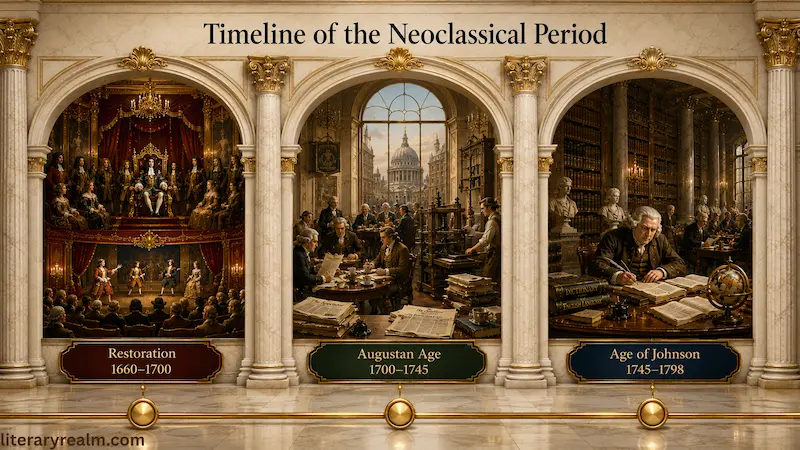
Although the Neoclassical Period (1660–1798) is often discussed as a single literary era, scholars generally divide it into three distinct phases: the Restoration Age, the Augustan Age, and the Age of Johnson. Each stage reflected the social, political, and intellectual developments of its time while preserving the central Neoclassical ideals of reason, order, clarity, and respect for classical traditions. Together, these three ages illustrate the gradual evolution of English literature during the 17th and 18th centuries.
| Age | Years | Major Characteristics |
| Restoration Age | 1660–1700 | Restoration of the monarchy, revival of theatre, wit, satire, realism, emphasis on social manners and political commentary |
| Augustan Age | 1700–1745 | Peak of Neoclassicism, imitation of Greek and Roman classics, reason, balance, polished prose, essays, satire, and moral instruction |
| Age of Johnson | 1745–1798 | Literary criticism, dictionaries, biographies, essays, moral philosophy, transition toward Romanticism, increasing emotional and individual expression |
Restoration Age (1660–1700)
The Restoration Age began in 1660 with the return of King Charles II to the English throne after the Commonwealth period. The reopening of theatres encouraged the revival of drama, while writers increasingly focused on wit, satire, and realistic portrayals of society. Literature often explored court life, politics, and human behaviour through clever dialogue and social criticism. This period established the foundations of Neoclassical literature by promoting order, moderation, and classical literary principles after years of political instability.
Augustan Age (1700–1745)
The Augustan Age is widely regarded as the golden age of Neoclassicism. Named after the reign of the Roman Emperor Augustus, this period reflected a deliberate admiration for the literary achievements of ancient Rome. Writers sought perfection in style, clarity, and structure while using literature to educate and improve society. Essays, satire, and heroic couplets became dominant literary forms, and authors emphasized reason, moral values, and intellectual refinement. Literature reached an exceptional level of polish and discipline during this era.
Age of Johnson (1745–1798)
The Age of Johnson represents the final phase of the Neoclassical Period and is named after the influential writer and critic Samuel Johnson. During this period, literature continued to value reason and moral instruction, but it also began to explore deeper emotions, imagination, and individual experience. Literary criticism, biographies, dictionaries, and essays flourished, reflecting a mature intellectual culture. As interest in emotion and nature gradually increased, this age served as a bridge between Neoclassicism and the emerging Romantic movement, which officially began near the end of the eighteenth century.
Major Characteristics of the Neoclassical Period
The Neoclassical Period is distinguished by a set of literary principles that emphasized rationality, discipline, and artistic excellence. Unlike the later Romantic writers, who celebrated imagination and personal emotion, Neoclassical authors believed that literature should be guided by reason, follow established rules, and contribute to the moral improvement of society. Influenced by the literary traditions of ancient Greece and Rome, writers produced works that valued clarity, balance, and universal truths over individual feelings and emotional intensity. The following characteristics define the literary identity of the Neoclassical Age.
Reason over Emotion
One of the defining characteristics of the Neoclassical Period is its emphasis on reason over emotion. Writers believed that human beings should rely on logic, rational judgment, and intellectual thought rather than uncontrolled feelings. Literature was expected to present balanced arguments and thoughtful observations instead of emotional outbursts. This focus reflected the influence of the Enlightenment, which encouraged people to seek truth through reason and evidence. Consequently, Neoclassical works often explore human nature through careful analysis and rational discussion rather than passionate expression.
Order and Balance
Neoclassical writers admired order and balance because they believed that harmony was essential in both art and society. Literary works were carefully organized with clear structures, logical progression, and proportional design. Authors avoided unnecessary complexity or excessive ornamentation, striving instead for elegance and symmetry. This orderly approach reflected their belief that literature should mirror the natural order of the universe and demonstrate intellectual discipline. Balance in ideas, language, and form became a hallmark of Neoclassical writing.
Classical Influence
Writers during this time were deeply inspired by ancient Greece and Rome. They saw classical authors as examples of artistic skill and moral wisdom. Neoclassical writers admired ideals like moderation, harmony, dignity, and universal truth. Many copied classical forms, themes, and styles, but adapted them for their own time. Instead of just copying old works, they wanted to keep the best classical ideas alive in modern literature.
Decorum and Discipline
Decorum refers to maintaining appropriateness in language, style, and subject matter. Neoclassical authors believed that every literary work should follow standards suited to its genre and audience. Heroes were expected to behave nobly, comedy should portray ordinary social life, and tragedy should treat serious themes with dignity. Writers also practised strict artistic discipline by carefully revising their works to achieve precision and refinement. This commitment to decorum ensured consistency, elegance, and literary credibility.
Satire as a Literary Weapon
Satire became one of the most powerful literary forms during the Neoclassical Period. Rather than attacking individuals with personal insults, writers used humour, irony, wit, and exaggeration to expose social hypocrisy, political corruption, vanity, and moral weakness. Satirical literature encouraged readers to recognize human faults and consider moral improvement. By combining entertainment with criticism, satire served both artistic and educational purposes. It reflected the Neoclassical belief that literature should correct society while remaining intellectually engaging.
Moral Instruction
Neoclassical literature consistently emphasized moral instruction. Writers believed that literature should educate readers, promote ethical values, and encourage responsible behaviour. Poems, essays, plays, and novels frequently explored themes such as honesty, moderation, self-control, justice, and virtue. Instead of existing solely for amusement, literary works were expected to offer practical lessons about human conduct and social responsibility. This educational purpose reinforced the period’s conviction that literature could contribute to the improvement of individuals and society as a whole.
Realism and Common Life
Although inspired by classical ideals, Neoclassical writers often focused on realistic portrayals of everyday life. Rather than depicting extraordinary adventures or supernatural events, many authors examined ordinary people, social customs, and familiar human experiences. They observed society with objectivity, highlighting both its strengths and weaknesses. Through realistic characterization and careful observation, writers revealed universal aspects of human nature while making their works accessible to a broad readership. This realism helped literature remain relevant to contemporary society.
Wit and Intellectual Expression
Wit was highly valued during the Neoclassical Period because it demonstrated intelligence, insight, and verbal skill. Writers delighted readers with clever arguments, sharp observations, refined humour, and sophisticated language. Intellectual expression took precedence over emotional intensity, encouraging audiences to appreciate thoughtful ideas and logical reasoning. Wit also enhanced satire by making criticism more engaging and memorable. This combination of intelligence and elegance became one of the defining stylistic features of Neoclassical literature.
Simplicity and Clarity of Language
Neoclassical authors preferred simplicity and clarity in their writing. They avoided obscure expressions, excessive ornamentation, and overly emotional language that might confuse readers. Instead, they aimed for precise vocabulary, straightforward sentence structure, and polished style. Clear communication was considered essential because literature should convey ideas effectively and educate readers. This emphasis on lucidity made Neoclassical works both intellectually accessible and aesthetically refined, contributing to their enduring appeal.
Respect for Rules and Form
Perhaps the most distinctive feature of Neoclassical literature was its strong respect for established literary rules and forms. Writers believed that artistic excellence resulted from disciplined craftsmanship rather than spontaneous inspiration alone. They carefully followed accepted conventions regarding poetic structure, dramatic composition, genre, and style, many of which were derived from classical criticism. Formal balance, regularity, and technical precision were considered signs of literary mastery. By respecting these established principles, Neoclassical authors created works that reflected order, harmony, and lasting artistic value.
Literary Forms During the Neoclassical Period
The Neoclassical Period witnessed the remarkable development of poetry, prose, and drama, each reflecting the era’s commitment to reason, order, and artistic discipline. Influenced by classical Greek and Roman models, writers produced literary works that entertained readers while also educating them about morality, society, and human behaviour. Whether through polished poetry, informative prose, or refined drama, Neoclassical literature maintained a strong emphasis on clarity, balance, and intellectual expression.
Poetry
Poetry was the most influential literary form of the Neoclassical Period. Poets valued precision, elegance, and strict adherence to formal structures. One of the defining poetic forms was the heroic couplet, consisting of two rhyming lines written in iambic pentameter. This form was admired for its balance, rhythm, and ability to present logical arguments with clarity and sophistication.
Another important genre was didactic poetry, which sought to teach moral lessons, philosophical ideas, or practical wisdom. Rather than expressing personal emotions, poets aimed to educate readers through reasoned reflection and ethical guidance.
The mock epic also became a distinctive feature of Neoclassical poetry. By applying the grand style of classical epic poetry to ordinary or trivial subjects, writers created humorous contrasts that exposed vanity, pride, and social pretensions. This technique combined entertainment with sharp social criticism.
Satirical poetry flourished throughout the period as poets employed wit, irony, and exaggeration to criticize political corruption, social hypocrisy, and human weaknesses. Satire reflected the Neoclassical belief that literature should reform society while remaining intellectually engaging.
Prose
The Neoclassical Period marked a significant expansion of English prose literature. Essays became highly popular because they allowed writers to discuss morality, politics, education, philosophy, and everyday life in a clear and logical manner. Their accessible style appealed to an increasingly educated reading public.
The growth of periodicals, including newspapers and literary magazines, further encouraged public discussion and the exchange of ideas. These publications featured essays, literary criticism, social commentary, and current affairs, making literature an important part of everyday intellectual life.
The novel also developed during this period as a major literary form. Early English novels emphasized realistic characters, believable situations, and moral development, reflecting the Neoclassical interest in ordinary life and ethical instruction. These works laid the foundation for the modern English novel.
Drama
Drama continued to thrive during the Neoclassical Period, although it differed significantly from the drama of the Elizabethan Age. The most popular dramatic genre was the Comedy of Manners, which portrayed the behaviour, fashions, and social conventions of the upper classes. Through witty dialogue and humorous situations, these plays exposed hypocrisy, vanity, and artificial social behaviour while entertaining audiences.
Another important dramatic form was heroic tragedy, which presented noble characters facing conflicts involving honour, love, duty, and political loyalty. Written in elevated language and following strict dramatic conventions, these plays emphasized courage, virtue, and moral responsibility. Together, these dramatic forms reflected the Neoclassical ideals of order, decorum, and disciplined artistic expression.
Major Writers of the Neoclassical Period
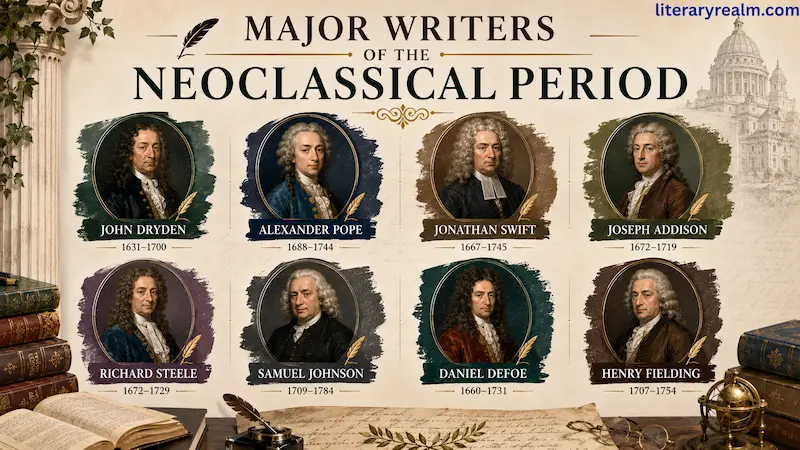
The Neoclassical Period produced some of the most influential writers in English literary history. Inspired by the ideals of reason, order, morality, and classical tradition, these authors shaped the development of English poetry, prose, drama, literary criticism, and the novel. Through satire, essays, dictionaries, and carefully crafted verse, they established literary standards that continued to influence generations of writers. The following figures are among the most significant literary voices of the Neoclassical Age.
John Dryden
John Dryden (1631–1700) is widely regarded as the father of English literary criticism and one of the leading figures of the Restoration Age. A distinguished poet, dramatist, translator, and critic, Dryden helped establish the literary principles that defined the early Neoclassical Period. His writing emphasized clarity, balance, and adherence to classical models while also reflecting the political and cultural changes of Restoration England.
Among his most celebrated works are Absalom and Achitophel, Mac Flecknoe, All for Love, and An Essay of Dramatic Poesy. His satirical poetry and critical essays demonstrated remarkable intellectual discipline and stylistic elegance.
Dryden’s greatest contributions lie in shaping English literary criticism, refining poetic language, and popularising the heroic couplet. His influence established many of the literary standards that later Neoclassical writers followed.
Alexander Pope
Alexander Pope (1688–1744) was the greatest poet of the Augustan Age and one of the finest masters of the heroic couplet. His poetry is celebrated for its precision, wit, balance, and moral insight. Pope believed that poetry should combine artistic beauty with intellectual depth and ethical reflection.
His best-known works include An Essay on Criticism, The Rape of the Lock, An Essay on Man, and The Dunciad. These poems display his mastery of satire, philosophical reflection, and polished verse.
Pope’s literary importance lies in perfecting the heroic couplet and elevating satirical and didactic poetry to their highest artistic level. His works remain classic examples of Neoclassical craftsmanship and intellectual elegance.
Jonathan Swift
Jonathan Swift (1667–1745) was one of the greatest satirists in English literature. Through irony, humour, and sharp social criticism, he exposed political corruption, human pride, and societal injustice. Swift believed that satire could reveal human weaknesses and encourage moral reform.
His most famous works include Gulliver’s Travels, A Modest Proposal, The Battle of the Books, and A Tale of a Tub. These writings combine imaginative storytelling with profound political and philosophical commentary.
Swift’s contribution to English literature lies in transforming satire into a powerful instrument of social criticism. His works continue to be admired for their wit, originality, and enduring relevance.
Joseph Addison
Joseph Addison (1672–1719) played a crucial role in developing the English essay as a respected literary form. His writing promoted good manners, moral conduct, and intellectual refinement while remaining accessible to ordinary readers.
His most influential contributions appeared in The Spectator and The Tatler, periodicals that offered essays on literature, society, philosophy, and everyday life. Addison’s prose is known for its clarity, elegance, and balanced style.
His literary importance lies in making literature an essential part of daily public discourse and in helping shape modern English prose through his thoughtful and engaging essays.
Richard Steele
Richard Steele (1672–1729) was a prominent essayist, journalist, and playwright who worked closely with Joseph Addison. Together, they transformed periodical writing into a major literary genre that informed, entertained, and educated the growing middle-class readership.
Steele founded The Tatler and later collaborated with Addison on The Spectator. His essays often focused on family life, morality, education, and social behaviour, presenting serious ideas in a friendly and conversational style.
Steele’s contribution lies in expanding the influence of journalism and essay writing while promoting ethical values and polite social conduct through accessible prose.
Samuel Johnson
Samuel Johnson (1709–1784) was one of the most respected literary figures of the eighteenth century. A poet, essayist, critic, biographer, and lexicographer, Johnson significantly influenced the English language and literary criticism during the final stage of the Neoclassical Period.
His most famous works include A Dictionary of the English Language, The Lives of the English Poets, The Rambler, and Rasselas. His dictionary became a landmark achievement in English lexicography and remained authoritative for many decades.
Johnson’s literary importance extends beyond his writings. His critical judgments, moral philosophy, and scholarly contributions shaped English literary studies and marked the transition from Neoclassicism toward Romanticism.
Daniel Defoe
Daniel Defoe (c. 1660–1731) is widely recognized as one of the pioneers of the English novel. His realistic storytelling, detailed descriptions, and believable characters helped establish prose fiction as a major literary form.
His best-known works include Robinson Crusoe, Moll Flanders, A Journal of the Plague Year, and Captain Singleton. These novels explore themes such as survival, individual effort, morality, and social experience through realistic narratives.
Defoe’s greatest contribution was demonstrating that fiction could realistically portray ordinary life and individual experience, laying the foundation for the development of the modern English novel.
Henry Fielding
Henry Fielding (1707–1754) was one of the prominent novelists of the Neoclassical Period and an important architect of the English realistic novel. His works combine humour, social observation, moral reflection, and vivid characterization to portray eighteenth-century society.
His most celebrated novels include The History of Tom Jones, a Foundling, Joseph Andrews, Amelia, and Jonathan Wild. Through these works, Fielding presented complex characters and carefully structured plots that reflected both human virtues and weaknesses.
Fielding’s literary importance lies in advancing the novel as a sophisticated literary genre. His realistic narratives, narrative techniques, and insightful portrayal of human nature influenced the future development of English fiction and established him as one of the foremost novelists of the eighteenth century.
Major Literary Works of the Neoclassical Period
The Neoclassical Period in English literature produced numerous literary masterpieces that continue to influence English literature and literary criticism. These works reflect the defining ideals of the age, including reason, order, satire, moral instruction, and realism. Through poetry, prose, essays, and novels, Neoclassical writers explored human nature, criticized social and political institutions, and promoted ethical values. Many of these texts became foundational works in their respective genres and remain widely studied in schools and universities. The following table highlights some of the most significant literary works of the Neoclassical Period and their lasting contributions to English literature.
| Work | Author | Genre | Importance |
| The Rape of the Lock | Alexander Pope | Mock epic poem | The finest example of the mock epic, combining satire, wit, and the heroic couplet to criticize the vanity and superficiality of eighteenth-century aristocratic society. |
| Gulliver’s Travels | Jonathan Swift | Satirical novel | A masterpiece of political and social satire that examines human nature, government, and society through imaginative voyages and allegory. |
| Robinson Crusoe | Daniel Defoe | Novel | One of the earliest English novels, celebrated for its realistic narrative, themes of self-reliance, perseverance, and individualism. |
| The Spectator | Joseph Addison and Richard Steele | Periodical essays | A highly influential collection of essays that promoted morality, polite manners, literary taste, and intellectual discussion among the growing middle-class readership. |
| The Lives of the English Poets | Samuel Johnson | Literary criticism and biography | A landmark work of literary criticism and biography that evaluates the lives and writings of major English poets while establishing enduring standards of literary judgment. |
Lasting Influence of the Neoclassical Period in English Literature
The Neoclassical Period has had a profound and lasting influence on English literature, literary criticism, and intellectual thought. Although the Romantic Movement later challenged many of its principles, the Neoclassical emphasis on reason, structure, and artistic discipline continues to shape literary studies and creative writing today.
One of its greatest contributions is its influence on later literature. The period established high standards of clarity, balance, and craftsmanship that inspired subsequent generations of poets, novelists, dramatists, and essayists. Even modern writers often draw upon Neoclassical techniques such as satire, structured argument, and precise language when addressing contemporary issues.
The era also laid the foundation for modern literary criticism. Writers such as John Dryden and Samuel Johnson developed critical methods that evaluated literature according to style, structure, purpose, and artistic merit. Many of these critical principles continue to influence literary scholarship and academic analysis.
In education, Neoclassical works remain central to English literature curricula worldwide. Students study these texts to understand the development of literary forms, the influence of classical traditions, and the historical relationship between literature and society.
The Neoclassical emphasis on reason also shaped political writing by encouraging logical argument, public debate, and thoughtful discussion of government, ethics, and civic responsibility. Essays and periodicals from this era helped establish an informed public discourse that remains essential to democratic societies.
Finally, the tradition of satire developed during the Neoclassical Period continues to thrive in modern literature, journalism, television, and digital media. Contemporary satirical works still use wit, irony, and humour to expose social injustice, political corruption, and human folly, demonstrating the enduring relevance of Neoclassical literary techniques.
Conclusion
The Neoclassical Period stands as one of the most influential eras in the history of English literature. Emerging after the Restoration of the monarchy and shaped by the Enlightenment, it emphasized reason, order, balance, morality, and respect for classical traditions. Inspired by the literary achievements of ancient Greece and Rome, Neoclassical writers produced works that sought not only to entertain but also to educate, reform society, and promote intellectual discipline.
Throughout this period, literature was characterized by rational thought, structured forms, satire, realism, clarity of language, and adherence to established literary conventions. Distinguished writers such as John Dryden, Alexander Pope, Jonathan Swift, Joseph Addison, Richard Steele, Samuel Johnson, Daniel Defoe, and Henry Fielding enriched English literature through their poetry, essays, novels, criticism, and drama. Their works continue to be admired for their artistic excellence and enduring relevance.
For any literature enthusiast, learning about various literary movements can enhance their knowledge of literature and help them understand why each literary age is distinct and unique from others, as well as the significance of literature in shaping the minds of contemporary society. The Neoclassical age especially focused on the betterment of society. Each literary age introduced its own innovations across various genres, through which it conveyed its messages. Satire most prominently ridicules society’s follies and vices so that the readers can reflect and improve themselves. To sum up, the Neoclassical age still holds a significant place in English literature.
Frequently Asked Questions
What is the Neoclassical Period in English Literature?
The Neoclassical Period in English literature was an era approximately spanning 1660 to 1798. It emphasized reason, order, balance, discipline, classical influence, clarity, and moral instruction. The period was strongly influenced by ancient Greek and Roman literature and the intellectual climate of the Enlightenment.
Why is the Neoclassical Period called the Age of Reason?
The Neoclassical Period is called the Age of Reason because its writers placed strong emphasis on reason, logic, rational thinking, and intellectual discipline. Influenced by the Enlightenment, they believed literature should promote wisdom, moral improvement, and social responsibility rather than rely primarily on emotion and imagination.
What are the main characteristics of the Neoclassical Period?
The main characteristics of the Neoclassical Period include reason over emotion, order and balance, classical influence, decorum, discipline, satire, moral instruction, realism, wit, clarity of language, and respect for literary rules and established forms.
What are the three major phases of the Neoclassical Period?
The three commonly discussed phases of the Neoclassical Period are the Restoration Age (1660–1700), the Augustan Age (1700–1745), and the Age of Johnson (1745–1798). Together, these phases trace the development of Neoclassical literature from the Restoration of the monarchy to the transition toward Romanticism.
Who are the major writers of the Neoclassical Period?
Major writers of the Neoclassical Period include John Dryden, Alexander Pope, Jonathan Swift, Joseph Addison, Richard Steele, Samuel Johnson, Daniel Defoe, and Henry Fielding. They made important contributions to poetry, satire, essays, literary criticism, drama, journalism, and the English novel.