
The Characteristics of the Restoration Age reflect one of the most remarkable transformations in the history of English literature. Following the restoration of King Charles II to the English throne in 1660, England experienced significant political, social, and cultural changes that profoundly influenced literary expression. The reopening of theatres, the revival of public entertainment, the growing appreciation for wit and satire, and a renewed interest in classical ideals all contributed to the emergence of a distinctive literary period known as the Restoration Age. This era marked the beginning of a new phase in English literature after the strict Puritan rule under Oliver Cromwell and laid the foundation for the broader Neoclassical Age.
The Restoration Age is often described as the Age of Dryden, in recognition of John Dryden’s immense influence, whose works shaped the period’s literary standards. Writers of this age embraced reason, order, elegance, and intellectual refinement while drawing inspiration from the literary traditions of ancient Greece and Rome. At the same time, they explored contemporary society with realism, humour, and sharp social criticism, making literature both entertaining and thought-provoking.
Understanding the Characteristics of the Restoration Age is essential for students, researchers, and literature enthusiasts because these defining features explain how English literature evolved from religious austerity to artistic freedom and rational thought. This article explores the historical background of the Restoration Age, the factors that shaped its literary identity, its major characteristics, influential writers, popular literary forms, and its lasting significance in the development of English literature.
What Was the Restoration Age?
The Restoration Age refers to the period in English literature that began in 1660, when Charles II returned to the English throne after years of political instability following the English Civil War and the Commonwealth under Oliver Cromwell. The restoration of the monarchy ended nearly two decades of Puritan rule and ushered in a new cultural and intellectual climate characterised by greater political stability, renewed artistic expression, and revived public entertainment. In literary history, the Restoration Age generally spans 1660 to 1700, although some scholars view its influence as extending into the early eighteenth century.
The Restoration Age forms the opening phase of the Neoclassical Age in English Literature, a broader literary movement that emphasized reason, balance, order, and adherence to classical principles. Inspired by the literary achievements of ancient Greek and Roman authors such as Horace, Virgil, and Aristotle, Restoration writers valued clarity, discipline, and artistic restraint over the emotional intensity that had characterized much of the earlier Renaissance literature.
The return of Charles II also brought significant changes to England’s cultural life. One of his earliest acts was to reopen the theatres, which had been closed by the Puritans since 1642. This decision revived English drama and encouraged the development of new theatrical forms, particularly Restoration Comedy, known for its witty dialogue, sophisticated humour, and satirical portrayal of fashionable society. Another historic development was the emergence of professional actresses on the English public stage, replacing the earlier practice of boys performing female roles.
Beyond the theatre, London emerged as a vibrant intellectual centre where writers, scholars, politicians, and merchants exchanged ideas in coffeehouses and literary circles. These environments encouraged debate, critical thinking, and the growth of prose, journalism, satire, and literary criticism. As a result, literature increasingly reflected the realities of urban life, social manners, political events, and human behaviour.
The Restoration Age, therefore, represents much more than the return of a king. It signifies the restoration of artistic freedom, the revival of classical learning, and the beginning of a literary tradition that prized wit, rationality, realism, and stylistic elegance. These developments created the distinctive literary identity that scholars now recognize as the defining characteristics of Restoration literature.
Why Did the Restoration Age Develop These Characteristics?
The distinctive Characteristics of the Restoration Age did not emerge by chance. They were shaped by a combination of political change, cultural revival, foreign influence, and intellectual developments that transformed English society after 1660. The return of the monarchy under Charles II ended the strict Puritan regime and created an environment in which literature, theatre, and the arts could flourish once again. As England embraced greater social freedom and intellectual inquiry, writers responded by adopting new literary styles, themes, and techniques that reflected the spirit of the age.
Political Restoration and the Return of the Monarchy
The most important event that influenced Restoration literature was the restoration of Charles II to the English throne in 1660. During the Commonwealth period under Oliver Cromwell, England had been governed according to strict Puritan principles. Public theatres were closed, many forms of entertainment were discouraged, and literature often reflected religious and moral concerns.
When Charles II returned from exile, he brought with him a more cosmopolitan outlook shaped by his years in France and the Netherlands. His reign encouraged artistic freedom and cultural expression, replacing the austerity of the Puritan era with an atmosphere that celebrated literature, drama, music, and intellectual discussion. As a result, writers shifted their focus from predominantly religious themes to worldly subjects, social behaviour, politics, and human nature. This political transformation laid the foundation for many of the defining features of Restoration literature, including wit, satire, realism, and theatrical innovation.
Influence of French Literature and Culture
Charles II spent much of his exile at the French court of Louis XIV, where he became familiar with the elegance, refinement, and classical ideals that dominated French literary culture. After his restoration, these influences found their way into English literature.
French Neoclassicism, particularly the works of dramatists such as Pierre Corneille, Jean Racine, and Molière, emphasized order, clarity, balance, and adherence to classical principles derived from ancient Greek and Roman literature. English writers adopted many of these ideals while adapting them to their own cultural context. The result was literature that valued polished language, disciplined structure, intellectual sophistication, and artistic restraint.
The influence of French society also encouraged writers to portray the manners, conversations, and social customs of the upper classes. This development was especially evident in Restoration Comedy, which depicted fashionable London society through witty dialogue, satire, and humorous examinations of human relationships.
Rise of Rationalism and Scientific Thinking
Another significant force behind the literary characteristics of the Restoration Age was the growing emphasis on reason and rational inquiry. The seventeenth century witnessed remarkable advances in science and philosophy that changed the way people understood the world.
Thinkers such as Francis Bacon, René Descartes, and John Locke promoted observation, logical reasoning, and empirical investigation rather than unquestioning acceptance of tradition. In 1660, the establishment of the Royal Society of London further encouraged scientific research and intellectual curiosity.
Although literary writers were not scientists, they were deeply influenced by this intellectual climate. Instead of relying solely on imagination or religious symbolism, many authors sought to portray life realistically, analyze human behaviour, and present ideas with clarity and logical organization. Consequently, Restoration literature emphasized reason, moderation, and critical thinking qualities that later became hallmarks of the broader Neoclassical movement.
Coffeehouse Culture and Intellectual Exchange
The rapid growth of coffeehouses during the Restoration period also played a pivotal role in shaping literary culture. Coffeehouses became important meeting places where writers, scholars, politicians, merchants, and philosophers gathered to discuss current events, literature, science, and politics.
These lively discussions encouraged the exchange of ideas and fostered a culture of debate and criticism. Writers became increasingly aware of public opinion and began producing works that reflected contemporary society rather than distant historical or mythical subjects. This environment contributed to the popularity of essays, journalism, satire, literary criticism, and prose writing.
Coffeehouse culture also helped establish literature as a subject of public conversation, making authors more responsive to their readers’ interests and concerns.
Reopening of Theatres and the Revival of Drama
Perhaps no event had a more immediate impact on English literature than the reopening of theatres after 1660. Under Puritan rule, public stage performances had been prohibited because they were considered morally corrupt and socially harmful. With the return of Charles II, theatres reopened under royal patronage, creating new opportunities for playwrights and actors.
The revival of drama led to the emergence of Restoration Comedy, a theatrical genre distinguished by witty dialogue, sophisticated plots, social satire, and humorous portrayals of aristocratic life. The period also saw the development of heroic drama, which presented noble characters confronting conflicts of love, honour, and duty, often in elevated poetic language.
A groundbreaking innovation of the Restoration theatre was the introduction of professional actresses on the English public stage. Their participation not only transformed theatrical performance but also influenced the creation of more complex female characters and broadened the scope of dramatic storytelling.
How These Developments Shaped Restoration Literature
Together, these political, cultural, and intellectual changes created a literary environment unlike any that had existed in England before. The restoration of the monarchy restored artistic freedom; French Neoclassicism encouraged elegance and classical discipline; scientific thought promoted reason and realism; coffeehouses stimulated intellectual debate; and reopened theatres revitalized English drama.
As a result, Restoration writers produced literature that celebrated wit, valued rational thought, examined society with sharp observation, and followed principles of order and balance. These influences collectively explain why the Characteristics of the Restoration Age became so distinctive and why the period occupies such an important place in the history of English literature.
Characteristics of the Restoration Age
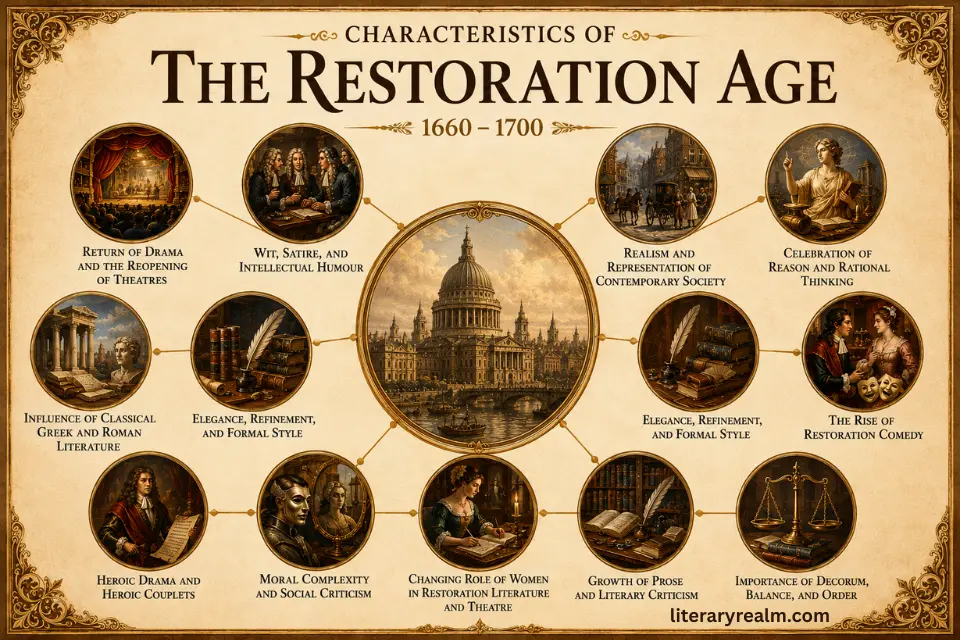
The Characteristics of the Restoration Age reflect the political, social, and intellectual changes that transformed England after the restoration of the monarchy in 1660. Unlike the literature of the preceding Puritan period, which largely emphasized religion and morality, Restoration literature celebrated reason, wit, social observation, and artistic refinement. Writers sought to entertain, instruct, and critique society while drawing inspiration from classical models and contemporary life.
The following characteristics distinguish Restoration literature and explain why the period occupies a unique place in the history of English literature.
Return of Drama and the Reopening of Theatres
One of the most significant characteristics of the Restoration Age was the revival of English drama. During the Puritan Commonwealth (1642–1660), public theatres were officially closed because dramatic performances were considered morally corrupt. This prohibition severely disrupted the development of English theatre and deprived playwrights of opportunities to produce new works.
The situation changed dramatically when Charles II ascended the throne in 1660. One of his earliest cultural initiatives was to grant patents to establish professional theatre companies, allowing dramatic performances to resume under royal patronage. This decision marked the beginning of a new era in English theatre.
The reopening of theatres encouraged experimentation with new dramatic forms, elaborate stage designs, movable scenery, and improved theatrical techniques. It also introduced professional actresses to the English public stage for the first time, replacing the earlier convention of having female roles performed by boys. This development allowed playwrights to create more realistic and psychologically complex female characters.
The revival of theatre gave rise to influential dramatic genres such as Restoration Comedy and heroic drama. Playwrights including William Congreve, George Etherege, and William Wycherley explored themes of love, marriage, social manners, ambition, and hypocrisy through witty dialogue and carefully structured plots. Consequently, drama once again became the dominant literary form of the age and played a central role in shaping Restoration literature.
Wit, Satire, and Intellectual Humour
Perhaps the most recognizable characteristic of Restoration literature is its emphasis on wit and satire. Rather than appealing primarily to emotion, Restoration writers valued intelligence, quick thinking, and verbal skill. Their works often entertained readers through clever conversations, ironic observations, and sophisticated humour.
Wit refers to the ability to express ideas in an ingenious and intellectually stimulating manner. Restoration audiences admired authors who could combine elegance with sharp reasoning and humorous insight. As a result, literary dialogue became polished, lively, and highly conversational.
Closely connected with wit was satire, which writers used to expose human weaknesses, social pretensions, political corruption, and moral hypocrisy. Instead of delivering direct moral sermons, they criticized individuals and institutions through irony, exaggeration, ridicule, and humour.
Among the leading practitioners of satire was John Dryden, whose political poems, such as Absalom and Achitophel, demonstrate how satire could be used to comment on contemporary political events while maintaining literary sophistication. Similarly, Restoration comedies humorously exposed the vanity, superficiality, and fashionable lifestyles of London’s upper classes.
Through wit and satire, Restoration writers entertained their audiences while encouraging them to reflect critically on society and human behaviour.
Realism and Representation of Contemporary Society
Another defining feature of the Restoration Age was its strong commitment to realism. Unlike many earlier literary works that focused on legendary heroes, medieval romances, or idealized worlds, Restoration authors turned their attention to the realities of contemporary English society.
Their works portrayed the everyday lives, conversations, ambitions, relationships, and social customs of people living in Restoration England, particularly the aristocracy and the emerging urban middle class. Writers were interested in observing human behaviour as it actually existed rather than presenting idealised moral examples.
This realistic approach is especially evident in Restoration Comedy, where characters often represent recognizable social types such as fashionable gentlemen, witty ladies, fortune hunters, jealous husbands, and ambitious social climbers. Although these characters are sometimes exaggerated for comic effect, they reflect genuine aspects of seventeenth-century society.
Realism also extended to political life, urban culture, and social institutions. Literature became a mirror of contemporary England, allowing readers to recognize both the strengths and weaknesses of their own society. This focus on realistic observation later influenced the development of the English novel in the eighteenth century.
Celebration of Reason and Rational Thinking
The Restoration Age formed the opening stage of the broader Neoclassical movement, which emphasized reason, logic, and intellectual discipline. Writers believed that literature should appeal to the mind as well as entertain the imagination.
Influenced by the scientific discoveries and philosophical developments of the seventeenth century, Restoration authors viewed rational thinking as the best means of understanding both society and human nature. They valued moderation, self-control, and balanced judgment rather than excessive emotion or uncontrolled passion.
This preference for reason shaped not only literary themes but also writing style. Authors organized their arguments logically, developed ideas systematically, and sought clarity rather than unnecessary ornamentation. Poetry frequently displayed careful structure, while prose emphasized precision and coherence.
The importance of reason also helps explain why Restoration writers admired classical authors such as Horace and Virgil, whose works emphasised order, proportion, and artistic discipline. By combining intellectual inquiry with literary elegance, Restoration literature reflected the growing confidence in human reason that characterized the age.
Influence of Classical Greek and Roman Literature
A profound admiration for the literature of ancient Greece and Rome was another defining characteristic of the Restoration Age. Restoration writers believed that classical authors had established enduring standards of literary excellence and therefore looked to them as models for composition.
The influence of classical literature is evident in the emphasis on order, balance, harmony, and decorum. Writers often followed principles derived from classical criticism, especially those associated with Aristotle and Horace. Literary works were expected to maintain unity, clarity, and artistic restraint rather than relying on emotional excess or imaginative extravagance.
Many playwrights adapted classical dramatic conventions, while poets employed forms and styles inspired by Roman literature. Classical mythology, historical references, and Latin learning frequently appeared in literary works, reflecting the education of Restoration authors and readers.
However, Restoration writers did not simply imitate classical literature. Instead, they adapted ancient principles to address contemporary English society, creating works that were both intellectually grounded and socially relevant.
Elegance, Refinement, and Formal Style
The literature of the Restoration Age is also distinguished by its elegance and refinement. Writers carefully selected their words, organized their ideas logically, and cultivated a polished literary style that reflected the tastes of educated readers.
Unlike the highly emotional or ornate language found in some earlier periods, Restoration prose and poetry favoured clarity, precision, and stylistic balance. Authors avoided unnecessary complexity while striving for smooth expression and rhetorical effectiveness.
This preference for refinement was closely connected with the social culture of the Restoration court and fashionable London society, where graceful conversation, courtesy, and intellectual sophistication were highly valued. Literature became an extension of this culture, emphasizing controlled expression rather than emotional spontaneity.
The influence of John Dryden was particularly significant in establishing these standards. His poetry, criticism, and prose demonstrated how elegance could be combined with logical organization, making him one of the principal architects of Restoration literary style.
Consequently, Restoration literature came to represent a mature, disciplined, and highly polished approach to writing that profoundly influenced later Neoclassical authors, including Alexander Pope and Samuel Johnson.
The Rise of Restoration Comedy
Among all the Characteristics of the Restoration Age, the emergence of Restoration Comedy stands out as one of the most distinctive literary developments. After the reopening of theatres in 1660, comedy became the dominant dramatic form, reflecting the tastes and lifestyles of the aristocratic society that flourished under the patronage of Charles II.
Restoration Comedy, often called the Comedy of Manners, focused on the fashionable upper classes of London. Instead of presenting heroic adventures or religious themes, these plays depicted courtship, marriage, infidelity, ambition, and social etiquette. Their plots revolved around misunderstandings, clever intrigues, and romantic relationships, while their dialogue was celebrated for its brilliance, wit, and sophistication.
One of the defining features of Restoration Comedy is its satirical portrayal of society. Playwrights mocked hypocrisy, vanity, greed, and pretentious behaviour, encouraging audiences to recognize the flaws hidden beneath polished manners. The characters were rarely idealised heroes or villains; rather, they were complex individuals driven by personal desires and social ambitions.
Prominent playwrights such as William Congreve, George Etherege, and William Wycherley perfected this genre. Congreve’s The Way of the World (1700), although published at the end of the Restoration period, remains one of the finest examples of the Comedy of Manners because of its witty dialogue, intricate plot, and insightful portrayal of social relationships. Similarly, Wycherley’s The Country Wife (1675) and Etherege’s The Man of Mode (1676) illustrate the period’s fascination with fashionable society and sophisticated conversation.
Although Restoration Comedy was immensely popular in its own time, modern readers often note that some of its treatment of gender and sexuality reflects the social values of seventeenth-century aristocratic culture. Understanding these works within their historical context allows readers to appreciate both their literary artistry and their role in documenting the customs of Restoration society.
Heroic Drama and Heroic Couplets
Another important characteristic of Restoration literature was the popularity of heroic drama and the widespread use of heroic couplets in poetry.
Heroic drama emerged as a serious dramatic genre that portrayed noble heroes facing conflicts involving love, honour, patriotism, and duty. These plays often featured extraordinary characters, grand emotions, and dramatic events inspired by classical history or legendary subjects. Although their themes were elevated, they reflected the Restoration’s admiration for order, courage, and moral responsibility.
John Dryden became the foremost practitioner of heroic drama. His plays, including The Conquest of Granada (1670–1671) and Aureng-Zebe (1675), demonstrate the genre’s emphasis on heroic ideals, rhetorical grandeur, and carefully structured plots. These works illustrate how Restoration dramatists combined classical influence with contemporary theatrical innovation.
Closely associated with Restoration poetry was the heroic couplet, a poetic form consisting of two rhyming lines written in iambic pentameter. The heroic couplet became the preferred medium for expressing logical arguments, moral reflections, satire, and philosophical ideas because its balanced structure suited the Neoclassical preference for clarity and order.
John Dryden’s mastery of the heroic couplet established it as the dominant poetic form of the late seventeenth century. His influence later inspired poets such as Alexander Pope, who refined the form during the eighteenth century. The popularity of heroic couplets, therefore, reflects the Restoration commitment to precision, symmetry, and disciplined artistic expression.
Moral Complexity and Social Criticism
Although Restoration literature is often associated with entertainment and wit, it also examines the moral and social complexities of contemporary life. Rather than presenting characters as entirely virtuous or completely wicked, Restoration writers portrayed individuals with mixed motives, conflicting desires, and personal weaknesses.
This nuanced treatment of human nature distinguished Restoration literature from the more overtly moralistic works of the Puritan period. Authors explored themes such as ambition, hypocrisy, deception, jealousy, vanity, and the pursuit of wealth or social status. Their objective was not merely to entertain audiences but also to encourage reflection on the behaviour of individuals and society.
Satire became one of the most effective tools for social criticism. Through irony and humour, writers exposed political corruption, superficial manners, and the misuse of power without resorting to direct condemnation. John Dryden’s political satires, particularly Absalom and Achitophel (1681), illustrate how literature could engage with contemporary political issues while maintaining artistic sophistication.
Similarly, Restoration comedies criticized the artificial conventions of fashionable society. Although audiences laughed at the clever dialogue and humorous situations, they were also invited to recognize the moral contradictions underlying aristocratic life. This combination of entertainment and critical observation remains one of the defining literary achievements of the Restoration Age.
Changing Role of Women in Restoration Literature and Theatre
The Restoration Age marked a turning point in the history of English theatre with the introduction of professional actresses on the public stage. Before 1660, female roles in English drama were typically performed by boys or young men because women were not permitted to act in public theatres.
Following the restoration of the monarchy, Charles II granted permission for women to perform professionally. This historic change transformed theatrical performance by allowing female characters to be portrayed more realistically and naturally. It also encouraged playwrights to create more complex and substantial roles for women.
The period also witnessed the rise of Aphra Behn, one of the first English women to earn a living primarily through writing. Her success challenged traditional assumptions about women’s participation in literature and demonstrated that female authors could contribute significantly to English literary culture.
Behn’s comedy The Rover (1677) explores themes of love, freedom, and gender roles while displaying much of the wit and sophistication associated with Restoration drama. Although she wrote within the conventions of her time, her works provide valuable perspectives on women’s experiences and social expectations during the Restoration period.
The emergence of actresses and professional women writers, therefore, represents an important cultural development that expanded the scope and diversity of English literature.
Growth of Prose and Literary Criticism
Another notable characteristic of the Restoration Age was the rapid development of prose writing and literary criticism. While drama remained the most popular literary form, prose became increasingly important as literacy expanded and public interest in political, philosophical, and cultural discussions grew.
Essays, biographies, historical writings, translations, journalism, and religious prose all flourished during this period. Coffeehouses and the expanding print industry created a larger reading public, encouraging authors to write on a wide range of contemporary subjects.
Equally significant was the emergence of systematic literary criticism. Writers began evaluating literature according to principles such as clarity, order, unity, decorum, and adherence to classical models. Instead of simply appreciating literary works, critics sought to establish standards by which they could be judged.
No figure contributed more to Restoration literary criticism than John Dryden. His influential work An Essay of Dramatic Poesy (1668) compares classical and modern drama while discussing the purpose of literature and the qualities of effective dramatic writing. Because of his pioneering contributions, Dryden is widely regarded as the Father of English Literary Criticism.
The development of prose and criticism helped establish literature as an intellectual discipline, influencing generations of writers and scholars throughout the Neoclassical Age.
Importance of Decorum, Balance, and Order
The final defining characteristic of the Restoration Age is its strong emphasis on decorum, balance, and order, principles inherited from classical literary theory and central to Neoclassical aesthetics.
Decorum refers to the idea that every literary work should maintain appropriateness in style, language, character, and subject matter. Characters were expected to behave in accordance with their social status, and writers sought consistency between form and content. This principle reflected the Restoration belief that literature should demonstrate discipline rather than uncontrolled emotion.
Similarly, Restoration authors valued balance and proportion in both structure and style. Whether composing poetry, drama, or prose, they aimed to achieve harmony through logical organization, measured language, and carefully developed arguments. Excessive ornamentation or emotional exaggeration was generally avoided in favour of clarity and moderation.
The principle of order extended beyond literature to the Restoration worldview itself. Following years of political upheaval during the Civil War and the Commonwealth, many writers regarded stability, reason, and social hierarchy as essential foundations of civilized society. Consequently, literary works often emphasized self-control, rational judgment, and respect for established conventions.
These ideals profoundly influenced not only Restoration literature but also the broader Neoclassical Age, shaping the works of later writers such as Alexander Pope and Samuel Johnson. Their continued influence demonstrates the lasting importance of Restoration literary principles in the development of English literature.
Major Writers Who Shaped the Characteristics of the Restoration Age
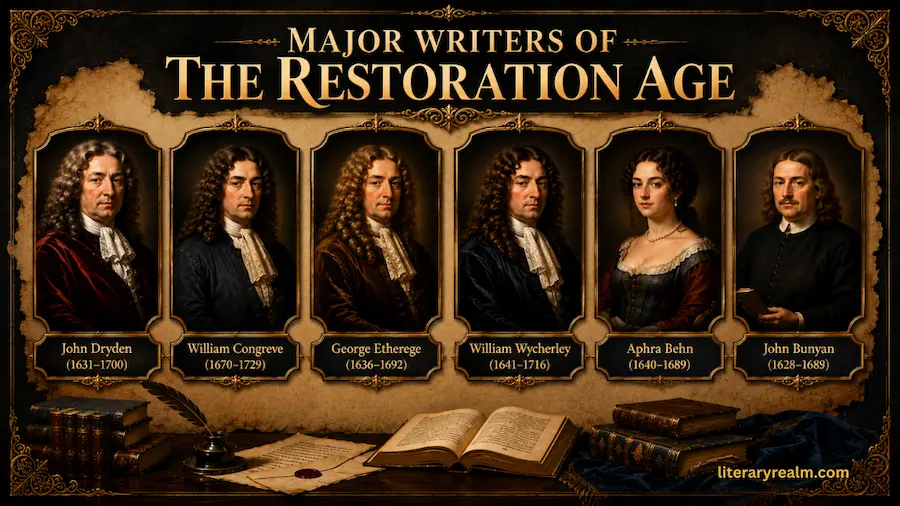
The literary achievements of the Restoration Age were shaped by a remarkable group of writers whose works reflected the ideals of wit, reason, satire, realism, and classical discipline. These authors not only captured the spirit of their time but also influenced the development of English literature for generations. Through drama, poetry, prose, and literary criticism, they established the stylistic and intellectual foundations of the broader Neoclassical movement.
John Dryden (1631–1700)
No writer represents the Restoration Age more completely than John Dryden, who is often called the “Father of English Criticism” and is widely regarded as the leading literary figure of the period. Because of his immense influence on poetry, drama, and criticism, the Restoration Age is frequently referred to as the Age of Dryden.
Dryden’s literary career demonstrates many of the defining Characteristics of the Restoration Age. His poetry reflects balance, clarity, and rational thought, while his political satires reveal exceptional wit and intellectual sophistication. Works such as Absalom and Achitophel (1681) and Mac Flecknoe (1682) showcase his mastery of satire, using irony and heroic couplets to comment on political events and literary rivalries.
Dryden also made lasting contributions to literary criticism through An Essay of Dramatic Poesy (1668), one of the earliest and most influential works of English literary criticism. In this essay, he compares classical and modern drama while establishing critical principles that shaped later Neoclassical authors. His mastery of the heroic couplet and his commitment to classical ideals made him the central literary figure of the Restoration period.
William Congreve (1670–1729)
William Congreve is widely regarded as the finest playwright of Restoration Comedy. His works represent the culmination of the Comedy of Manners, combining brilliant wit, sophisticated dialogue, intricate plotting, and insightful social satire. Through his masterful portrayal of fashionable society, Congreve elevated Restoration comedy to its highest artistic achievement.
His masterpiece, The Way of the World (1700), is widely known as one of the greatest examples of the Comedy of Manners. The play presents intelligent and witty characters navigating complex social and romantic relationships while exposing vanity, hypocrisy, greed, and the artificial conventions of aristocratic society. Rather than relying on physical comedy, Congreve employed polished dialogue, irony, and psychological insight to entertain audiences and encourage critical reflection on human behaviour.
Congreve’s plays embody many of the defining Characteristics of the Restoration Age, including wit, realism, elegance, social observation, and classical restraint. His ability to blend entertainment with thoughtful social criticism ensured his lasting influence on English drama, making him one of the most significant literary figures of the Restoration period.
George Etherege (1636–1692)
Sir George Etherege was among the earliest playwrights to establish the conventions of Restoration Comedy. His dramas introduced audiences to fashionable gentlemen, witty heroines, and sophisticated urban settings that later became hallmarks of the genre.
His best-known play, The Man of Mode (1676), offers a vivid portrayal of aristocratic London society. Through lively dialogue and satirical characterization, Etherege explores themes such as courtship, reputation, appearance, and social ambition.
Etherege’s emphasis on elegance, conversational wit, and realistic observation reflects many of the defining literary characteristics of the Restoration Age. His influence helped shape the dramatic tradition that later playwrights, including Congreve, would refine and perfect.
William Wycherley (1641–1716)
William Wycherley made significant contributions to Restoration drama through his bold and satirical comedies. His plays examine the moral contradictions of fashionable society while entertaining audiences with intricate plots and clever dialogue.
His most famous work, The Country Wife (1675), is one of the best-known examples of Restoration Comedy. Through humour and irony, the play exposes hypocrisy, deception, and the complexities of marriage and social relationships. Although some aspects of its content reflect the conventions and attitudes of its own time, the play remains an important literary document that illustrates the values and social customs of Restoration England.
Wycherley’s works demonstrate how satire can critique society while remaining highly entertaining, making him one of the period’s most influential dramatists.
Aphra Behn (c. 1640–1689)
Aphra Behn occupies a unique place in English literary history as one of the first English women to earn a living primarily through professional writing. Her success challenged contemporary assumptions about women’s participation in literature and opened new opportunities for future generations of female authors.
Her best-known play, The Rover (1677), combines many of the defining features of Restoration Comedy, including witty dialogue, intricate plotting, romantic intrigue, and lively social satire. At the same time, Behn explored questions of love, freedom, and gender roles with remarkable confidence and originality.
Beyond her dramatic achievements, Aphra Behn demonstrated that women could make significant intellectual and artistic contributions to English literature. Her career represents one of the most important cultural developments of the Restoration period and broadens our understanding of its literary diversity.
John Bunyan (1628–1688)
Although John Bunyan differed significantly from many Restoration writers, he remains an important literary figure of the period. Unlike the courtly dramatists and satirists, Bunyan focused primarily on religious themes shaped by his Puritan beliefs.
His masterpiece, The Pilgrim’s Progress (Part I published in 1678), is one of the most influential works of religious allegory in English literature. Through the symbolic journey of the protagonist Christian, Bunyan explores themes of faith, perseverance, temptation, and spiritual salvation.
Bunyan’s writing contrasts sharply with the secular wit and aristocratic culture that dominated much of Restoration literature. Nevertheless, his work demonstrates that the literary landscape of the Restoration Age was diverse, encompassing important religious voices alongside the fashionable literature of the royal court. His contribution reminds readers that the period cannot be understood solely through comedy and satire but must also include the continuing influence of religious writing.
Collective Contribution of Restoration Writers
Although these writers worked in different literary forms, they collectively established the defining identity of Restoration literature. John Dryden provided intellectual leadership through poetry and literary criticism; William Congreve, George Etherege, and William Wycherley perfected the Comedy of Manners; Aphra Behn expanded the role of women in English literature; and John Bunyan preserved the tradition of religious prose during an age increasingly associated with secular themes.
Together, they embodied the Characteristics of the Restoration Age by promoting wit, realism, classical influence, rational thought, refined style, and social observation. Their works not only defined the literary culture of the late seventeenth century but also laid the foundation for the continued development of Neoclassical literature in England.
Major Literary Forms of the Restoration Age
The Restoration Age witnessed remarkable growth in English literature, with several literary forms flourishing under the influence of political stability, intellectual inquiry, and renewed artistic freedom. The reopening of theatres, the spread of print culture, and the popularity of coffeehouse discussions created opportunities for writers to experiment with diverse genres. Although drama dominated the literary landscape, poetry, prose, and literary criticism also developed significantly, each reflecting the defining characteristics of Restoration literature.
Drama
Drama was the most influential literary form of the Restoration Age. Following the reopening of theatres in 1660, playwrights produced works that appealed to audiences eager for entertainment after years of Puritan restrictions. The two principal dramatic genres were Restoration Comedy and heroic drama, both of which reflected the values and concerns of the age.
Restoration Comedy portrayed the manners, relationships, and social customs of fashionable London society through witty dialogue, satire, and intricate plots. Heroic drama, on the other hand, presented noble characters confronting conflicts of love, honour, and duty in an elevated style. Together, these dramatic forms illustrate the Restoration emphasis on wit, realism, classical influence, and artistic refinement.
Poetry
Poetry remained an important literary form during the Restoration period, although its style differed considerably from that of earlier ages. Restoration poets favoured clarity, logic, restraint, and intellectual elegance over emotional intensity. Their works often explored political events, moral questions, philosophical ideas, and social issues through carefully organised arguments and polished language.
The heroic couplet, consisting of two rhyming lines in iambic pentameter, became the dominant poetic form because its balanced structure suited the Neoclassical ideals of order and precision. John Dryden popularized this form in his political satires and critical poems, establishing a poetic tradition that later reached its fullest expression in the works of Alexander Pope.
Prose
The Restoration Age also witnessed the growing importance of prose writing. As literacy increased and the printing industry expanded, readers developed a greater interest in essays, biographies, historical accounts, religious writings, translations, and political commentary.
Coffeehouses played a significant role in encouraging prose literature by providing spaces where educated readers and writers exchanged ideas on politics, philosophy, science, and current affairs. Consequently, prose became increasingly informative, analytical, and accessible, reflecting the Restoration commitment to reason, observation, and intellectual discussion.
Religious prose also continued to flourish during this period. John Bunyan’s The Pilgrim’s Progress remains one of the most celebrated works of English prose, demonstrating that religious literature maintained an important place alongside the more secular writings of the Restoration court.
Literary Criticism
One of the most significant developments of the Restoration Age was the emergence of literary criticism as an independent discipline. Writers no longer limited themselves to producing literary works; they also analyzed and evaluated literature in accordance with established artistic principles.
The leading figure in Restoration criticism was John Dryden, whose An Essay of Dramatic Poesy (1668) examined the nature and purpose of drama while comparing classical and modern literary traditions. Dryden argued that literature should balance artistic creativity with logical structure, clarity, and adherence to sound critical principles.
The growth of literary criticism reflected the Restoration belief that literature should not only entertain but also demonstrate intellectual discipline and artistic excellence. These critical standards later became central to the broader Neoclassical movement.
Lasting Significance of Restoration Literary Forms
The literary forms of the Restoration Age collectively illustrate the period’s commitment to reason, wit, classical influence, and social observation. Drama entertained audiences while exposing human weaknesses; poetry expressed ideas with precision and elegance; prose promoted intellectual discussion; and literary criticism established enduring standards of artistic evaluation.
Together, these forms shaped the development of English literature and prepared the way for the literary achievements of the eighteenth century, making the Restoration Age one of the most influential periods in literary history.
Why Are the Characteristics of the Restoration Age Important?
The Characteristics of the Restoration Age are important because they mark a turning point in the evolution of English literature. Following years of political conflict and Puritan rule, the Restoration period introduced a new literary outlook that emphasized reason, wit, realism, and classical ideals. These characteristics not only defined the literature of the late seventeenth century but also established principles that influenced English literary traditions for generations.
One of the Restoration Age’s most significant contributions was its role in shaping the broader Neoclassical movement. Writers embraced order, balance, clarity, and rational thinking, believing that literature should both entertain and instruct. They were inspired by the works of ancient Greek and Roman authors, and they developed literary standards that later writers, including Alexander Pope, Joseph Addison, Richard Steele, and Samuel Johnson, continued to refine throughout the eighteenth century.
The Restoration period also transformed English drama. The reopening of theatres after 1660 revived dramatic writing and introduced new theatrical conventions that changed the course of English theatre. The development of Restoration Comedy, with its witty dialogue, realistic characters, and sharp social satire, established a dramatic tradition that remains an important subject of literary study. The introduction of professional actresses to the English public stage further expanded theatrical possibilities and represented a significant cultural milestone.
Another enduring contribution of the Restoration Age was the advancement of satire and literary criticism. Writers such as John Dryden demonstrated how literature could examine politics, society, and human behaviour through reasoned argument, irony, and artistic discipline. Dryden’s critical writings helped establish literary criticism as a respected intellectual field, influencing the study and evaluation of literature for centuries.
The period also reflected important changes in English society. Literature increasingly portrayed contemporary life instead of focusing primarily on mythology or medieval romance. By examining the manners, ambitions, and moral complexities of urban society, Restoration writers created works that were both entertaining and socially insightful. This realistic approach contributed to the later development of prose fiction and the English novel.
For students of English literature, understanding the Characteristics of the Restoration Age provides valuable insight into how historical events, political change, and cultural developments influence literary expression. The period serves as a bridge between the religious seriousness of the Puritan Age and the intellectual refinement of the Neoclassical Age, making it essential for understanding the broader development of English literary history.
Conclusion
The Characteristics of the Restoration Age illustrate how literature evolved in response to one of the most significant political and cultural transformations in English history. Following the restoration of Charles II in 1660, English writers embraced a new literary vision shaped by reason, wit, realism, classical influence, and artistic refinement. The revival of drama, the popularity of satire, the growth of literary criticism, and the emphasis on balance and decorum collectively distinguished Restoration literature from the religious austerity of the preceding Puritan period.
The period also produced remarkable writers such as John Dryden, William Congreve, George Etherege, William Wycherley, Aphra Behn, and John Bunyan, whose works reflected the diverse literary interests of the age. Through drama, poetry, prose, and criticism, they established enduring standards that influenced the development of English literature throughout the eighteenth century and beyond.
For students, researchers, and literature enthusiasts, studying the Characteristics of the Restoration Age provides a deeper understanding of the relationship between history, society, and literary expression. More importantly, it reveals how the Restoration period laid the intellectual and artistic foundations of the Neoclassical Age, making it an indispensable chapter in the history of English literature.
Frequently Asked Questions
What are the main characteristics of the Restoration Age?
The main characteristics of the Restoration Age include the revival of drama, wit and satire, realism, rational thinking, classical influence, elegance and refinement, Restoration Comedy, heroic drama, social criticism, the growth of prose and literary criticism, and an emphasis on decorum, balance, and order.
Why is the Restoration Age important in English literature?
The Restoration Age is important because it revived English theatre, strengthened satire and literary criticism, introduced professional actresses to the public stage, and established literary principles that helped shape the broader Neoclassical Age.
What influenced the characteristics of the Restoration Age?
The characteristics of the Restoration Age were influenced by the restoration of Charles II in 1660, French culture and Neoclassicism, the rise of rationalism and scientific thinking, coffeehouse culture, and the reopening of theatres.
What are the major literary forms of the Restoration Age?
The major literary forms of the Restoration Age were drama, poetry, prose, and literary criticism. Restoration Comedy and heroic drama were especially important developments in theatre, while the heroic couplet became a prominent poetic form.
Who were the major writers of the Restoration Age?
The major writers of the Restoration Age included John Dryden, William Congreve, George Etherege, William Wycherley, Aphra Behn, and John Bunyan. Their works represented different aspects of Restoration literature, including satire, comedy, poetry, prose, criticism, and religious writing.