
Romanticism and Neoclassicism are two of the most influential literary movements in English literature, each shaping the development of poetry, prose, and literary criticism in distinct ways. Understanding Romanticism vs Neoclassicism helps readers appreciate how English literature evolved from valuing reason, order, and classical traditions to celebrating emotion, imagination, and individual experience. Although these movements emerged in different historical contexts, their contrasting philosophies continue to influence literature, art, and culture today.
This comparison is especially important for English literature students, researchers, competitive exam candidates, and literature enthusiasts because the differences between these movements frequently appear in academic discussions and examinations. While Neoclassicism emphasized discipline, rationality, and adherence to established literary conventions, Romanticism challenged those ideals by placing greater importance on creativity, nature, and personal freedom.
In this article, you will learn what Neoclassicism and Romanticism are, how they developed, their defining characteristics, the difference between Neoclassicism and Romanticism, their major writers, representative works, and their lasting impact on English literature. By the end, you will have a clear understanding of Neoclassicism vs Romanticism and why both movements remain essential to the study of literary history.
What Is Neoclassicism?
Neoclassicism is a literary movement that flourished in England during the late seventeenth and eighteenth centuries, roughly from the Restoration in 1660 to the end of the eighteenth century. Inspired by the literature, philosophy, and artistic principles of ancient Greece and Rome, Neoclassical writers believed that literature should uphold reason, order, balance, and moral instruction. Rather than encouraging emotional expression, they sought to create works that reflected logic, discipline, and universal truths.
The movement developed during a period of political stability, scientific advancement, and intellectual growth known as the Enlightenment. Thinkers increasingly trusted human reason as the primary means of understanding the world, and literature reflected this intellectual climate. Writers aimed to educate readers while entertaining them, often using satire, wit, and carefully structured language to expose social and moral shortcomings.
Neoclassicism is commonly divided into three phases:
- The Restoration Age (1660–1700)
- The Augustan Age (1700–1745)
- The Age of Sensibility (1745–1798)
Despite their differences, these phases shared a commitment to classical ideals and literary discipline.
The core philosophy of Neoclassicism emphasized that human behaviour should be guided by reason rather than emotion. Writers admired restraint, moderation, and adherence to established literary conventions. They believed that art should imitate nature—not untamed wilderness, but universal human nature governed by order and rationality.
Major characteristics of Neoclassical literature include:
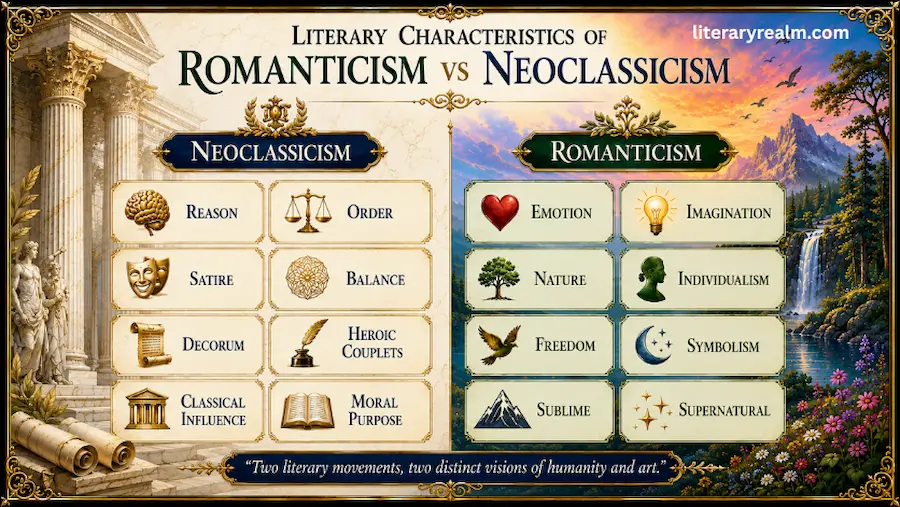
- Emphasis on reason and rationality
- Order, balance, and harmony
- Imitation of Greek and Roman classics
- Satire and intellectual wit
- Moral and didactic purpose
- Respect for literary rules and conventions
- Clear, polished, and formal language
Because of its strong faith in rational thinking and intellectual inquiry, the Neoclassical period is often called the Age of Reason. This title reflects the era’s belief that logical thought, education, and disciplined judgment were the foundations of both literature and society.
What Is Romanticism?
Romanticism, also known as the Romantic Movement, emerged in the late eighteenth century as a reaction against the rationalism and formalism of Neoclassicism. In English literature, the movement is generally considered to have begun with the publication of Lyrical Ballads (1798) by William Wordsworth and Samuel Taylor Coleridge. Romanticism flourished until around 1837, profoundly transforming English poetry, prose, and literary thought.
Unlike Neoclassical writers, Romantic authors believed that imagination, emotion, intuition, and individual experience were essential sources of truth. They rejected rigid literary rules and sought to express the richness of human feeling through original and deeply personal works.
The movement arose during a time of significant political, social, and industrial change. Events such as the French Revolution inspired hopes for liberty and equality, while the Industrial Revolution prompted many writers to criticize urbanization and the growing separation of humanity from nature. These historical developments encouraged Romantic writers to explore themes of freedom, individuality, and the restorative power of the natural world.
At the heart of Romanticism lies the belief that imagination is a creative force capable of revealing profound truths beyond the reach of reason alone. Nature was viewed not merely as scenery but as a living presence that could inspire moral growth, spiritual insight, and emotional healing.
The major characteristics of Romantic literature include:
- Celebration of emotion and imagination
- Deep appreciation of nature
- Individualism and self-expression
- Interest in the supernatural and the mysterious
- Emphasis on freedom and creativity
- Ordinary people and everyday life as literary subjects
- Symbolism and vivid imagery
- Preference for spontaneous expression over strict literary rules
Romanticism developed largely as a response to the limitations many writers perceived in Neoclassicism. While Neoclassical literature valued discipline, convention, and intellectual restraint, Romantic writers argued that genuine literature should arise from sincere emotion and imaginative vision. This shift transformed English literature, giving rise to some of its most celebrated poets and enduring works. If you’re interested in learning more, you can read Characteristics of Romantic Poetry for a better understanding.
Romanticism vs Neoclassicism: Key Differences Explained
Understanding Romanticism vs Neoclassicism is essential because the two movements represent a major shift in literary history. The following comparison highlights the most important differences between the movements and explains how each contributed to the evolution of English literature.
Romanticism vs Neoclassicism: Comparison Table
| Aspect | Neoclassicism | Romanticism |
|---|---|---|
| Historical Background | Influenced by the Enlightenment and classical antiquity | Influenced by the French Revolution, Industrial Revolution, and reaction against Enlightenment rationalism |
| Time Period | c. 1660–1798 | c. 1798–1837 |
| Philosophy | Reason, logic, balance, and order | Emotion, imagination, intuition, and individual freedom |
| Primary Focus | Society, morality, and universal truths | Individual experience and personal expression |
| Reason vs Emotion | Reason is supreme | Emotion is equally or more important than reason |
| Imagination | Controlled and secondary | Central creative force |
| Nature | Ordered and symbolic | Living, spiritual, and inspirational |
| Literary Style | Formal, polished, restrained | Expressive, lyrical, and imaginative |
| Literary Rules | Strict adherence to classical conventions | Freedom from rigid literary rules |
| Human Nature | Imperfect and governed by reason | Naturally good and emotionally complex |
| Common Literary Forms | Satire, essays, heroic couplets | Lyric poetry, odes, ballads, sonnets |
| Major Writers | Dryden, Pope, Swift, Addison, Steele | Wordsworth, Coleridge, Shelley, Keats, Byron |
Historical Background
The historical contexts of the two movements greatly influenced their literary values.
Neoclassicism developed after the Restoration of the English monarchy in 1660 during a period of political stability and intellectual confidence. The Enlightenment encouraged faith in science, rational inquiry, and social order. Writers believed literature should reflect these ideals by promoting reason and moral discipline.
Romanticism emerged several decades later amid political revolutions and rapid industrialization. The French Revolution inspired hopes for liberty, equality, and individual rights, while the Industrial Revolution transformed society through urban growth and mechanization. Romantic writers often viewed these changes critically, turning instead to nature, imagination, and personal freedom as sources of truth and inspiration.
Time Period
Another important difference between Neoclassicism and Romanticism is their historical chronology.
Neoclassicism dominated English literature from approximately 1660 to 1798, encompassing the Restoration, Augustan, and Age of Sensibility periods.
Romanticism began around 1798, marked by the publication of Lyrical Ballads, and continued until about 1837. Although literary movements rarely begin or end abruptly, this period represents the height of English Romantic literature.
Philosophy and Worldview
The two movements were built upon contrasting philosophical foundations.
Neoclassical writers believed that literature should imitate universal truths discovered through reason. Human beings, in their view, achieved wisdom through education, discipline, and adherence to established moral principles. Classical literature provided the ideal model for artistic excellence.
Romantic writers challenged this perspective by arguing that truth could also be discovered through imagination, intuition, and emotional experience. Rather than following ancient models, they encouraged originality and celebrated the uniqueness of every individual.
This philosophical contrast defines the broader debate of Neoclassicism vs Romanticism.
Reason vs Emotion
Perhaps the most recognizable distinction between these literary movements is their attitude toward reason and emotion.
For Neoclassical writers, reason was the highest human faculty. Emotional excess was viewed with suspicion because it could disrupt social harmony and sound judgment—literature, therefore, emphasized moderation, self-control, and intellectual clarity.
Romantic writers believed that emotions reveal essential truths about human existence. Love, joy, grief, wonder, and even melancholy became worthy literary subjects. Instead of suppressing emotion, Romantic poets explored it with honesty and intensity.
This transition from reason to emotion marks one of the defining developments in English literary history.
Imagination vs Rationality
In Neoclassical literature, imagination served reason. Writers valued creativity, but only when it respected established artistic conventions and logical structure.
Romanticism dramatically elevated imagination. Authors such as William Wordsworth and Samuel Taylor Coleridge described it as a creative power capable of revealing deeper spiritual and emotional realities. Poetry was no longer merely an imitation of life but an imaginative re-creation of human experience.
Consequently, Romantic literature often contains symbolic imagery, visionary landscapes, and emotional depth that differ markedly from the measured style of Neoclassical writing.
Nature
Nature occupies very different positions within the two literary traditions.
Neoclassical writers generally regarded nature as a reflection of universal order and rational design. References to nature were often symbolic or decorative, reinforcing themes of harmony and balance.
Romantic writers transformed nature into one of literature’s central subjects. Mountains, rivers, forests, flowers, and changing seasons became living companions that inspired spiritual reflection and emotional renewal. Nature was viewed as a teacher capable of nurturing the human soul.
This profound appreciation of nature distinguishes the Romantic Movement from earlier literary traditions.
Literary Themes
The literary themes of Neoclassicism and Romanticism reflect their contrasting views of the purpose of literature and human experience. Neoclassical literature primarily explores themes of reason, morality, social order, duty, and universal human nature. Writers often employed satire to expose human weaknesses and social vices, believing that literature should both entertain and instruct readers. Consequently, many Neoclassical works focus on civilization, public life, political issues, and ethical conduct, emphasizing the importance of balance, decorum, and rational judgment. In contrast, Romantic literature celebrates emotion, imagination, individual freedom, and the beauty of nature. Romantic writers were deeply interested in personal experience, childhood, memory, love, the supernatural, and the spiritual connection between humanity and the natural world. Rather than using literature primarily as a means of moral instruction, they sought to express authentic emotions, explore the inner self, and reveal truths through imagination and intuition. These contrasting thematic priorities clearly illustrate the differences between Neoclassicism and Romanticism: one emphasizes reason, social responsibility, and universal values, while the other emphasizes emotional depth, personal expression, and the limitless possibilities of the human imagination.
Literary Style and Language
The literary style of each movement reveals its artistic priorities.
Neoclassical prose and poetry are characterized by precision, clarity, balance, and polished expression. Writers preferred formal diction and carefully structured sentences, often employing heroic couplets to achieve elegance and symmetry.
Romantic writers adopted a more natural and expressive style. Wordsworth famously advocated language drawn from ordinary life so that poetry could communicate genuine human feeling. Romantic literature frequently employs vivid imagery, symbolism, musical rhythm, and emotional intensity.
This stylistic transformation made literature more accessible while expanding its expressive possibilities.
Rules and Literary Freedom
Another significant aspect of Romanticism and Neoclassicism is their differing attitudes toward literary conventions.
Neoclassical authors admired established rules inherited from classical criticism. They believed that successful literature should maintain unity, proportion, and decorum. Following accepted conventions demonstrated artistic discipline.
Romantic writers rejected many of these restrictions. They argued that rigid formulas should not constrain creativity. Originality became more valuable than imitation, allowing writers greater freedom in subject matter, structure, and poetic form.
This shift encouraged experimentation and helped shape many later literary movements.
View of Human Nature
The two movements also present contrasting views of humanity.
Neoclassical writers generally regarded human beings as imperfect creatures whose passions required control through reason, education, and moral discipline. Literature, therefore, sought to expose human weaknesses while encouraging virtuous behaviour.
Romantic writers adopted a more optimistic perspective. Influenced in part by the philosophy of Jean-Jacques Rousseau, they often portrayed individuals as naturally good but corrupted by society and artificial institutions. Personal growth, emotional authenticity, and communion with nature became central ideals.
Literary Forms
The literary forms favoured by Neoclassicism and Romanticism further demonstrate their distinct artistic philosophies. Neoclassical writers preferred highly structured and rule-based forms that reflected order, balance, and precision. Satirical poetry, mock epics, essays, literary criticism, formal drama, and poems composed in heroic couplets became defining features of Neoclassical literature. These forms allowed writers to present intellectual arguments, moral lessons, and social criticism with clarity, elegance, and disciplined craftsmanship. Romantic writers, however, embraced literary forms that encouraged greater freedom of expression and creative experimentation. Lyric poetry, ballads, odes, sonnets, and narrative poems became especially popular because they offered poets space to convey personal emotions, vivid imagery, and imaginative visions. Rather than adhering strictly to classical conventions, Romantic authors often adapted traditional forms or experimented with new techniques to capture the spontaneity and intensity of human experience. This difference reflects the broader philosophies of the two literary movements: while Neoclassicism regarded form as a means of achieving artistic perfection through discipline and convention, Romanticism viewed form as a flexible medium for expressing individuality, emotion, and creative imagination.
Major Writers
The leading authors of each movement embody their respective literary ideals.
Major Neoclassical writers include:
- Alexander Pope
- Jonathan Swift
- John Dryden
- Joseph Addison
- Richard Steele
These writers excelled in satire, essays, moral criticism, and polished poetic craftsmanship.
Major Romantic writers include:
- William Wordsworth
- Samuel Taylor Coleridge
- Percy Bysshe Shelley
- John Keats
- Lord Byron
Their poetry celebrates imagination, emotion, beauty, nature, and the limitless potential of the human spirit.
Influence on English Literature
The influence of both movements extends far beyond their historical periods.
Neoclassicism established enduring standards of clarity, balance, satire, and disciplined literary craftsmanship. Its emphasis on structure and reason continues to influence criticism, rhetoric, and formal writing.
Romanticism expanded the possibilities of literature by legitimizing personal experience, emotional depth, and imaginative creativity. It paved the way for Victorian poetry, Transcendentalism, Symbolism, Modernism, and many later literary developments.
Rather than viewing one movement as superior, it is more accurate to see them as complementary stages in the evolution of English literature. Neoclassicism provided a foundation of intellectual discipline, while Romanticism broadened literature’s emotional and imaginative horizons. Together, they remain indispensable to understanding the history and development of English literary traditions.
Examples of Romanticism and Neoclassicism in English Literature
The defining characteristics of Romanticism and Neoclassicism are best understood through the works of their major writers. Although both movements produced enduring literary masterpieces, they differ significantly in their treatment of subject matter, style, and artistic purpose. The following examples illustrate how representative authors embodied the ideals of their respective literary movements.
The Romantic Movement is represented by poets who celebrated imagination, emotion, nature, and individual experience. William Wordsworth regarded nature as a powerful moral and spiritual force capable of shaping human character. In works such as “Lines Composed a Few Miles above Tintern Abbey” and “I Wandered Lonely as a Cloud, he portrays ordinary life and natural landscapes with simplicity and emotional depth. His poetry mirrors the Romantic belief that profound truths can be discovered through personal experience and communion with nature. Readers interested in his poetic philosophy may also explore Discuss William Wordsworth as a Poet of Nature.
Samuel Taylor Coleridge expanded the scope of Romantic poetry by blending imagination with the supernatural. Poems such as The Rime of the Ancient Mariner and Kubla Khan demonstrate his fascination with mystery, symbolism, and the psychological dimensions of human experience. His unique treatment of supernatural elements makes him one of the movement’s most distinctive voices. For a deeper study, readers can refer to Coleridge as a Supernatural Poet.
Percy Bysshe Shelley exemplifies the revolutionary spirit of Romanticism through his idealism, political vision, and lyrical brilliance. In Ode to the West Wind, Shelley uses the wind as a symbol of destruction, renewal, and hope for social transformation. At the same time, Ode to a Skylark celebrates imagination and transcendent beauty. His works demonstrate how Romantic poets combined emotional intensity with philosophical reflection.
John Keats represents the Romantic pursuit of beauty, imagination, and artistic permanence. Poems such as Ode on a Grecian Urn, Ode to a Nightingale, and Ode on Melancholy explore the relationship between beauty, mortality, and human suffering through rich sensory imagery and philosophical insight. His poetry illustrates the Romantic conviction that beauty and imagination possess enduring significance.
Lord Byron, another leading Romantic poet, is known for his passionate individualism and rebellious spirit. His works, including Childe Harold’s Pilgrimage and Don Juan, feature independent, unconventional protagonists who challenge social norms. The famous “Byronic hero” became one of Romanticism’s most influential literary archetypes, reflecting the movement’s celebration of freedom and individuality.
In contrast, Neoclassical literature emphasizes reason, order, wit, and moral instruction. Alexander Pope perfected the heroic couplet in works such as An Essay on Criticism, The Rape of the Lock, and An Essay on Man. His poetry demonstrates the Neoclassical ideals of balance, intellectual precision, and polished expression while offering insightful observations on human nature and society.
Jonathan Swift employed satire as a powerful instrument of social and political criticism. His masterpieces, Gulliver’s Travels and A Modest Proposal, expose human folly, corruption, and hypocrisy through irony and wit. Swift’s writing exemplifies the Neoclassical belief that literature should entertain while encouraging moral reflection.
John Dryden, one of the foremost writers of the Restoration period, contributed significantly to poetry, drama, and literary criticism. His works, including Absalom and Achitophel and Mac Flecknoe, display the clarity, discipline, and satirical brilliance characteristic of Neoclassicism. His critical essays also helped establish important literary principles that influenced later generations.
Joseph Addison and Richard Steele transformed English prose through their influential periodicals, The Tatler and The Spectator. Their essays addressed everyday social behaviour, morality, education, and manners in a clear, elegant style, making literature accessible to a growing reading public. Their work reflects the Neoclassical commitment to reason, civility, and the improvement of society through thoughtful writing.
Together, these writers demonstrate how Romanticism and Neoclassicism developed distinct literary traditions. While Romantic authors sought inspiration in emotion, imagination, and nature, Neoclassical writers emphasized reason, order, satire, and moral purpose. Their collective contributions continue to shape the study and appreciation of English literature.
Romanticism vs Neoclassicism: Which Movement Had the Greater Influence?
Determining whether Romanticism or Neoclassicism had the greater influence on English literature is not straightforward, as each movement shaped literary history in different but equally significant ways. Rather than viewing one as superior to the other, it is more accurate to recognize that both contributed uniquely to the evolution of literary thought, style, and expression.
Neoclassicism laid a strong intellectual and artistic foundation for English literature. Its emphasis on reason, order, clarity, and adherence to classical principles established high standards of literary craftsmanship. Through satire, essays, literary criticism, and formal poetry, Neoclassical writers refined language and promoted literature as a means of moral instruction and social improvement. Their influence can still be seen in critical writing, rhetorical techniques, and works that value precision, balance, and disciplined structure.
Romanticism, however, transformed literature by expanding its emotional and imaginative possibilities. Romantic writers challenged rigid literary conventions and demonstrated that poetry could explore personal experience, individual identity, and the profound relationship between humanity and nature. Their emphasis on creativity, originality, and emotional authenticity inspired later literary movements, including Victorian poetry, Transcendentalism, Symbolism, and aspects of Modernism. The Romantic celebration of imagination also broadened the scope of artistic expression beyond the limits of classical tradition.
In the realm of poetry, Romanticism arguably introduced the more dramatic shift. Poets such as William Wordsworth, Samuel Taylor Coleridge, Percy Bysshe Shelley, John Keats, and Lord Byron redefined poetic language by favoring simplicity, vivid imagery, and sincere emotional expression over the polished formality characteristic of Neoclassical verse. Their innovations continue to influence poets and readers around the world.
Despite these differences, the lasting legacy of both movements lies in their complementary contributions to English literature. Neoclassicism reminds readers of the importance of reason, discipline, and artistic craftsmanship, while Romanticism highlights the value of imagination, emotion, and individual creativity. Modern literature often reflects elements of both traditions, combining intellectual depth with emotional resonance.
Ultimately, the question is not which movement had the greater influence, but how each enriched English literature in its own way. Together, Neoclassicism and Romanticism represent two essential stages in the development of literary history, and understanding both provides a deeper appreciation of the diversity and evolution of literary expression.
Conclusion
The comparison of Romanticism vs Neoclassicism reveals two literary movements that, while fundamentally different, have each played a vital role in shaping English literature. Neoclassicism championed reason, order, balance, and classical ideals, producing works marked by intellectual discipline and moral purpose. Romanticism, on the other hand, celebrated emotion, imagination, individuality, and the beauty of nature, transforming literature into a more personal and expressive art form.
Understanding the difference between Neoclassicism and Romanticism provides valuable insight into the historical and philosophical evolution of literary thought. Their contrasting approaches to reason and emotion, artistic rules and creative freedom, and society and the individual continue to influence literary studies and critical interpretation.
Rather than viewing these movements as opposing forces, they should be appreciated as complementary stages in the development of English literature. Together, they demonstrate how literature evolves in response to changing ideas, cultures, and historical circumstances. Exploring Romanticism vs Neoclassicism offers a deeper understanding of the enduring richness and diversity of the English literary tradition.