
Victorian poetry stands as one of the most influential and thought-provoking literary traditions in English literature. Emerging during the reign of Queen Victoria (1837–1901), it reflects an era of remarkable social, political, scientific, and cultural transformation. Unlike the Romantic poets who celebrated imagination and individual emotion, Victorian poets sought to engage with the realities of a rapidly changing world. Their works explore themes of morality, faith, industrialization, nature, social justice, and the complexities of human life, making Victorian poetry both intellectually rich and emotionally compelling.
Understanding the Characteristics of Victorian Poetry is essential for anyone interested in the evolution of English poetry. These defining features reveal how poets responded to the challenges of their time while preserving the beauty and emotional depth that poetry offers. From dramatic monologues and realistic portrayals of society to reflections on religious doubt and scientific progress, Victorian poetry captures the spirit of an age caught between tradition and modernity.
If you are interested in exploring poetry from the Victorian period, then you’re on the right track, as this comprehensive article will lead you to learn about the historical forces that shaped the movement and to understand why its themes and literary techniques continue to influence readers and writers today. Whether you are preparing for an examination or expanding your literary knowledge, this article will provide a clear and engaging overview of this remarkable poetic era.
What Is Victorian Poetry?
Victorian poetry refers to the body of English poetry written during the Victorian Era, spanning 1837 to 1901, the period in which Queen Victoria ruled the United Kingdom. This literary period followed the Romantic Age and preceded the Modern Age, serving as a bridge between the emotional idealism of Romanticism and the realistic, questioning spirit of modern literature.
Named after Queen Victoria, the era witnessed extraordinary political stability, rapid industrial growth, scientific discoveries, imperial expansion, and significant social reform. These developments profoundly influenced writers, encouraging them to address contemporary issues rather than focusing solely on imagination or personal emotion. As a result, Victorian poetry became a reflection of both the achievements and anxieties of nineteenth-century society.
Unlike Romantic poetry, which emphasized nature, freedom, and the power of imagination, Victorian poetry often examined the realities of everyday life. Victorian poets explored moral responsibility, social inequality, religious uncertainty, technological progress, and the changing relationship between humanity and nature. Their works frequently combined emotional sensitivity with intellectual inquiry, producing poetry that was both beautiful and socially relevant.
Many renowned poets contributed to this literary tradition, including Alfred, Lord Tennyson, Robert Browning, Elizabeth Barrett Browning, Matthew Arnold, Christina Rossetti, and Gerard Manley Hopkins. Each brought a unique voice to Victorian literature while sharing common concerns about faith, society, and the human condition.
Today, Victorian poetry remains an important subject of literary study because it reflects one of the most transformative periods in British history. As a modern reader who enjoys this era’s poetry, I find it offers timeless insights into personal identity, ethical responsibility, and the challenges of living in a rapidly changing world.
Historical Background of Victorian Poetry
To fully appreciate the Characteristics of Victorian Poetry, it is crucial to know about the historical events that shaped the Victorian Age. The nineteenth century was marked by unprecedented economic, scientific, political, and social change, all of which deeply influenced the themes and styles of Victorian poets.
One of the most significant influences was the Industrial Revolution. Rapid industrialization transformed Britain from an agricultural society into a modern industrial nation. Factories, railways, and expanding cities created new opportunities for economic growth but also led to overcrowding, poverty, pollution, and difficult working conditions. Victorian poets often explored these contrasting realities, celebrating progress while questioning its human cost.
Scientific discoveries also reshaped Victorian thought. Advances in geology, astronomy, and medicine challenged long-held beliefs about the natural world. Most notably, Charles Darwin’s On the Origin of Species (1859) introduced the theory of evolution, prompting widespread debate about religion, creation, and humanity’s place in the universe. Many Victorian poets reflected this intellectual uncertainty by examining the relationship between faith and scientific knowledge.
At the same time, religious uncertainty became a defining feature of the era. Traditional Christian beliefs faced increasing scrutiny as scientific discoveries and philosophical ideas encouraged people to question established doctrines. Rather than rejecting religion outright, many Victorian poets explored the emotional struggle between belief and doubt, creating poetry filled with spiritual reflection and philosophical inquiry.
The expansion of the British Empire further influenced Victorian literature. Britain’s growing global influence fostered feelings of national pride, curiosity about other cultures, and discussions about imperial responsibility. While some poets celebrated the empire’s achievements, others raised moral questions about colonialism and its consequences.
Victorian society also experienced important social reforms. Campaigns for improved education, better working conditions, women’s rights, and public health gradually transformed British life. These reforms inspired poets to address issues such as poverty, class inequality, child labour, and social justice, making poetry a powerful medium for social commentary.
Together, these historical developments shaped a literary movement that balanced beauty with realism, emotion with intellect, and imagination with social responsibility. Victorian poetry became a mirror of an age striving to reconcile rapid progress with enduring moral and human concerns, giving the period a distinctive voice that continues to captivate readers today.
What Are the Characteristics of Victorian Poetry?
The Characteristics of Victorian Poetry reflect the remarkable social, intellectual, and cultural changes that defined the nineteenth century. Victorian poets sought to understand a world transformed by industrialization, scientific advancement, and changing moral values. Their poetry combined artistic expression with thoughtful commentary on contemporary life, making it one of the richest and most diverse periods in English literature. Victorian Poetry not only mirrored social advancement but also portrayed the struggles of human life amid immense changes in lifestyle.
Victorian poets successfully blended Romantic ideals with realism, preserving the emotional depth and appreciation of nature inherited from the Romantic movement while introducing greater attention to everyday experiences and social realities. They believed that poetry should not only inspire readers but also encourage reflection on ethical, political, and philosophical issues. Victorian poetry didn’t ignore human emotions but blended them with realism from an objective perspective.
Another defining feature of Victorian poetry is its emphasis on morality and social responsibility. Many poets used their works to explore themes such as justice, duty, faith, love, and compassion, often encouraging readers to reflect on their responsibilities to society. At the same time, scientific discoveries and religious uncertainty led poets to question traditional beliefs, resulting in poetry that examined the relationship among faith, reason, and modern knowledge.
Victorian poetry also demonstrates a deep awareness of social change. Industrialization, urban growth, and class inequality became important subjects, allowing poets to address the hopes and anxieties of an evolving society. Rich symbolism, vivid imagery, dramatic monologues, and emotional sincerity further enriched their literary style. Another defining feature of this era is child labour. Because of the Industrial Revolution, one part of society gained riches, while the other was left in the dark, in poverty, causing them to let their children work as labourers.
The following sections explore each of the defining characteristics of Victorian poetry in detail, illustrating how these distinctive qualities shaped one of the most influential literary movements in English literature.
15 Characteristics of Victorian Poetry
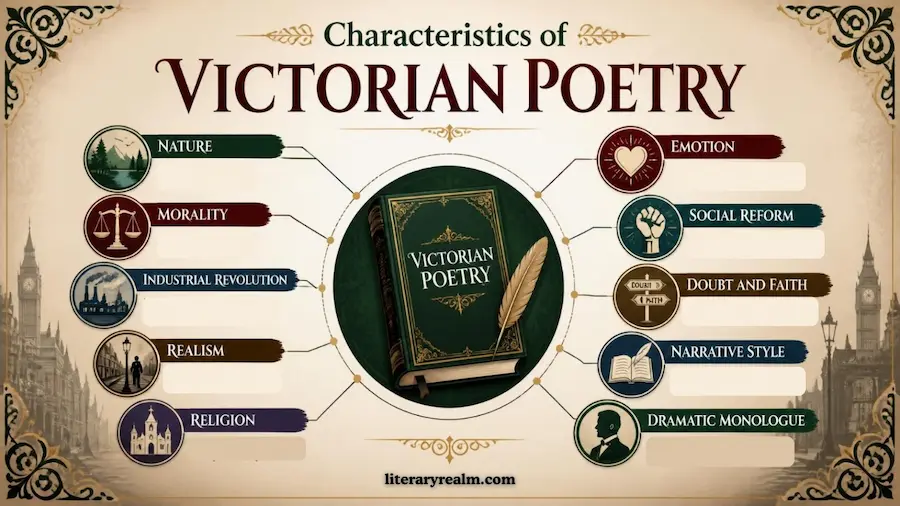
Victorian poetry is distinguished by a unique blend of tradition and innovation. While Victorian poets inherited many ideas from the Romantic movement, they also responded to the dramatic social, scientific, and political changes of the nineteenth century. As a result, their poetry reflects a careful balance between imagination and reality, personal emotion and social responsibility, faith and doubt, and beauty and moral purpose.
Below are the major characteristics that define Victorian poetry and distinguish it from earlier literary movements.
1. Realism
One of the most important characteristics of Victorian poetry is its emphasis on realism. Unlike the Romantic poets, who often idealised nature and celebrated imagination, the Victorians turned their attention to the realities of everyday life. They portrayed society as it truly was, highlighting both its achievements and its shortcomings. Poverty, industrialization, urban growth, class divisions, and the struggles of ordinary people became common subjects in their works.
This shift toward realism developed because nineteenth-century Britain experienced rapid industrial and social transformation. Expanding cities, new technologies, and changing economic conditions exposed many social problems that could no longer be ignored. Victorian poets believed literature should reflect these realities and encourage readers to think critically about the world around them.
A notable example is Matthew Arnold’s Dover Beach. Although the poem is lyrical, it also presents a realistic picture of uncertainty and the loss of religious faith in the modern world. Rather than escaping reality, Arnold confronts it with honesty and emotional depth.
For modern readers, realism makes Victorian poetry feel surprisingly relevant. The poems remind us that literature is not only about beauty and imagination but also about understanding society, questioning injustice, and reflecting on the complexities of everyday human experience.
2. Moral Purpose
Another defining characteristic of Victorian poetry is its strong moral purpose. Many Victorian poets believed that poetry should do more than entertain; it should educate, inspire, and encourage readers to lead ethical lives. Their works frequently explore themes such as honesty, duty, compassion, responsibility, and perseverance, reflecting the values that shaped Victorian society.
This emphasis on morality developed because the Victorian Age placed great importance on personal character and social responsibility. During a period marked by industrial growth, scientific advancement, and changing social values, many writers felt that literature could provide moral guidance and help preserve important ethical principles. Poetry became a medium through which poets examined questions of right and wrong while encouraging thoughtful reflection.
Alfred Lord Tennyson’s Ulysses illustrates this characteristic beautifully. Although the poem celebrates adventure and determination, it also promotes resilience, purpose, and the courage to continue striving despite old age and life’s challenges. Its famous closing lines encourage readers to remain steadfast in pursuing meaningful goals.
For today’s readers like us, the moral dimension of Victorian poetry offers valuable lessons without feeling overly preachy. Instead of providing simple answers, these poems invite us to consider our own values, responsibilities, and choices. This thoughtful balance between artistic beauty and ethical reflection is one of the reasons Victorian poetry continues to be widely studied and appreciated.
3. Social Criticism
Victorian poetry is also known for its powerful social criticism. Many poets used their works to expose the inequalities and injustices created by industrialization and rapid social change. Rather than ignoring society’s problems, they addressed issues such as poverty, child labour, exploitation, class inequality, and the gap between the rich and the poor.
This characteristic emerged because Britain was undergoing a dramatic economic and social transformation. While industrial progress brought wealth and technological innovation, it also created difficult living conditions for many people. Victorian poets felt a responsibility to draw attention to these problems and encourage greater compassion and reform through their writing.
Elizabeth Barrett Browning’s The Cry of the Children is one of the finest examples of social criticism in Victorian poetry. The poem highlights the suffering of child workers forced into exhausting labour, appealing directly to readers’ sense of justice and humanity. Rather than simply describing hardship, Browning challenges society to recognize and address these injustices.
For contemporary readers, this aspect of Victorian poetry demonstrates that literature can be a powerful force for social awareness. These poems encourage us to think critically about inequality, human dignity, and our collective responsibility to create a fairer society. Their messages remain meaningful because many of the issues they address persist in different forms around the world.
4. Interest in Science and Progress
The Victorian Age was a period of remarkable scientific discoveries and technological innovation, making interest in science and progress a defining characteristic of Victorian poetry. Many Victorian poets became deeply interested in the relationship between science, reason, and human existence. Their poetry reflects both admiration for scientific advancement and concern about its impact on traditional beliefs and values.
This characteristic developed because the nineteenth century witnessed groundbreaking inventions and discoveries that transformed everyday life. The expansion of railways, advances in medicine, improvements in communication, and the publication of Charles Darwin’s On the Origin of Species challenged long-held religious and philosophical ideas. Darwin’s theory raised doubts about human identity and shook people’s religious faith. As a result, a conflict arose between Science and religion. As society embraced scientific thinking, poets sought to understand how these changes affected humanity’s understanding of life, faith, and the natural world.
A notable example is Alfred Lord Tennyson’s In Memoriam A.H.H. Written after the death of his close friend Arthur Hallam, the poem explores grief while wrestling with scientific theories and religious belief. Tennyson neither rejects science nor abandons faith; instead, he presents the emotional struggle of reconciling new knowledge with spiritual hope.
For modern readers, this characteristic highlights the timeless tension between scientific progress and personal belief. Victorian poetry reminds us that technological advancement can bring remarkable achievements while also raising questions about identity, morality, and the meaning of life. This thoughtful engagement with science continues to make Victorian poetry relevant in today’s rapidly evolving world.
5. Religious Doubt and Faith
One of the most distinctive characteristics of Victorian poetry is its exploration of religious doubt and faith. Victorian poets lived during a time when traditional Christian beliefs were increasingly challenged by scientific discoveries, historical research, and philosophical inquiry. As a result, many poems express an emotional struggle between maintaining faith and confronting uncertainty.
This characteristic emerged because the Victorian period experienced what many scholars describe as a “crisis of faith.” Charles Darwin’s theory of evolution, along with advances in geology and biblical criticism, encouraged people to question long-accepted religious teachings. Rather than providing simple answers, Victorian poets examined these spiritual conflicts with honesty, sensitivity, and intellectual depth.
Matthew Arnold’s Dover Beach is one of the finest examples of this theme. In the poem, Arnold uses the image of the retreating sea to symbolize the gradual decline of religious certainty in the modern world. Although the poem expresses sadness over this loss, it ultimately suggests that love, loyalty, and human companionship can provide hope in times of uncertainty.
Similarly, Tennyson’s In Memoriam A.H.H. reflects the poet’s attempt to reconcile grief, scientific progress, and Christian faith. His work demonstrates that doubt does not necessarily destroy belief but can deepen one’s search for truth and understanding.
For today’s readers, this characteristic makes Victorian poetry deeply relatable. Questions about faith, purpose, and uncertainty remain central to human experience, and Victorian poets encourage us to approach these issues with both intellectual curiosity and emotional honesty. Their willingness to acknowledge uncertainty is one reason their poetry continues to resonate across generations.
6. Love of Nature
Although Victorian poetry moved beyond many Romantic ideals, a profound love of nature remained one of its defining characteristics. However, Victorian poets viewed nature differently from their Romantic predecessors. Instead of seeing it solely as a source of beauty, inspiration, and spiritual comfort, they often portrayed nature as a place that reflected scientific truth, human emotion, and the changing realities of the modern world.
This characteristic developed because Victorians lived through rapid industrialization and urban expansion. As factories replaced fields and cities grew larger, many poets looked to nature as a reminder of beauty, peace, and permanence. At the same time, scientific discoveries encouraged them to observe the natural world with greater accuracy and curiosity, blending emotional appreciation with intellectual inquiry.
Christina Rossetti’s A Birthday celebrates nature through vivid images of flowers, birds, and blossoming trees, using the natural world to express joy and emotional renewal. Likewise, Gerard Manley Hopkins filled his poetry with rich descriptions of landscapes, plants, and skies, celebrating the uniqueness and divine beauty found in creation.
Victorian writers rarely portrayed nature as a perfect escape from society. Instead, they acknowledged that nature could be both beautiful and indifferent, reflecting the complexities of life itself. Their poems often suggest that observing the natural world can inspire reflection, strengthen faith, or provide comfort during periods of uncertainty.
For modern readers, this characteristic offers an important reminder of humanity’s enduring connection with nature. Victorian poetry encourages us to appreciate the environment not only for its beauty but also for the wisdom, balance, and perspective it brings to our increasingly fast-paced lives.
7. Emotional Depth
Emotional depth is one of the most remarkable Characteristics of Victorian Poetry, setting it apart from many earlier literary traditions. Victorian poets explored the complexities of human emotions with honesty and psychological insight. Their poetry examines love, grief, loneliness, hope, regret, and personal conflict, revealing the inner struggles of individuals living in a rapidly changing society. Rather than expressing simple feelings, Victorian poets often portrayed emotions as layered, conflicted, and deeply intertwined with moral and philosophical questions.
This characteristic developed because the Victorian Age was a period of immense social and intellectual change. Industrialization, scientific discoveries, and religious uncertainty transformed people’s understanding of themselves and the world around them. As traditional beliefs were challenged, poets increasingly focused on the emotional consequences of these changes. Poetry became a means of exploring personal identity, loss, and the search for meaning in an uncertain age.
In Memoriam A.H.H., by Alfred Lord Tennyson, is one of the finest examples of emotional depth in Victorian poetry. Written after the death of his close friend Arthur Hallam, the poem moves through grief, despair, doubt, hope, and eventual acceptance. Instead of presenting sorrow as a temporary emotion, Tennyson explores its lasting impact on the human spirit while reflecting on faith and the purpose of life.
Similarly, Elizabeth Barrett Browning’s Sonnets from the Portuguese expresses profound love and devotion with remarkable emotional sincerity. Her poetry demonstrates that personal feelings can have universal significance, allowing readers across generations to connect with her experiences.
For modern readers, the emotional richness of Victorian poetry remains one of its greatest strengths. These poems remind us that feelings such as love, grief, anxiety, and hope are timeless aspects of the human experience. By exploring emotions with honesty and sensitivity, Victorian poets created works that continue to inspire empathy, reflection, and emotional understanding.
8. Dramatic Monologue
The dramatic monologue is one of the most innovative literary techniques developed during the Victorian Age and remains a defining characteristic of Victorian poetry. In this form, a single speaker addresses an implied listener, revealing not only a story but also their personality, thoughts, motivations, and moral values. Unlike a traditional lyric poem, the dramatic monologue allows readers to understand a character’s psychology through their own words.
This technique became popular because Victorian writers were increasingly interested in psychology, individual identity, and the complexity of human behaviour. Instead of presenting clear moral judgments, poets encouraged readers to interpret the speaker’s character independently. This approach reflected the Victorian fascination with the human mind and the motivations behind individual actions.
Robert Browning is widely regarded as the master of the dramatic monologue. His famous poem My Last Duchess presents a Renaissance duke who casually describes the portrait of his late wife. As he speaks, readers gradually realise his arrogance, jealousy, and possessiveness, though he never openly admits his wrongdoing. Browning masterfully allows the speaker’s own words to expose his true character.
Another excellent example is Browning’s Andrea del Sarto, where the artist reflects on ambition, artistic failure, and personal regret. Through intimate self-expression, the poem reveals emotional complexity while inviting readers to draw their own conclusions.
For today’s readers, the dramatic monologue feels surprisingly modern. It resembles a psychological conversation in which actions and emotions are revealed indirectly rather than explained outright. This innovative narrative style adds depth, suspense, and realism, making Victorian poetry intellectually engaging and emotionally compelling.
9. Medievalism
Another distinctive characteristic of Victorian poetry is medievalism, the fascination with the people, legends, values, and artistic traditions of the Middle Ages. Although Victorian poets lived during a period of scientific progress and industrial development, many looked back to medieval history for inspiration. Knights, castles, chivalry, Arthurian legends, and religious symbolism frequently appeared in their poetry, offering an idealized contrast to the rapidly modernizing world.
This interest developed partly in response to industrialisation. As factories expanded and cities became increasingly crowded, many Victorians felt that modern society had lost the sense of honour, spirituality, craftsmanship, and community associated with the medieval past. Poets used medieval settings not simply to escape reality but to examine timeless questions about duty, courage, loyalty, love, and moral responsibility.
Alfred Lord Tennyson’s Idylls of the King is one of the greatest examples of medievalism in Victorian poetry. Drawing upon the legends of King Arthur and the Knights of the Round Table, Tennyson explores themes such as leadership, justice, honour, temptation, and the decline of noble ideals. Although the poems are set in medieval Britain, they also reflect the moral concerns of Victorian society.
Christina Rossetti likewise incorporated medieval imagery into works such as Goblin Market, combining traditional symbolism with moral and spiritual themes. These poems demonstrate how medieval stories could be adapted to explore contemporary issues and human relationships.
For modern readers, medievalism adds richness and imagination to Victorian poetry. It shows that literature can revisit the past to better understand the present. By blending historical legend with universal human values, Victorian poets created works that remain both culturally significant and emotionally meaningful.
10. Patriotism and Imperialism
Patriotism and imperialism are recurring themes in Victorian poetry, reflecting Britain’s position as the world’s largest imperial power during the nineteenth century. The expansion of the British Empire profoundly influenced literature, shaping how many poets viewed national identity, duty, leadership, and Britain’s role in the world. While some poems celebrate the nation’s achievements and ideals, others question the moral responsibilities that accompany power.
This characteristic developed because the Victorian Age coincided with the rapid growth of British influence across Asia, Africa, and other parts of the world. Imperial expansion became a source of national pride for many Victorians, but it also sparked debates about justice, colonial rule, and the ethical responsibilities of an empire. Poetry became a medium through which writers expressed both admiration and concern.
Alfred Lord Tennyson frequently celebrated courage, honour, and service to the nation. His poem The Charge of the Light Brigade commemorates the bravery of British soldiers during the Crimean War. Rather than focusing solely on military victory, Tennyson honours the soldiers’ loyalty and sacrifice, capturing the Victorian admiration for duty even in the face of tragedy.
Today, this characteristic encourages readers to view Victorian poetry from multiple perspectives. It reveals both the confidence of an expanding empire and the moral questions that accompanied it, reminding us that literature often reflects the political realities and cultural values of its time.
11. Strong Narrative Style
Unlike many earlier lyric poems that focused primarily on personal emotion, Victorian poetry often tells compelling stories. A strong narrative style is one of its defining characteristics, allowing poets to develop memorable characters, dramatic situations, and meaningful plots while exploring complex moral and psychological themes.
This storytelling approach grew out of the Victorian fascination with history, biography, mythology, and everyday life. The nineteenth century also witnessed the rise of the novel, and its influence encouraged poets to create works with richer narratives and more detailed character development. Readers increasingly expected literature to entertain while offering insight into human nature and society.
Alfred Lord Tennyson’s Idylls of the King demonstrates this characteristic beautifully. Drawing on the Arthurian legends, the poem unfolds through interconnected stories that explore leadership, loyalty, temptation, and the decline of noble ideals. Likewise, Robert Browning’s dramatic monologues often present complete narratives through the voice of a single speaker, allowing readers to piece together events while interpreting the speaker’s character.
For modern readers, the narrative quality of Victorian poetry makes it especially engaging. Rather than presenting abstract ideas alone, these poems invite us into vivid stories where characters face moral choices, emotional conflicts, and life-changing experiences. This combination of storytelling and poetic artistry continues to distinguish Victorian poetry from many other literary traditions.
12. Symbolism and Imagery
Victorian poets relied heavily on symbolism and imagery to communicate ideas that extended beyond the literal meaning of their words. Rather than stating emotions or philosophical beliefs directly, they used symbolic objects, landscapes, colours, and natural elements to express complex themes such as faith, mortality, love, and personal transformation.
This literary technique became increasingly important as Victorian writers explored issues that often resisted simple explanations. Scientific discoveries, religious uncertainty, and social change created questions about life and human existence that could not always be answered directly. Symbolism enabled poets to convey these deeper meanings while inviting readers to interpret the poems for themselves.
Matthew Arnold’s Dover Beach provides one of the finest examples of Victorian symbolism. The image of the retreating sea symbolises the gradual loss of religious certainty, while the calm shoreline contrasts with humanity’s emotional uncertainty. Similarly, Christina Rossetti’s Goblin Market employs symbolic fruit, marketplaces, and natural imagery to explore, on multiple levels, the themes of temptation, sacrifice, and redemption.
The vivid imagery found throughout Victorian poetry also enhances its emotional impact. Carefully crafted descriptions appeal to the senses, allowing readers to visualise scenes and experience the emotions they evoke.
For contemporary audiences, symbolism and imagery make Victorian poetry endlessly rewarding. Each reading can reveal new layers of meaning, demonstrating that great poetry speaks not only through direct statements but also through powerful images that continue to inspire interpretation.
13. Musical Language and Rhythm
One of the most admired characteristics of Victorian poetry is its musical language and carefully crafted rhythm. Victorian poets believed that poetry should not only communicate ideas but also delight the ear through its sound, cadence, and harmony. As a result, they paid close attention to meter, rhyme, alliteration, repetition, and other poetic devices that gave their verses a memorable lyrical quality.
This emphasis on musicality developed from the influence of earlier literary traditions, particularly Romantic poetry, while also reflecting the Victorian appreciation for artistic craftsmanship. Poets viewed every line as something to be carefully shaped, ensuring that sound and meaning worked together to create a powerful emotional effect. Whether writing a sonnet, elegy, dramatic monologue, or narrative poem, they understood that rhythm could reinforce a poem’s mood and message.
Alfred Lord Tennyson is widely regarded as one of the greatest masters of poetic melody. In The Lotos-Eaters, the slow, flowing rhythm mirrors the dreamy atmosphere experienced by the sailors, while the repeated sounds create a sense of calm and enchantment. Similarly, Gerard Manley Hopkins experimented with what he called “sprung rhythm,” producing energetic and expressive verse that broke away from conventional metrical patterns while remaining intensely musical.
For readers, the musical quality of Victorian poetry makes the poems enjoyable to read aloud. Their rhythmic beauty strengthens emotional expression and often leaves a lasting impression long after the poem has been finished. This careful attention to sound demonstrates that Victorian poets valued both intellectual meaning and artistic elegance.
14. Individualism and Self-Reflection
Victorian poetry places significant emphasis on the individual’s inner life. Rather than focusing solely on external events, many poets explored personal identity, moral responsibility, ambition, regret, and the search for meaning. Through thoughtful self-reflection, they examined how individuals reacted to the challenges of a rapidly changing society.
This characteristic emerged because the Victorian period was marked by uncertainty and transformation. Industrialization altered traditional ways of life, scientific discoveries challenged established beliefs, and social reforms reshaped people’s understanding of their place in society. These changes encouraged poets to look inward, using poetry to understand themselves and the world around them.
Alfred Lord Tennyson’s Ulysses offers a powerful example of self-reflection. Speaking in the voice of the ageing Greek hero, the poem explores questions of purpose, ambition, and the desire to continue seeking knowledge despite advancing age. Ulysses reflects on his past achievements while refusing to accept a life of inactivity, making the poem both deeply personal and universally inspiring.
Matthew Arnold’s Dover Beach also illustrates this characteristic by expressing the poet’s private anxieties about faith and modern society. Although the poem arises from Arnold’s personal experience, its reflections speak to readers facing uncertainty in every generation.
For modern audiences, the introspective nature of Victorian poetry remains one of its greatest strengths. These poems encourage readers to pause, examine their own beliefs and emotions, and recognise that self-discovery is an essential part of the human experience.
15. Idealism Versus Reality
The tension between idealism and reality is a defining characteristic of Victorian poetry. Victorian poets admired noble ideals such as love, faith, honour, justice, and human progress, yet they also recognised that real life often fell short of these aspirations. Their poetry frequently explores the conflict between what people hope for and what they actually experience.
This theme developed because the Victorian Age was full of contradictions. Britain enjoyed unprecedented industrial growth, scientific advancement, and imperial success, but these achievements existed alongside poverty, social inequality, religious doubt, and political uncertainty. Victorian poets responded by acknowledging both the possibilities and limitations of human society, creating works that balanced hope with realism.
Matthew Arnold’s Dover Beach perfectly captures this struggle. While the speaker longs for certainty and lasting faith, he recognises that the modern world is filled with confusion and instability. Likewise, Tennyson’s In Memoriam A.H.H. reflects the conflict between grief and hope, questioning whether faith can survive in an age increasingly shaped by science and reason. Rather than choosing one side over the other, Tennyson suggests that hope and doubt can coexist.
This balance between idealism and reality gives Victorian poetry its enduring depth. The poets neither ignored life’s difficulties nor surrendered to despair. Instead, they encouraged readers to face reality with courage while continuing to believe in the values that give life purpose and meaning.
Together, these fifteen characteristics reveal why Victorian poetry occupies such an important place in English literature. By combining artistic beauty with intellectual inquiry, emotional honesty, social awareness, and moral reflection, Victorian poets created works that continue to inspire readers more than a century later. Their poetry not only captures the spirit of the Victorian Age but also addresses timeless questions about humanity, society, faith, and the search for meaning—ensuring its lasting relevance in the modern world.
Major Themes in Victorian Poetry
Victorian poetry is admired not only for its literary craftsmanship but also for the wide range of themes it explores. Living through an era of industrial expansion, scientific discovery, social reform, and religious uncertainty, Victorian poets addressed subjects that reflected both the changing world around them and the timeless concerns of human life. While each poet approached these ideas differently, several recurring themes defined the period and continue to make Victorian poetry relevant to modern readers.
Nature
Nature remains one of the central themes in Victorian poetry, though it is portrayed differently than in the Romantic Age. Rather than viewing nature solely as a source of beauty and spiritual inspiration, Victorian poets often explored its relationship with science, faith, and human existence. Nature could offer comfort, reveal divine order, or remind people of life’s constant cycle of change.
Alfred Lord Tennyson frequently used landscapes and seasonal imagery to reflect emotional states, while Gerard Manley Hopkins celebrated the beauty and uniqueness of the natural world through vivid language. For Victorian poets, nature became both a source of artistic inspiration and a mirror through which they examined humanity’s place in an evolving world.
Love
Love is another enduring theme that appears throughout Victorian poetry. However, Victorian poets presented love as more than a romantic emotion. Their works explore devotion, sacrifice, companionship, longing, and the emotional complexities that accompany meaningful relationships. Love is often portrayed as a force that offers hope during periods of uncertainty while also revealing the vulnerabilities of the human heart.
Elizabeth Barrett Browning’s Sonnets from the Portuguese beautifully illustrates this theme through deeply personal expressions of affection and commitment. Her poetry demonstrates that genuine love involves trust, emotional strength, and mutual respect rather than mere passion.
Death
Death occupies a significant place in Victorian poetry, reflecting both personal loss and broader philosophical concerns. Many poets experienced profound bereavement and used poetry to explore grief, memory, and the possibility of life beyond death. Rather than treating death as simply an ending, Victorian writers often examined its emotional and spiritual significance.
Tennyson’s In Memoriam A.H.H. remains one of the greatest poetic meditations on loss in English literature. Through a long journey of mourning, doubt, and acceptance, the poem explores how grief can transform one’s understanding of faith, friendship, and hope.
Religion
Religion is a recurring theme because the Victorian Age witnessed growing uncertainty about traditional Christian beliefs. Scientific discoveries, particularly Charles Darwin’s theory of evolution, challenged long-established religious ideas and prompted many people to question their faith.
Victorian poets did not simply reject religion; instead, they explored the tension between belief and doubt. Matthew Arnold’s Dover Beach captures this conflict through its powerful imagery of the “Sea of Faith,” symbolizing the gradual decline of religious certainty. Such poems reveal the emotional and intellectual struggles of individuals seeking meaning in a changing world.
Industrialization
The Industrial Revolution transformed Victorian society, making industrialization one of the defining themes of the period’s poetry. Expanding factories, crowded cities, technological innovation, and economic growth created opportunities while also exposing poverty, pollution, and harsh working conditions.
Many poets responded by examining the social consequences of rapid progress. Rather than celebrating industrial success uncritically, they questioned whether material advancement alone could improve human happiness. Their works encouraged readers to consider the ethical responsibilities that accompanied economic development.
Social Class
Victorian poetry frequently addresses issues of social class and inequality. As Britain became increasingly industrialized, the gap between wealthy landowners and struggling workers widened. Many poets highlighted the hardships faced by the poor, children, and the working class, encouraging compassion and social reform.
Elizabeth Barrett Browning’s The Cry of the Children powerfully exposes the suffering of child labourers, demonstrating how poetry can serve as a voice for those who have little opportunity to speak for themselves. Through such works, Victorian literature emphasized the importance of justice and human dignity.
Progress
Progress fascinated Victorian poets because it promised a brighter future while simultaneously creating uncertainty about traditional values. Advances in science, technology, education, and medicine transformed everyday life, yet many writers questioned whether material progress was accompanied by moral or spiritual growth.
Rather than presenting progress as entirely positive or negative, Victorian poetry often explores its complexities. Poets celebrated human achievement while reminding readers that compassion, wisdom, and ethical responsibility must guide every advancement.
Identity
The search for identity is another important theme that runs throughout Victorian poetry. Living during a period of rapid social and intellectual change, many poets questioned what it meant to be an individual in the modern world. Their works explore personal ambition, moral responsibility, self-discovery, and the struggle to reconcile private beliefs with public expectations.
Poems such as Tennyson’s Ulysses portray individuals seeking purpose despite uncertainty, inspiring readers to continue learning, growing, and striving throughout life. This emphasis on identity gives Victorian poetry a timeless quality, as questions about purpose and self-understanding remain relevant across every generation.
Literary Devices Commonly Used in Victorian Poetry
Victorian poets were celebrated not only for the depth of their ideas but also for their remarkable command of poetic language. They used a wide range of literary devices to create vivid imagery, convey complex emotions, and encourage readers to think beyond the literal meaning of a poem. These techniques allowed poets to address themes such as love, faith, social injustice, nature, and the challenges of modern life with greater artistic power. By combining traditional poetic forms with innovative narrative techniques, Victorian writers produced works that continue to captivate readers and scholars alike.
The following literary devices are among the most commonly used in Victorian poetry.
Imagery
Imagery is one of the most prominent literary devices in Victorian poetry. By appealing to the senses through descriptive language, poets create vivid mental pictures that help readers experience the emotions and atmosphere of a poem. Visual, auditory, tactile, and even symbolic imagery enrich the reading experience and make abstract ideas more tangible.
Alfred Lord Tennyson frequently painted detailed natural landscapes to mirror human emotions. In The Lady of Shalott, for example, the river, fields, and changing seasons create a rich visual setting while reinforcing themes of isolation and destiny. Such imagery allows readers to connect emotionally with both the setting and the characters.
Symbolism
Victorian poets often used symbolism to convey deeper meanings beyond the literal narrative. Everyday objects, elements of nature, colours, and landscapes frequently represented abstract ideas such as hope, temptation, faith, mortality, or redemption.
Matthew Arnold’s Dover Beach offers a classic example. The retreating “Sea of Faith” symbolizes the decline of religious certainty during the Victorian Age, transforming a simple natural image into a profound reflection on spiritual uncertainty. Similarly, Christina Rossetti’s Goblin Market uses fruit as a powerful symbol of temptation, sacrifice, and redemption.
Symbolism encourages readers to interpret poems on multiple levels, making Victorian poetry intellectually rewarding even after repeated readings.
Metaphor
Metaphor is another essential feature of Victorian poetry. Rather than making direct comparisons using “like” or “as,” metaphors describe one thing as another, allowing poets to communicate complex emotions and philosophical ideas with greater precision and beauty.
In Crossing the Bar, Tennyson compares death to a peaceful sea voyage, presenting it not as something frightening but as a calm transition into eternity. This extended metaphor softens the fear of death while expressing the poet’s quiet faith and acceptance.
Victorian poets relied on metaphors to make abstract ideas more relatable, enabling readers to understand them through familiar experiences.
Simile
Like metaphor, simile helps Victorian poets create vivid and memorable descriptions. By comparing two unlike things using words such as “like” or “as,” similes clarify emotions, settings, and characters while making poetic language more expressive.
Although Victorian poetry generally favours subtle imagery over excessive comparison, carefully chosen similes strengthen emotional impact and enhance descriptive passages. They help readers visualize scenes more clearly and appreciate the beauty of the poet’s observations.
Combined with imagery and metaphor, similes contribute to the elegance and readability that distinguish Victorian verse.
Irony
Irony is frequently employed to reveal the contrast between appearance and reality. Victorian poets used this device to challenge social conventions, expose hypocrisy, and encourage readers to question accepted beliefs. Rather than stating criticism directly, irony often allows poets to communicate their message with subtlety and sophistication.
Robert Browning’s My Last Duchess is an outstanding example. The Duke presents himself as a cultured and powerful nobleman, yet his own words gradually reveal his pride, jealousy, and cruelty. This dramatic irony invites readers to judge the speaker independently rather than accept his perspective.
Irony adds psychological depth to Victorian poetry, making it both intellectually engaging and emotionally compelling.
Allusion
Victorian poets frequently enriched their works through allusion, drawing on historical events, mythology, the Bible, classical literature, and earlier literary traditions. These references add depth to a poem while connecting contemporary concerns with broader cultural and historical contexts.
Tennyson’s Ulysses alludes to the legendary Greek hero from Homer’s Odyssey, using the familiar figure to explore ambition, perseverance, and the search for purpose in later life. Likewise, Idylls of the King draws upon Arthurian legend to examine Victorian ideals of honour, leadership, and morality.
Recognizing these allusions allows readers to appreciate additional layers of meaning and understand how Victorian poets linked the past with the present.
Personification
Personification is another widely used literary device in Victorian poetry. By attributing human qualities to nature, abstract ideas, or inanimate objects, poets create stronger emotional connections between readers and the world they describe.
Nature is often personified as a compassionate companion, a silent observer, or a powerful force that reflects human emotions. In many Victorian poems, the sea, wind, flowers, and seasons seem to possess thoughts and feelings that mirror the speaker’s experiences.
This technique transforms ordinary descriptions into emotionally resonant passages while emphasizing the close relationship between humanity and the natural world.
Dramatic Monologue
Among all the literary techniques associated with Victorian poetry, the dramatic monologue is perhaps the most distinctive. Perfected by Robert Browning, this form presents a single speaker addressing an implied listener. As the speaker tells a story or defends personal actions, readers gradually discover the speaker’s true personality, motives, and moral character.
My Last Duchess remains the finest example of this technique. The Duke’s polished, confident speech unintentionally reveals his possessive nature and abuse of power, allowing readers to draw their own conclusions without the author’s direct judgment.
The dramatic monologue transformed Victorian poetry by introducing psychological realism and narrative complexity. Its influence can still be seen in modern poetry, fiction, and dramatic writing, making it one of the Victorian era’s most enduring literary innovations.
Together, these literary devices demonstrate why Victorian poetry remains admired for both its intellectual depth and artistic excellence. Through imagery, symbolism, metaphor, irony, and innovative forms such as the dramatic monologue, Victorian poets created works that continue to inspire careful reading, thoughtful interpretation, and lasting appreciation.
Famous Victorian Poets and How They Reflect Victorian Characteristics
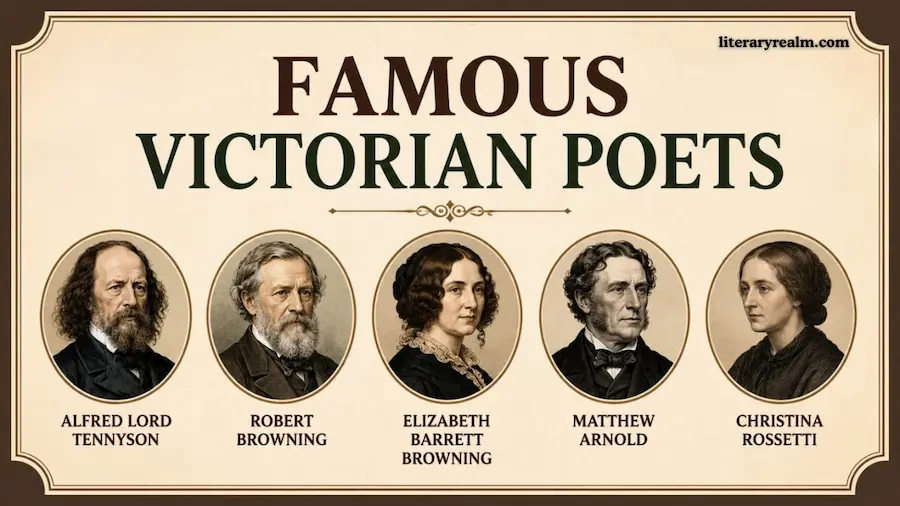
The Victorian Age produced some of the most celebrated poets in English literature. Although each writer developed a unique poetic voice, they collectively reflected the defining characteristics of Victorian poetry through their exploration of realism, morality, faith, social change, emotional depth, and artistic innovation. Their works continue to shape literary studies and remain essential reading for students and poetry enthusiasts alike.
Alfred Lord Tennyson
Widely known as the greatest poet of the Victorian Age, Alfred Lord Tennyson served as the Poet Laureate of Britain for over forty years. His poetry captures the hopes, anxieties, and moral values of Victorian society while combining lyrical beauty with philosophical reflection.
Among his most celebrated works are In Memoriam A.H.H., Ulysses, The Charge of the Light Brigade, The Lady of Shalott, and Idylls of the King. His writing is known for its rich imagery, musical language, symbolic depth, and emotional sincerity.
Tennyson’s poetry reflects many defining characteristics of Victorian poetry, including religious doubt, emotional depth, patriotism, moral purpose, and the conflict between idealism and reality. His ability to blend personal experience with universal themes makes him one of the most influential voices of the nineteenth century.
Robert Browning
Robert Browning revolutionized Victorian poetry through his mastery of the dramatic monologue. Rather than focusing solely on descriptive beauty, Browning explored the psychology of his speakers, allowing readers to uncover their personalities, motives, and moral complexities.
His best-known poems include My Last Duchess, Andrea del Sarto, Fra Lippo Lippi, and The Bishop Orders His Tomb at Saint Praxed’s Church. These works demonstrate his fascination with character, motivation, and the hidden aspects of human nature.
Browning’s poetry reflects realism, individualism, psychological insight, and narrative strength. His innovative storytelling transformed Victorian poetry and significantly influenced the development of modern literary techniques.
Elizabeth Barrett Browning
Elizabeth Barrett Browning was one of the leading female poets of the Victorian Era. Her poetry combines emotional intensity with social awareness, addressing both personal relationships and the injustices of Victorian society.
Her most famous collections include Sonnets from the Portuguese, featuring the beloved poem “How Do I Love Thee?”, and The Cry of the Children, a powerful protest against child labour.
Her literary style is characterized by passionate language, moral conviction, vivid imagery, and lyrical elegance. Through her poetry, she reflects Victorian characteristics such as emotional depth, moral purpose, social criticism, and compassion for the disadvantaged. Her work demonstrates that poetry can inspire both personal reflection and social change.
Matthew Arnold
Matthew Arnold occupies a unique place in Victorian literature because his poetry captures the intellectual uncertainty of the age. Writing during a period of rapid scientific and cultural change, Arnold explored questions of faith, modernity, and the search for meaning.
His most celebrated works include Dover Beach, The Scholar-Gipsy, and Thyrsis. Arnold’s poetry is thoughtful, restrained, and philosophical, often combining beautiful natural imagery with profound reflections on society and religion.
The characteristics most strongly reflected in his work include realism, religious doubt, symbolism, emotional restraint, and the tension between progress and spiritual certainty. His poetry continues to resonate with readers confronting similar questions about identity and belief.
Christina Rossetti
Christina Rossetti is renowned for her lyrical style, symbolic imagination, and exploration of faith, love, sacrifice, and redemption. Although her poems often appear simple on the surface, they contain rich layers of meaning and emotional complexity.
Her most famous works include Goblin Market, Remember, In the Bleak Midwinter, and A Birthday. Rossetti combined vivid imagery with strong religious and moral themes, creating poetry that appealed to both emotions and intellect.
Her writing reflects several defining characteristics of Victorian poetry, including symbolism, love of nature, spiritual reflection, emotional sincerity, and moral purpose. Rossetti’s enduring popularity demonstrates how Victorian poetry could unite artistic beauty with profound human insight.
Victorian Poetry vs Romantic Poetry
Although Victorian poetry developed directly from the Romantic movement, the two literary periods differ significantly in their themes, outlook, and artistic priorities. Romantic poets celebrated imagination, emotion, and the beauty of nature, whereas Victorian poets responded to the realities of industrialization, scientific discovery, and social transformation. While both movements valued poetic expression, Victorian poetry adopted a more reflective, realistic, and socially conscious perspective.
One of the most noticeable differences lies in their treatment of themes. Romantic poetry focuses on individual freedom, imagination, and the sublime power of nature. Victorian poetry, by contrast, explores morality, social responsibility, religious uncertainty, industrial progress, and the complexities of modern life.
Both periods celebrate nature, but they interpret it differently. Romantic poets such as William Wordsworth viewed nature as a way of gaining spiritual healing and inspiration. Victorian poets continued to admire nature but often examined it alongside scientific discovery, faith, and humanity’s changing relationship with the environment.
Emotion remains central to both traditions. However, Romantic poetry expresses spontaneous personal feelings, whereas Victorian poetry presents emotions with greater psychological depth and moral reflection.
In terms of religion, Romantic poets generally expressed spiritual optimism, while Victorian writers frequently explored the conflict between faith and doubt in response to scientific advances and changing beliefs.
Victorian poetry is also more deeply engaged with society. Industrialization, poverty, class inequality, and social reform became important poetic subjects, reflecting the realities of nineteenth-century Britain.
Stylistically, Romantic poetry favours lyrical simplicity and imaginative expression, whereas Victorian poetry often combines lyrical beauty with narrative complexity, symbolism, and philosophical inquiry. The tone likewise shifts from Romantic idealism to Victorian realism and thoughtful introspection.
| Feature | Romantic Poetry | Victorian Poetry |
| Historical Period | Late 18th to early 19th century | 1837–1901 (Victorian Era) |
| Major Themes | Nature, imagination, freedom, emotion | Society, morality, faith, progress, realism |
| View of Nature | Spiritual guide and source of inspiration | Symbolic, scientific, and reflective of reality |
| Emotion | Passionate and spontaneous | Deep, controlled, and psychologically complex |
| Religion | Faith and spiritual optimism | Faith questioned by science and modernity |
| Society | Limited social criticism | Strong focus on social reform and inequality |
| Style | Lyrical, imaginative, personal | Narrative, reflective, symbolic, realistic |
| Literary Techniques | Imagery, lyricism, personification | Symbolism, dramatic monologue, imagery, irony |
Although Victorian poetry inherited many qualities from Romanticism, it ultimately developed its own identity by responding to the intellectual, social, and political challenges of the nineteenth century. Together, these two literary movements represent successive stages in the evolution of English poetry, each leaving a lasting influence on literature worldwide.
Why the Characteristics of Victorian Poetry Still Matter Today
Although the Victorian Age ended more than a century ago, the characteristics of Victorian poetry continue to influence literature, education, and cultural discussions worldwide. The themes explored by Victorian poets—identity, morality, faith, social justice, and human resilience—remain just as relevant today as they were in the nineteenth century. Their ability to combine artistic beauty with thoughtful commentary ensures that Victorian poetry continues to resonate with modern readers.
One of the most significant reasons for its lasting importance is its influence on modern literature. Contemporary poets and novelists frequently draw inspiration from Victorian storytelling, symbolism, psychological depth, and character-driven narratives. Literary techniques such as the dramatic monologue and layered symbolism, perfected by poets like Robert Browning and Christina Rossetti, continue to shape poetry, fiction, and even dramatic writing today.
Victorian poetry also holds a central place in education. Students study these works not only to appreciate their literary craftsmanship but also to understand the historical, cultural, and philosophical changes that shaped nineteenth-century Britain. Through the poetry of Alfred Lord Tennyson, Matthew Arnold, Elizabeth Barrett Browning, and others, readers gain valuable insights into the Industrial Revolution, the crisis of faith, and the social reforms that transformed Victorian society.
Beyond its historical value, Victorian poetry remains a powerful form of social commentary. Issues such as poverty, inequality, technological progress, environmental change, and ethical responsibility continue to dominate public discussion, making many Victorian poems remarkably relevant to contemporary life. Their exploration of moral questions encourages readers to think critically about justice, compassion, and personal responsibility rather than accept easy answers.
Perhaps the greatest strength of Victorian poetry lies in its understanding of human emotions. Love, grief, hope, ambition, self-doubt, and the search for meaning are universal experiences that transcend time and culture. Because Victorian poets expressed these emotions with honesty and psychological insight, their works continue to connect with readers across generations.
The enduring legacy of Victorian poetry lies in its remarkable ability to unite artistic excellence with intellectual depth. Its timeless themes, innovative literary techniques, and thoughtful exploration of the human condition ensure that it remains one of the most influential and rewarding periods in English literature.
Conclusion
The characteristics of Victorian poetry reflect one of the most dynamic and transformative periods in English literary history. Shaped by industrialisation, scientific discovery, religious uncertainty, and social reform, Victorian poets created works that balanced imagination with realism, emotional depth with intellectual inquiry, and artistic beauty with moral purpose. Their poetry captured the complexities of an age experiencing rapid change while exploring timeless questions about faith, identity, love, society, and the human experience.
Throughout this guide, we have examined the defining characteristics, recurring themes, literary devices, and influential poets that distinguish Victorian poetry from other literary movements. From Alfred Lord Tennyson’s philosophical reflections and Robert Browning’s dramatic monologues to Elizabeth Barrett Browning’s social criticism, Matthew Arnold’s exploration of doubt, and Christina Rossetti’s symbolic imagination, each poet contributed to the rich legacy of Victorian literature.
More than a historical literary movement, Victorian poetry continues to inspire readers through its relevance, emotional honesty, and enduring wisdom. Its themes remain meaningful in today’s world, reminding us that literature has the power to question, comfort, challenge, and transform.
Frequently Asked Questions
What are the main characteristics of Victorian poetry?
The main characteristics of Victorian poetry include realism, moral purpose, social criticism, interest in science and progress, religious doubt and faith, love of nature, emotional depth, dramatic monologue, medievalism, patriotism and imperialism, narrative style, symbolism and imagery, musical language, individualism, and the tension between idealism and reality.
How is Victorian poetry different from Romantic poetry?
Victorian poetry is generally more realistic, socially conscious, and reflective than Romantic poetry. While Romantic poetry emphasizes imagination, individual emotion, freedom, and the spiritual power of nature, Victorian poetry focuses more on social issues, morality, scientific progress, religious doubt, industrialization, and the complexities of modern life.
Why is religious doubt an important feature of Victorian poetry?
Religious doubt became important because scientific discoveries, particularly Darwin’s theory of evolution, challenged traditional Christian beliefs during the Victorian Age. Victorian poets explored the resulting conflict between faith and reason, often presenting doubt as part of a deeper search for truth and meaning.
Why is the dramatic monologue important in Victorian poetry?
The dramatic monologue is important because it allows a single speaker to reveal their personality, thoughts, motivations, and moral character while addressing an implied listener. Robert Browning became especially famous for this technique, using poems such as My Last Duchess to explore psychology and human behaviour.
How did the Industrial Revolution influence Victorian poetry?
The Industrial Revolution influenced Victorian poetry by transforming the subjects poets wrote about. Industrialization brought factories, expanding cities, technological progress, poverty, pollution, child labour, and difficult working conditions. Victorian poets responded by exploring social inequality, moral responsibility, progress, and the human cost of industrial change.