
Robert Browning, as a poet of dramatic monologue, marks one of the most significant artistic achievements in Victorian poetry, where poetic expression is transformed into a powerful medium for psychological exploration and dramatic character study. This approach reshaped how poets presented voice and identity, moving far beyond traditional lyric forms.
Rather than speaking in his own voice, Browning constructed intricate dramatic speakers who reveal their personalities through speech, reflection, and interaction with implied listeners. This technique allowed him to explore human psychology with remarkable depth, exposing hidden motives, emotional contradictions, and moral complexity. His characters often speak in ways that unintentionally reveal more about themselves than they intend, making his poetry intellectually engaging and dramatically layered.
By combining narrative structure with psychological insight, Browning elevated the dramatic monologue into a sophisticated literary form. His contribution not only reshaped Victorian poetry but also laid the foundation for modern approaches to character-driven, psychologically focused literature.
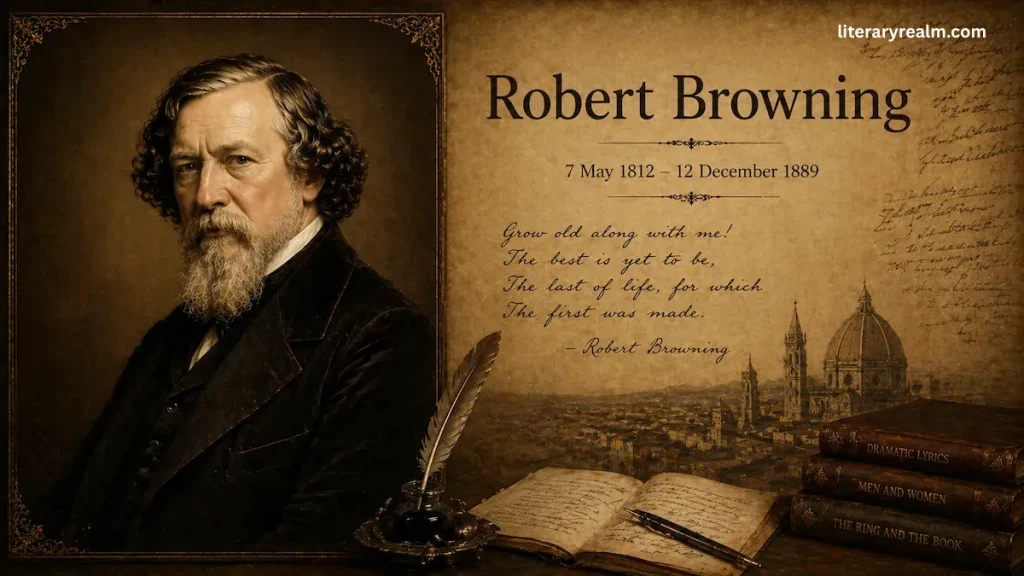
Browning holds a central position in Victorian poetry because he shifted the focus from emotional lyricism to psychological realism. Instead of expressing personal feelings directly, he allowed fictional speakers to reveal their inner thoughts. This unique Browning poetry style introduced complexity, subtle irony, and vivid characterisation, distinguishing him from many of his contemporaries. His poetry reflects the intellectual curiosity and moral questioning that defined the Victorian age.
A dramatic monologue is a poem in which a single speaker addresses an implied listener in a specific situation, gradually revealing the speaker’s personality and motives through the speech. Although earlier poets experimented with this form, Browning perfected and popularised it, giving it depth, dramatic tension, and realism. His mastery of voice and characterisation turned the dramatic monologue into a powerful literary tool.
Many of Browning’s major poems demonstrate his command of the form. Works such as My Last Duchess, Fra Lippo Lippi, and Andrea del Sarto showcase his ability to create memorable speakers and complex dramatic situations, offering readers insight into human nature and moral conflict.
What is a Dramatic Monologue?
Definition of Dramatic Monologue
The dramatic monologue is a type of poem in which a single speaker addresses a silent listener in a specific situation, revealing personal thoughts, emotions, and motives. This poetic form became especially popular during the Victorian period and reached its artistic peak in the works of Robert Browning.
A dramatic monologue typically includes several essential elements. The first is the speaker, who is a clearly defined character rather than the poet himself. This speaker may be a historical figure, a fictional character, or a social figure placed in a meaningful setting. The speaker’s voice drives the poem and shapes its tone.
Another important element is the silent listener. Although the listener does not speak directly in the poem, their presence is strongly implied through the speaker’s responses, tone, or explanations. This silent interaction creates realism and adds dramatic tension to the poem.
A dramatic situation also plays a crucial role. The poem typically occurs at a significant moment, such as a confession, an argument, or a reflection. This situation provides context and helps readers understand the speaker’s motives and emotional state.
Finally, dramatic monologues involve psychological revelation. As the speaker continues talking, hidden emotions, desires, and moral weaknesses gradually become visible. Often, the speaker unintentionally reveals more about their character than intended, making the poem psychologically engaging.
Key Features of Dramatic Monologue
Understanding the features of dramatic monologue helps readers identify this poetic form and appreciate its dramatic qualities. One of the most noticeable characteristics of a dramatic monologue is the presence of a single speaker who dominates the poem. Unlike dialogues or traditional narratives, only one voice is heard directly.
Another defining feature is the implied audience, meaning the speaker addresses a listener whose responses the reader must imagine. This silent presence shapes the direction of the speech and adds tension to the poem’s structure.
Self-revelation is also central to dramatic monologues. Through speech, the speaker gradually exposes personal values, beliefs, fears, or weaknesses. This process allows readers to analyse the character’s psychology and moral outlook.
Additionally, a strong dramatic context supports the poem’s structure. The speaker is usually placed in a specific time, location, or social setting that influences their language and actions.
While Robert Browning perfected this poetic form, other Victorian poets, such as Alfred, Lord Tennyson, also experimented with monologue techniques. However, Browning’s work is generally considered more psychologically complex, making him the foremost master of the dramatic monologue tradition.
Robert Browning as a Pioneer of Dramatic Monologue
Robert Browning is widely recognised as a pioneer of dramatic monologue, credited with refining this poetic form into one of the most powerful tools of character exploration in Victorian literature. Although earlier poets had experimented with monologue-style poems, Browning introduced a depth of psychological realism and narrative complexity that transformed the genre into a major literary achievement.
One of Browning’s greatest contributions lies in his refinement of the dramatic monologue form. He moved beyond simple narrative speech and developed a structure where the speaker’s personality is gradually revealed through subtle hints, contradictions, and emotional expressions. Browning’s dramatic technique allowed readers to interpret the speaker’s true nature by analysing tone, word choice, and hidden meanings rather than relying on direct explanation. His speakers often appear confident or composed, yet their speech unintentionally exposes jealousy, pride, ambition, or insecurity. This method gave dramatic monologues a new level of intellectual engagement.
Browning is often described as the master of dramatic monologue because of his consistent ability to create vivid and believable speakers. Each character in his poems feels distinct, realistic, and psychologically complex. Unlike many poets who focused on personal feelings, Browning chose to speak through imagined voices, such as nobles, artists, or religious figures. This approach allowed him to explore diverse human experiences and moral conflicts. His mastery is evident in poems such as My Last Duchess, Fra Lippo Lippi, and Andrea del Sarto, in which each speaker reveals personal struggles through dramatic speech.
Another reason Browning is regarded as a pioneer of dramatic monologue is his originality. He avoided traditional poetic conventions and introduced conversational language that resembled real speech. His use of dramatic settings and implied listeners created a sense of immediacy, as if readers were witnessing an actual conversation. This originality made his poetry dynamic and memorable, distinguishing him from many of his contemporaries.
Browning’s narrative innovation also played a major role in shaping modern poetic storytelling. He blended dramatic action with psychological analysis, allowing the narrative to unfold naturally through speech rather than description. This technique influenced later poets and writers who sought to develop character-driven narratives. Through his inventive style and profound understanding of human nature, Robert Browning firmly established himself as one of the most influential figures in the development of the dramatic monologue tradition.
Major Characteristics of Robert Browning’s Dramatic Monologues
Understanding Robert Browning as a poet of dramatic monologue requires close attention to the distinctive traits that define his poetic method. The features of Browning’s monologues reveal his mastery of character portrayal, psychological realism, and dramatic intensity. His poems are not merely narratives but carefully constructed speeches that expose the inner lives of complex individuals. These characteristics form the foundation of his enduring literary reputation.
Psychological Depth
One of the most striking features of Browning’s monologues is their extraordinary psychological depth. Robert Browning excelled at exploring the hidden thoughts and emotions of his speakers. Instead of presenting characters in a simple or idealized way, he allowed them to reveal their personalities gradually through speech.
Browning’s characters often expose their fears, ambitions, jealousy, or pride without fully realizing what they are revealing. This method creates a layered understanding of character psychology. For example, a speaker may attempt to justify certain actions while unintentionally revealing guilt or insecurity. Readers must carefully interpret the language and tone to understand the speaker’s true nature.
This Browning’s dramatic style transformed poetry into a psychological study of human behavior. His poems encourage readers to analyze motives, recognize contradictions, and evaluate moral attitudes. By focusing on the inner workings of the human mind, Browning introduced a new level of intellectual depth to Victorian poetry.
Use of Historical and Imaginary Characters
Another important characteristic of Browning’s dramatic monologues is his use of historical and imaginary characters. Rather than speaking in his own voice, Browning created fictional speakers drawn from history, art, religion, and imagination. This approach allowed him to explore diverse cultural and social contexts.
Many of Browning’s monologues are set in Renaissance settings, which provided dramatic backgrounds rich in artistic and political significance. By placing characters in historical periods, he gave his poems authenticity and vivid detail. Renaissance Italy, in particular, served as a frequent setting, reflecting the poet’s interest in art, culture, and intellectual development.
Religious figures also appear frequently in his work. These characters often struggle with moral and spiritual dilemmas, revealing conflicts between faith, ambition, and human weakness. Such figures allow Browning to examine questions of morality and belief from multiple perspectives.
This technique highlights an essential Browning poetic technique: distancing the poet from the speaker. By using historical or imaginary characters, Browning ensured the poem’s voice remained dramatic rather than autobiographical. This method enriched the dramatic structure and expanded the range of themes he could explore.
Dramatic Irony
Dramatic irony is another defining feature of Browning’s monologues. In many of his poems, the reader understands more about the speaker than the speaker understands about himself. This difference in awareness creates tension and deepens the dramatic impact.
For instance, a speaker may attempt to present himself as reasonable or admirable, while readers recognize signs of arrogance or cruelty. This contrast between appearance and reality forms the basis of Browning’s dramatic irony. The audience becomes an active participant, interpreting hidden meanings and judging the speaker’s behavior.
This aspect of Browning’s dramatic style adds complexity to his poetry. Rather than delivering clear moral lessons, Browning invites readers to draw their own conclusions. Dramatic irony encourages critical thinking and enhances the poem’s intellectual engagement.
Realistic Speech Style
Another significant feature of Browning’s dramatic monologues is the realistic speech style he employed. Unlike traditional poetry, which relied heavily on formal structure and ornate language, Browning adopted a conversational tone that resembled natural speech.
His lines often mimic everyday conversation, complete with pauses, interruptions, and spontaneous expressions. This natural voice creates authenticity, making the speaker feel like a real person rather than an abstract poetic figure. The rhythm of his poetry reflects spoken language, contributing to the dramatic atmosphere.
This realism is central to Browning’s poetic technique, as it strengthens the illusion of a genuine interaction between speaker and listener. Readers feel as though they are overhearing a private conversation rather than reading a carefully crafted poem. Such immediacy makes the dramatic experience more vivid and memorable.
Moral and Psychological Conflict
Moral and psychological conflict lies at the heart of many of Browning’s dramatic monologues. His speakers frequently face inner struggles between personal desires and moral responsibilities. These conflicts create dramatic tension and reveal deeper truths about human nature.
Robert Browning used conflict to highlight the complexity of human decision-making. Characters may wrestle with guilt, ambition, pride, or regret, often attempting to justify questionable actions. Through their speech, readers witness the struggle between conscience and self-interest.
This focus on internal conflict represents one of the most powerful features of Browning’s monologues. It demonstrates how dramatic poetry can explore ethical dilemmas and psychological challenges simultaneously. The combination of emotional intensity and moral questioning defines the lasting significance of Browning’s dramatic art.
Famous Dramatic Monologues by Robert Browning
To fully appreciate Robert Browning as a poet of dramatic monologue, it is essential to examine his most celebrated poems in detail. These famous Browning poems provide outstanding dramatic monologue examples, revealing how Browning shaped character, psychology, and moral tension through carefully chosen words. His speakers often reveal their true nature through memorable lines that highlight themes of power, ambition, morality, and artistic struggle. The following major works by Browning demonstrate the depth and brilliance of his dramatic method.
My Last Duchess
Among the most admired dramatic monologue examples, My Last Duchess stands as a perfect illustration of Browning’s mastery. The poem features the Duke of Ferrara speaking to a visitor while showing a portrait of his late wife. From the very beginning, the Duke’s sense of ownership and pride becomes evident in the line:
That’s my last Duchess painted on the wall,
Looking as if she were alive.
This statement reflects his possessive attitude, as he refers to the Duchess as an object under his control. As the poem progresses, the Duke complains about the Duchess’s friendly nature, suggesting that he dislikes her appreciation of simple pleasures. His arrogance becomes more visible when he says:
Sir, ’twas not
Her husband’s presence only, called that spot
Of joy into the Duchess’ cheek;
Through this remark, the Duke reveals jealousy and an expectation of exclusive admiration. The most chilling moment appears in the line:
I gave commands;
Then all smiles stopped together.
Although he does not openly describe the Duchess’s fate, readers understand the implication of deadly authority. This gradual psychological revelation makes the poem one of Browning’s finest works, demonstrating themes of power and control through dramatic irony.
The Bishop Orders His Tomb at Saint Praxed’s Church
Another powerful entry among the famous Browning poems is The Bishop Orders His Tomb at Saint Praxed’s Church. In this monologue, a dying bishop gives instructions about the design of his tomb, revealing his obsession with wealth and prestige. Instead of reflecting on spiritual matters, he expresses envy and pride, as shown in the line:
Old Gandolf envied me, so fair she was!
His desire to surpass others even after death highlights strong materialism and vanity. Another striking line reveals his fascination with luxurious decoration:
And I shall fill my slab of basalt there,
Through such expressions, Browning exposes religious hypocrisy, showing how a religious leader becomes more concerned with worldly glory than spiritual humility.
Andrea del Sarto
Andrea del Sarto is one of the most reflective examples of a dramatic monologue, focusing on the struggles of an artist who recognizes his own limitations.
One of the most quoted lines from the poem expresses artistic aspiration:
Ah, but a man’s reach should exceed his grasp,
Or what’s a heaven for?
This line captures the belief that true greatness lies in striving beyond present abilities. However, Andrea also acknowledges his lack of emotional depth despite technical perfection. His self-awareness appears in the reflective line:
All is silver-grey,
Placid and perfect with my art
While his work is technically flawless, it lacks inspiration. The poem strongly highlights artistic failure and deep self-doubt, presenting a moving portrait of a talented artist burdened by regret and unfulfilled ambition.
Fra Lippo Lippi
Among Browning’s major works, Fra Lippo Lippi stands out for its lively storytelling and philosophical reflection. The poem begins with a dramatic introduction:
“I am poor brother Lippo, by your leave!”
This energetic opening immediately introduces the speaker’s bold and lively personality. As the poem progresses, Fra Lippo defends his artistic philosophy, arguing that art should represent real life. His belief appears clearly in the famous line:
And we in our graves! This world’s no blot for us,
Nor blank; it means intensely, and means good
Another memorable statement reinforces his artistic realism:
we’re made so that we love
First when we see them painted, things we have passed
Perhaps a hundred times nor cared to see;
Through these lines, Browning explores the tension between art and religion, as well as realism versus spirituality. Fra Lippo’s speech celebrates creativity while challenging strict religious expectations, making this poem one of the most engaging examples of a dramatic monologue in Browning’s literary legacy.
Themes in Robert Browning’s Dramatic Monologues (400 Words)
The study of themes in dramatic monologues is essential to understanding the depth and complexity of Robert Browning’s poetry. His poems explore a wide range of human emotions, moral conflicts, and social concerns. These recurring Browning themes reveal his interest in psychology, ethical dilemmas, and the contradictions within human behavior. By examining these Browning poetry themes, readers gain insight into both individual character and broader Victorian society.
Power and Control
One of the most dominant themes in Browning’s work is the struggle for power and control. Many of Browning’s speakers hold positions of authority and attempt to dominate others emotionally or socially. This theme highlights the dangers of pride and possessiveness. Characters often seek control over relationships, status, or reputation, revealing how authority can lead to arrogance and cruelty. Through these portrayals, Browning demonstrates how the misuse of power can damage both individuals and moral values. His exploration of dominance also reflects the hierarchical nature of Victorian society, where social rank and reputation were highly valued.
Love and Jealousy
Another significant theme in dramatic monologue is the complex relationship between love and jealousy. Browning presents love not as purely romantic or idealized but as a force often mixed with insecurity, possessiveness, and suspicion. Many speakers express affection while simultaneously revealing envy or distrust. Jealousy frequently becomes a destructive emotion that leads to misunderstanding and emotional conflict. By combining love with jealousy, Browning portrays relationships as psychologically complicated rather than simple expressions of devotion. This theme highlights the fragile nature of human emotions and the difficulty of maintaining trust in personal relationships.
Art and Morality
Art and morality form another important part of Browning’s poetry themes. Browning frequently introduces artists, painters, or creative individuals as speakers in his dramatic monologues. These characters often struggle to balance artistic freedom with ethical responsibility. The theme explores whether art should reflect reality exactly or aim for spiritual or moral ideals. Through such conflicts, Browning examines the purpose of art and its influence on society. His focus on artistic responsibility reflects broader Victorian debates about creativity, truth, and moral standards.
Religion and Corruption
Religion plays a central role in many of Browning’s dramatic monologues, but it is often linked with corruption and hypocrisy. This theme exposes the gap between religious authority and genuine spirituality. Some characters hold respected religious positions yet display greed, vanity, or pride. By highlighting these contradictions, Browning criticizes institutions that prioritize wealth and power over moral integrity. This theme also reflects Victorian concerns about the role of religion in public and private life.
Human Psychology
Perhaps the most significant theme in the dramatic monologue is the exploration of human psychology. Robert Browning focused on the inner thoughts and emotional struggles of individuals. His speakers reveal hidden fears, regrets, ambitions, and moral conflicts. This emphasis on psychological depth distinguishes his poetry from earlier forms and contributes to his reputation as a master of character analysis. By examining human psychology, Browning created poems that remain intellectually engaging and emotionally powerful.
Robert Browning vs Other Victorian Dramatic Monologue Poets

The Victorian period produced several influential dramatic monologue poets, but Robert Browning stands apart for his originality and psychological depth. A comparison of Browning, Tennyson, and Matthew Arnold reveals important differences in style, dramatic intensity, and thematic focus.
Style Differences
In comparing Browning vs Tennyson, one notices that Alfred Lord Tennyson favored musical rhythm, polished language, and emotional elegance. His monologues, as in Ulysses, often present heroic reflection and philosophical thought in a highly structured, lyrical style. Tennyson’s language tends to be smooth, symbolic, and carefully balanced, reflecting his interest in beauty and harmony.
In contrast, Browning adopted a more conversational, natural style. His dramatic voices resemble real-life conversations, including interruptions, hesitations, and sudden emotional shifts. This informal and realistic style makes his poems feel immediate and dramatic. Browning focused less on musical perfection and more on psychological realism, giving his poetry a dynamic and sometimes unpredictable quality.
Psychological Depth
Another significant difference among Victorian dramatic monologue poets lies in the level of psychological insight. Browning’s speakers often reveal hidden motives and personal flaws, allowing readers to examine the inner workings of the human mind. His characters expose jealousy, ambition, pride, and insecurity, often without realizing the consequences of their speech.
Tennyson, on the other hand, typically presents more noble and reflective characters. While psychological elements exist in his poetry, they are generally less complex and less morally ambiguous than those in Browning’s work. Similarly, Matthew Arnold focused more on philosophical reflection and social criticism than on dramatic character analysis. Arnold’s poetry often explores doubt, faith, and cultural decline rather than individual psychological conflict.
Dramatic Intensity
In terms of dramatic intensity, Browning remains unmatched among Victorian poets of the dramatic monologue. His poems create strong tension through implied conflict, irony, and emotional struggle. Readers often feel as though they are witnessing a real conversation at a critical moment.
Tennyson’s monologues are dramatic but usually emphasize reflection rather than conflict, while Arnold’s poetry tends to be contemplative and intellectual. Through his vivid characters and intense emotional situations, Robert Browning established a powerful dramatic tradition that distinguished him from his contemporaries.
Why Robert Browning is Called the Master of Dramatic Monologue
Robert Browning is widely recognized as the master of the dramatic monologue because of his groundbreaking contributions to poetic form and narrative technique. His innovations transformed the dramatic monologue from a simple poetic structure into a sophisticated method of storytelling and psychological exploration.
One of the primary reasons Browning earned this title is his innovation. He developed new ways of presenting character through speech, allowing speakers to gradually reveal their personalities and emotions. Instead of directly describing events, Browning allowed readers to discover truth through interpretation. His use of irony, realistic dialogue, and implied listeners created complex dramatic situations that required active engagement from readers. This innovative approach gave dramatic monologues greater depth and artistic significance.
Browning also played a crucial role in popularizing the dramatic monologue. Although earlier poets experimented with similar forms, Browning produced a large number of memorable monologues that demonstrated the full potential of the genre. His consistent use of this form across major poems made it widely recognized and admired. As a result, the dramatic monologue became a defining feature of Victorian poetry and an essential literary technique.
Another important factor behind his reputation as the master of dramatic monologue is his lasting literary influence. Browning’s methods influenced later poets, dramatists, and novelists who adopted character-driven storytelling and psychological realism. His focus on inner conflict and moral complexity shaped modern literary traditions.
Finally, Browning’s long-term impact remains visible in contemporary literature. His dramatic techniques continue to be studied in academic settings and admired for their intellectual richness. Through his originality, influence, and artistic mastery, Robert Browning secured his place as one of the greatest innovators in English poetry.
Influence of Robert Browning on Modern Poetry
The Browning influence on later literary traditions is both profound and far-reaching. Robert Browning reshaped Victorian poetry through his mastery of the dramatic monologue, and his innovations laid the foundation for much of modern dramatic poetry. His techniques significantly transformed narrative poetry, psychological representation, and dramatic realism in literature.
One of Browning’s most important contributions is his impact on narrative poetry. Instead of relying on external description, he allowed stories to unfold through a single speaker’s voice. This method encouraged later poets to focus on character-driven storytelling rather than purely lyrical expression. His poems demonstrated that narrative could be deeply personal, fragmented, and psychologically complex.
Browning also revolutionized psychological storytelling. His speakers often reveal their inner thoughts indirectly, exposing hidden motives, emotional contradictions, and moral struggles. This approach influenced modernist poets who were interested in the fragmented and unstable nature of human consciousness. The emphasis on internal conflict became a defining feature of twentieth-century poetry.
In addition, Browning strengthened the use of dramatic realism in poetry. His conversational style, implied listeners, and realistic speech patterns created a sense of immediacy. This technique made poetry feel more like real-life dialogue, bridging the gap between literature and lived experience.
His influence can be seen in the works of major modernist poets such as T. S. Eliot and Ezra Pound, who both experimented with fragmented voices, dramatic structures, and psychological depth. Eliot’s exploration of fragmented identity and Pound’s focus on imagistic expression both reflect Browning’s legacy of experimenting with voice and perspective. Through these innovations, Browning helped shape the direction of modern dramatic poetry, making it more introspective and structurally flexible.
Critical Evaluation of Robert Browning’s Dramatic Monologues
A comprehensive Browning critical analysis reveals both the strengths and limitations of Robert Browning’s dramatic monologues. Through detailed examination of Browning’s literary criticism, scholars have consistently recognized his originality, psychological depth, and narrative innovation, while also noting certain stylistic challenges.
One of Browning’s greatest strengths is his ability to create complex psychological portraits. His speakers are rarely simple or one-dimensional; instead, they are layered characters with conflicting emotions and hidden motives. This depth allows readers to engage in interpretive analysis, making his poetry intellectually stimulating. His use of irony and indirect revelation enhances the dramatic impact of his work, ensuring that meaning unfolds gradually rather than being explicitly stated.
Another major strength is his mastery of dramatic structure and voice. Browning’s monologues feel alive due to their conversational tone, implied listeners, and realistic speech patterns. This technique gives his poems a theatrical quality, transforming the reading experience into a dramatic one. His ability to combine narrative, dialogue, and psychological insight is a key reason for his lasting literary reputation.
However, Browning’s literary criticism also highlights certain limitations. His poetry is often considered linguistically dense and syntactically complex, making it difficult for readers to follow the narrative on first reading. The indirect nature of his storytelling sometimes requires careful, repeated analysis to fully understand its meaning and context. Additionally, some critics argue that his focus on psychological complexity can overshadow emotional immediacy, making certain poems feel intellectually demanding rather than emotionally accessible.
Despite these limitations, Browning’s contributions to poetry remain highly significant. His innovations in character portrayal and dramatic technique have had a lasting influence on literary tradition. Overall, Robert Browning, as a poet of dramatic monologue, is regarded as one of the most important achievements in English literature, combining intellectual depth with artistic experimentation.

In conclusion, the study of Robert Browning clearly establishes his unparalleled contribution to English literature, particularly through the development of the dramatic monologue. Robert Browning, as a poet of dramatic monologue, represents a turning point in Victorian poetry, where poetic expression shifted from simple emotional reflection to complex psychological and dramatic exploration.
Throughout his works, Browning refined the dramatic monologue into a sophisticated literary form that combines narrative, character study, and psychological depth. His poems consistently feature a single speaker who reveals inner thoughts, often unintentionally exposing hidden emotions, moral flaws, and personal conflicts. This technique allows readers to engage actively with the text, interpreting meaning beyond surface-level narration. As a result, Browning’s poetry becomes both intellectually stimulating and dramatically powerful.
Key ideas in his poetry include the exploration of power and control, love and jealousy, art and morality, and religious hypocrisy. These recurring themes reflect his deep interest in human psychology and ethical complexity. His famous poems, such as My Last Duchess, Andrea del Sarto, and Fra Lippo Lippi, demonstrate how dramatic monologue can be used to portray diverse characters with realism and emotional intensity.
Browning’s importance in literary history lies in his ability to transform poetry into a dramatic experience. He expanded the possibilities of poetic voice by allowing characters, rather than the poet himself, to speak. This innovation influenced later writers and contributed significantly to modern narrative techniques in literature.
From a final literary evaluation, Browning stands as a pioneering figure whose work bridges Victorian poetry and modern psychological storytelling. His mastery of irony, character portrayal, and dramatic structure ensures his lasting relevance in literary studies. Even today, his dramatic monologues remain essential reading for understanding the evolution of poetic form and the depth of human consciousness in literature.