
Why Is My Last Duchess a Dramatic Monologue? This question lies at the heart of understanding one of the most psychologically complex poems in Victorian literature. Written by Robert Browning, My Last Duchess is a brilliant example of how poetic form can intensify meaning, character, and dramatic tension.
Browning, a leading figure of Victorian Literature, is widely recognized for perfecting the dramatic monologue as a poetic form. Unlike traditional narrative poetry, Browning’s works often delve into the inner psyche of characters, revealing their motives, flaws, and moral complexities through speech rather than direct description.
A dramatic monologue is a poetic form in which a single speaker addresses a silent listener, revealing their personality and situation unintentionally through their speech. This form emphasizes psychological depth and dramatic context rather than external action.
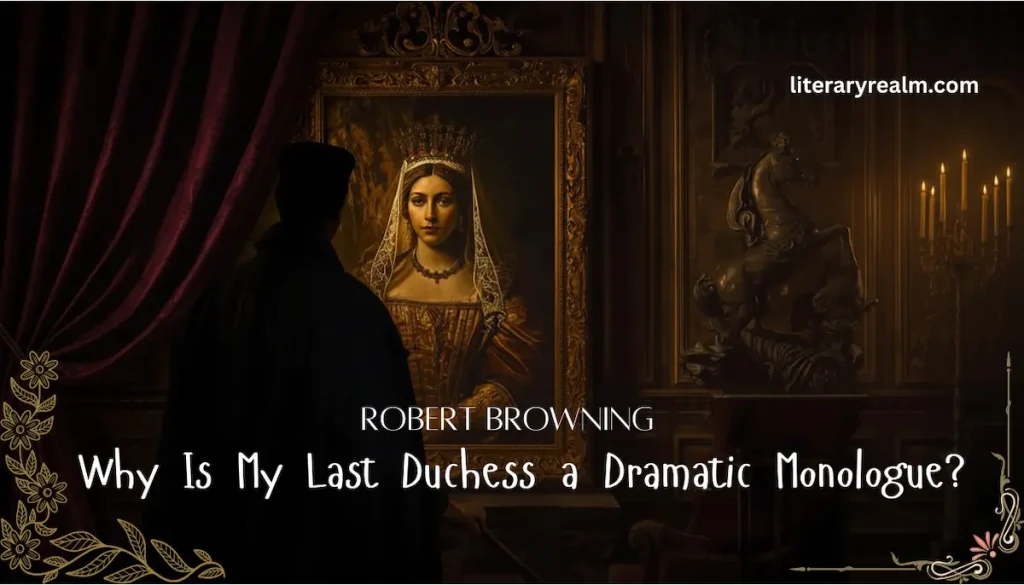
At its core, My Last Duchess is not merely about a Duke describing a portrait—it is a carefully constructed dramatic performance. The Duke of Ferrara speaks to an envoy while negotiating a marriage, but in doing so, he exposes far more than he intends. His words gradually uncover his authoritarian nature, jealousy, and disturbing sense of control.
This article argues that My Last Duchess perfectly embodies the dramatic monologue form through three essential elements: a dominant single speaker, a silent listener, and the powerful psychological revelation that emerges from seemingly casual conversation. By examining these aspects closely, we can better understand why this poem remains a definitive example of the genre.
What Is a Dramatic Monologue?
A dramatic monologue is a highly specialized poetic form that gained prominence during the nineteenth century, particularly within Victorian Literature. It is characterized by a single speaker addressing a silent listener in a clearly defined dramatic situation. The speaker’s speech, while directed outward, ultimately reveals their inner thoughts, emotions, and moral disposition.
One of the defining features of a dramatic monologue is the presence of a single, controlling voice. The speaker dominates the poem entirely, with no narrative intervention or external commentary. This uninterrupted speech creates a sense of immediacy and realism, allowing readers to engage directly with the speaker’s perspective.
Equally important is the silent listener, whose presence is implied rather than expressed. Although the listener does not speak, their role is crucial in shaping the monologue’s direction and tone. The speaker often adjusts their language, tone, and content in response to the listener’s anticipated reactions, thereby creating a dynamic, interactive, dramatic context.
Another essential feature is the specific dramatic situation. The poem typically unfolds at a critical moment, such as a confession, argument, or negotiation. This context provides the framework for gradually revealing the speaker’s personality and intentions.
Perhaps the most significant aspect of a dramatic monologue is its emphasis on psychological depth. The speaker often exposes their true nature unintentionally. What they say—and how they say it—allows readers to infer underlying traits such as pride, insecurity, or moral corruption.
Robert Browning is widely regarded as a master of this form. His dramatic monologues, including My Last Duchess, are celebrated for their ability to combine formal structure with intense psychological insight, making them enduring works of literary analysis and critical study.
Why Is My Last Duchess a Dramatic Monologue?
Why is My Last Duchess a dramatic monologue? The poem qualifies as a dramatic monologue because it perfectly fulfills the essential criteria of the form: a single, dominant speaker; an implied silent listener; a clearly defined dramatic situation; and a powerful psychological revelation that emerges through speech. Written by Robert Browning, the poem stands as a model example of how structure and character merge to create dramatic intensity.
First and foremost, the poem features a single speaker—the Duke of Ferrara—who controls the entire narrative. From the opening line to the closing image, the Duke’s voice dominates without interruption. There is no external narrator to guide interpretation. Instead, readers must rely entirely on what the Duke says and how he says it. This uninterrupted speech is a defining feature of the dramatic monologue, allowing Browning to present the Duke’s personality in a raw, unfiltered manner.
Secondly, the presence of an implied listener—the envoy—is crucial. The Duke is not speaking into a void; he is addressing a representative of a Count whose daughter he intends to marry. Although the envoy never speaks, his presence is subtly indicated through the Duke’s polite gestures and persuasive tone, such as “Will’t please you sit and look at her?” and references to “your master’s known munificence.” These brief phrases reveal that the Duke is consciously performing, tailoring his speech to impress and negotiate.
The third key element is the dramatic situation, which unfolds during a marriage negotiation. The Duke is showcasing a portrait of his late Duchess while discussing the terms of a future alliance. This setting is not neutral—it is loaded with social and political implications. As the Duke moves from art appreciation to personal history, the conversation becomes increasingly unsettling. The casual shift from aesthetic admiration to the chilling phrase “I gave commands” reveals the underlying tension of the situation.
Most importantly, the poem exemplifies psychological revelation, the hallmark of a dramatic monologue. The Duke unintentionally exposes his inner character through his own words. His repeated emphasis on status—such as his “nine-hundred-years-old name”—reveals deep-seated pride. His irritation at the Duchess’s innocent behavior, like her appreciation of simple gifts or smiles at others, exposes his jealousy and insecurity. He expects absolute control and cannot tolerate what he perceives as disrespect.
Crucially, the Duke never explicitly confesses wrongdoing. Instead, readers infer his guilt and moral corruption from subtle clues. His calm tone when discussing the Duchess’s fate, combined with his immediate shift to the dowry arrangements, highlights his emotional detachment and manipulative nature.
Through these elements—a single speaker, a silent listener, a charged dramatic situation, and profound psychological exposure—My Last Duchess fully embodies the characteristics of a dramatic monologue. Browning’s craftsmanship ensures that the poem is not just a narrative but a dramatic performance in which meaning emerges indirectly, making it one of the most compelling examples of the form in English literature.
Key Features of Dramatic Monologue in My Last Duchess
1. The Dominant Speaker
One of the most striking features of My Last Duchess is the dominance of the Duke’s voice. As the sole speaker, he controls not only the content of the conversation but also its tone and direction. Every detail we learn about the Duchess, the setting, and the situation is filtered through his perspective.
This narrative control reflects the Duke’s personality. He carefully selects what to reveal and how to present it, attempting to maintain an image of sophistication and authority. However, this control is ultimately illusory. While he believes he is managing the narrative effectively, his speech reveals contradictions and moral flaws that undermine his self-presentation.
Browning uses this technique to demonstrate how a dominant speaker can inadvertently expose more than intended. The Duke’s authority over language mirrors his desire for control in life, making his voice both powerful and self-incriminating.
2. The Silent Listener
The presence of a silent listener is another defining characteristic of the dramatic monologue. In this poem, the envoy plays a crucial but indirect role. Although he never speaks, his presence significantly shapes the Duke’s speech.
The Duke’s politeness, formal tone, and strategic references to wealth and status suggest that he is trying to impress and persuade. Phrases like “Will’t please you rise?” indicate moments where the Duke responds to the listener’s physical or implied reactions.
This silent interaction creates a sense of realism and dramatic tension. Readers become active participants, interpreting both the Duke’s words and the listener’s implied responses. The absence of the envoy’s voice makes the Duke’s revelations even more striking, as there is no counterargument or interruption to challenge his perspective.
3. Psychological Exposure
A central feature of the dramatic monologue is the gradual revelation of the speaker’s inner self. In My Last Duchess, the Duke unintentionally exposes his psychological complexity through his speech.
At first, he appears refined and cultured, discussing art and aesthetics. However, as he continues, darker aspects of his personality emerge. His irritation at the Duchess’s “too soon made glad” attitude reveals his insecurity. His emphasis on rank and heritage highlights his arrogance. Most disturbingly, his casual reference to “I gave commands” suggests a capacity for cruelty and violence.
This indirect method of characterization is what makes the poem so powerful. Rather than telling readers what to think, Browning helps them to draw conclusions based on the Duke’s own words. The result is a deeply engaging and unsettling psychological portrait.
4. Dramatic Context
The poem’s dramatic context enhances its effectiveness as a monologue. The setting—an art gallery within the Duke’s palace—serves as more than just a backdrop. It symbolizes control, display, and possession.
The Duke treats the Duchess’s portrait as an object he can reveal or conceal at will, drawing a curtain to control who sees it. This act mirrors his approach to relationships, where control and ownership take precedence over emotional connection.
Simultaneously, the ongoing marriage negotiation adds another layer of tension. The Duke is not merely reminiscing; he is strategically presenting himself to secure a new alliance. This dual context—art appreciation and political negotiation—creates a rich and complex dramatic situation that reinforces the poem’s status as a dramatic monologue.
Character Analysis of the Duke
The Duke of Ferrara, the central figure in My Last Duchess, is one of the most intricately constructed characters in Victorian poetry. Through the dramatic monologue form, Robert Browning presents a character defined by arrogance, possessiveness, and manipulation, offering a subtle yet powerful critique of aristocratic values.
At the core of the Duke’s personality is arrogance. He is deeply conscious of his social status and lineage, as seen in his reference to his “nine-hundred-years-old name.” This pride is not merely personal but institutional, reflecting the hierarchical values of Renaissance aristocracy. He believes that his rank entitles him to absolute respect and obedience, and any deviation from this expectation is perceived as a personal affront.
Closely linked to his arrogance is his possessiveness. The Duke views the Duchess not as an individual with her own thoughts and emotions, but as an extension of his status. Her ability to find joy in simple pleasures—such as a sunset or a courteous gesture—disturbs him because it suggests independence. He desires exclusive control over her expressions of gratitude and affection.
This possessiveness extends beyond life into art. The portrait becomes a controlled version of the Duchess, no longer challenging his authority. By keeping the painting behind a curtain that only he can draw, the Duke asserts complete dominance over her image and memory.
The Duke is also profoundly manipulative. His speech is carefully constructed to achieve specific goals. He presents himself as cultured and reasonable, discussing art and etiquette, while subtly conveying his expectations for the future marriage. His ability to shift seamlessly from his late wife to dowry negotiations reveals a calculated, strategic mindset.
Importantly, the Duke’s character reflects the values of Renaissance aristocracy, where power, lineage, and control were paramount. However, Browning, writing in the Victorian era, uses this historical setting to offer a subtle critique. The Duke’s extreme behavior exposes the dangers of unchecked authority and rigid social hierarchies.
Rather than explicitly condemning the Duke, Browning allows his character to reveal his own flaws. This indirect critique is more effective because it engages readers in the interpretive process. The Duke’s calm, measured tone contrasts sharply with the implications of his words, creating a sense of dramatic irony.
Ultimately, the Duke embodies the darker aspects of power and control. Through the dramatic monologue, Browning transforms him into a compelling study of human psychology, making My Last Duchess not only a masterpiece of form but also a profound exploration of character.
Themes Supporting the Dramatic Monologue Form
The effectiveness of My Last Duchess as a dramatic monologue is not limited to its structure; it is significantly reinforced by its central themes. These themes—power and control, jealousy, art versus reality, and patriarchal dominance—are not merely thematic concerns but active forces that shape the Duke’s speech and deepen the monologue form. Through them, Robert Browning intensifies psychological revelation and dramatic tension.
The theme of power and control is foundational. The Duke’s monologue is, in essence, an assertion of authority. He controls the conversation, the narrative, and even the visibility of the Duchess’s portrait by drawing the curtain himself. This desire for control is mirrored in the monologue form, where a single speaker dominates without interruption. His language reflects ownership and command, suggesting that both art and human relationships are subject to his will.
Closely connected is the theme of jealousy, which operates subtly yet powerfully within the Duke’s speech. His dissatisfaction with the Duchess stems from her “too soon made glad” nature—her tendency to appreciate simple pleasures and show kindness to others. This jealousy is not expressed as emotional vulnerability but as irritation masked by aristocratic pride. The dramatic monologue allows readers to detect this insecurity indirectly, as the Duke himself never openly admits it.
The theme of art versus reality further strengthens the dramatic structure. The Duke prefers the painted version of the Duchess because it is fixed, silent, and controllable. In contrast, the real Duchess was spontaneous and free-spirited. This contrast reflects the nature of the monologue itself: a constructed narrative that seeks to shape reality through the speaker’s perspective. The Duke’s admiration for the portrait reveals his preference for control over authenticity.
Finally, patriarchal dominance underpins the entire poem. The Duke embodies a social system in which women are expected to be obedient and submissive. His inability to tolerate the Duchess’s individuality highlights the oppressive nature of this system. The monologue becomes a vehicle through which this dominance is both exercised and exposed. While the Duke believes he is presenting a reasonable account, readers perceive the imbalance of power and its consequences.
Together, these themes deepen the dramatic monologue by aligning form with content. The Dukes’ need for control, his jealousy, and his adherence to patriarchal values are not just ideas—they are enacted through his speech. This integration of theme and form is what makes the poem so compelling and enduring.
Literary Techniques Used by Browning
Robert Browning employs a range of sophisticated literary techniques in My Last Duchess to enhance its effectiveness as a dramatic monologue. These techniques—particularly irony, enjambment, iambic pentameter, and conversational tone—work together to create a sense of realism while simultaneously revealing the complexities of the Duke’s character.
One of the most significant techniques is irony, which operates at multiple levels. The Duke presents himself as a cultured, refined aristocrat with a deep appreciation for art. However, his speech reveals a starkly different reality. His casual reference to “I gave commands” suggests a capacity for cruelty that contradicts his polished exterior. This contrast between appearance and reality creates dramatic irony, where readers understand more than the speaker intends to reveal. It is a crucial element that drives both interpretation and critical analysis.
Enjambment is another key device that contributes to the poem’s natural flow. Browning frequently allows sentences to run over multiple lines without pause, mimicking the rhythms of spontaneous speech. This technique prevents the poem from sounding overly rigid despite its formal structure. It also reflects the Duke’s attempt to maintain control while speaking fluidly, revealing his thoughts in a continuous, almost unfiltered manner.
The use of iambic pentameter provides a structural foundation for the poem. Each line follows a rhythmic pattern of unstressed and stressed syllables, creating a sense of order and discipline. However, Browning skillfully manipulates this meter to avoid monotony. The rhythm’s regularity mirrors the Duke’s controlled demeanor, while subtle variations suggest underlying tension and instability.
Equally important is the monologue’s conversational tone. Despite its poetic form, the Duke’s speech feels remarkably natural and direct. He uses polite expressions, rhetorical questions, and topic shifts that resemble real conversation. This tone enhances the poem’s dramatic realism, making the situation more immediate and believable.
Together, these techniques reinforce the illusion of a real-life interaction while simultaneously exposing the psychological depth of the speaker. Browning’s mastery lies in his ability to combine formal precision with conversational ease, ensuring that the poem remains both structurally sound and emotionally compelling.
Critical Interpretation
Psychological Reading
From a psychological perspective, the Duke in My Last Duchess functions as an unreliable narrator. Although he appears composed, articulate, and rational, his speech reveals deep-seated instability and moral distortion. He carefully constructs a narrative to justify his actions, yet subtle inconsistencies expose his flawed reasoning.
The Duke’s emphasis on control—over the Duchess, the portrait, and even the conversation—suggests a compulsive need for dominance. His irritation at the Duchess’s harmless gestures indicates insecurity rather than justified grievance. Because the dramatic monologue allows only his voice to be heard, readers must interpret the truth indirectly, reading between the lines of his polished but revealing speech.
This psychological complexity is precisely what makes the poem so effective. The Duke does not openly admit guilt; instead, his calm tone and selective storytelling create a chilling contrast with the implications of his words. His unreliability invites readers to become active interpreters, a hallmark of Browning’s technique.
Feminist Perspective
From a feminist standpoint, the poem highlights the objectification and silencing of women within a patriarchal system. The Duchess, though central to the narrative, never speaks. Her identity is entirely mediated through the Duke’s perspective, reducing her to an object of display and control.
The Duke’s dissatisfaction stems from the Duchess’s independence—her ability to appreciate simple pleasures and interact freely with others. Rather than valuing these qualities, he interprets them as a failure to prioritize himself above all else. This reflects a broader societal expectation that women should be submissive and defined by their relationships to men.
The transformation of the Duchess into a portrait further reinforces this objectification. In art, she becomes passive, silent, and permanently controlled. The Duke’s pride in displaying the painting underscores his desire to possess not only her image but also her identity.
Through this lens, Robert Browning subtly critiques patriarchal authority by exposing its consequences. The dramatic monologue becomes a powerful element for revealing the imbalance of power between genders.
Historical Context
The poem is set in the Italian Renaissance, a period characterized by strong aristocratic hierarchies and an emphasis on lineage, wealth, and power. The Duke’s references to his “nine-hundred-year-old name” reflect the importance of social status during this time.
However, Browning wrote during the Victorian era, a period marked by increasing concern with morality, individual responsibility, and social reform. By placing a morally ambiguous character in a Renaissance setting, Browning creates a critical distance that allows readers to examine issues of power and ethics more objectively.
This dual context enriches the dramatic monologue. The Duke embodies Renaissance values of dominance and control, while Victorian readers—and modern audiences—are encouraged to question and critique those values. The result is a layered interpretation that bridges historical periods and deepens the poem’s significance.
Why This Poem Is a Perfect Dramatic Monologue
My Last Duchess stands as a perfect dramatic monologue because it integrates all the essential structural and thematic elements of the form with exceptional precision. Written by Robert Browning, the poem demonstrates how a single voice can carry an entire narrative while simultaneously revealing complex psychological and social dynamics.
At the structural level, the poem fulfills every criterion of a dramatic monologue. It features a single, dominant speaker whose uninterrupted voice shapes the entire text. The presence of a silent listener creates a dynamic interaction, even in the absence of dialogue. The dramatic situation—a marriage negotiation—provides a clear and compelling context that drives the conversation forward.
What truly sets the poem apart, however, is its mastery of psychological revelation. The Duke unintentionally exposes his arrogance, jealousy, and need for control through his own words. This indirect characterization is far more impactful than an explicit description, as it engages readers in the interpretive process.
The poem’s uniqueness lies in its subtlety. There is no overt moral judgment, no dramatic climax in the traditional sense. Instead, tension builds gradually as the Duke’s polished exterior begins to crack, revealing darker truths. This restrained approach enhances the monologue’s realism and complexity.
When compared to other dramatic monologues by Robert Browning, such as Porphyria’s Lover, My Last Duchess stands out for its balance of form and content. While both poems explore themes of control and obsession, My Last Duchess achieves a higher level of sophistication through its social context and nuanced characterization.
Ultimately, the poem exemplifies the dramatic monologue by transforming a seemingly simple speech into a rich exploration of character, power, and morality. Its structural precision, thematic depth, and psychological insight make it not only a defining example of the form but also a timeless work of literary art.
Conclusion
Why Is My Last Duchess a Dramatic Monologue? The answer becomes unmistakably clear when we consider how seamlessly Robert Browning integrates structure, voice, and psychology in My Last Duchess. The poem exemplifies the dramatic monologue form through its single, commanding speaker, the implied presence of a silent listener, and the gradual yet powerful revelation of character.
What makes the poem particularly remarkable is its structural brilliance. Browning does not rely on external narration or overt explanation. Instead, he allows the Duke’s controlled speech to carry the entire weight of the narrative. The carefully constructed dramatic situation—an art viewing intertwined with a marriage negotiation—creates a layered context in which meaning unfolds naturally and persuasively.
Equally compelling is the poem’s psychological depth. The Duke’s personality is not described; it is revealed through his own words. His pride, jealousy, and desire for control emerge subtly, making readers active participants in interpretation. This indirect method of characterization is what elevates the poem from a simple narrative to a profound psychological study.
In terms of timeless relevance, the poem continues to resonate because it explores universal themes—power, authority, gender dynamics, and the dangers of unchecked control. These concerns extend beyond the Renaissance setting and Victorian context, remaining significant in modern critical discourse.
Ultimately, My Last Duchess is not just a perfect dramatic monologue; it is a demonstration of how poetic form can illuminate the complexities of human behavior. Browning’s achievement lies in transforming a single voice into a multidimensional exploration of power and perception—an insight that continues to challenge and engage readers across generations.
Frequently Asked Questions
Why is My Last Duchess regarded as the best example of a dramatic monologue?
My Last Duchess is widely regarded as one of the finest examples of a dramatic monologue because it combines all the defining elements of the form: a single speaker, a silent listener, a dramatic situation, and psychological self-revelation. Robert Browning uses the Duke’s uninterrupted speech to expose his personality without direct authorial commentary, making the poem a model of Victorian dramatic monologue.
Who is the silent listener in My Last Duchess?
The silent listener in My Last Duchess is an envoy representing a Count whose daughter is being considered for marriage to the Duke. Although the envoy never speaks, his presence shapes the Duke’s language, tone, and behavior. This implied listener is essential because it creates a realistic dramatic situation and encourages readers to infer meaning from the Duke’s responses.
How does Robert Browning reveal the Duke’s true character?
Robert Browning reveals the Duke’s true character indirectly through his speech rather than through narration. As the Duke discusses his late wife and her portrait, he unintentionally exposes his arrogance, jealousy, possessiveness, and desire for control. This technique allows readers to judge the Duke based on his own words, making the characterization more powerful and psychologically convincing.
Why doesn’t Browning directly tell readers that the Duke is guilty?
Browning avoids directly stating the Duke’s guilt because the dramatic monologue relies on inference rather than explicit explanation. Readers gradually piece together clues from the Duke’s language, tone, and behavior, especially his statement that he “gave commands.” This indirect approach creates suspense, encourages critical thinking, and makes the psychological impact of the poem more effective.
What makes My Last Duchess different from other dramatic monologues?
Unlike many dramatic monologues, My Last Duchess combines psychological depth with social criticism. The poem explores the Duke’s mind while also examining themes such as power, patriarchy, class, and artistic control. Its subtle characterization, layered symbolism, and dramatic tension have made it one of the most influential dramatic monologues in English literature.
What is the most important point to remember about My Last Duchess as a dramatic monologue?
The most important point is that the poem reveals the Duke’s personality through his own speech rather than through direct description. While he believes he is presenting himself as dignified and cultured, his words expose his insecurity, obsession with authority, and moral corruption. This indirect psychological revelation is what makes My Last Duchess a classic dramatic monologue and a masterpiece of Victorian poetry.