
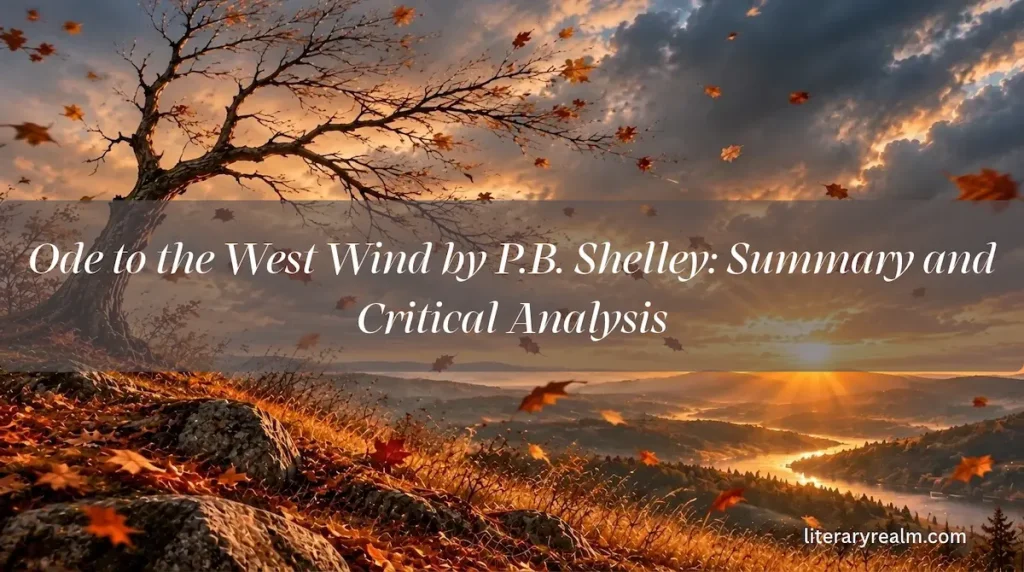
Percy Bysshe Shelley wrote Ode to the West Wind in autumn 1819 and published it in 1820. In it, the speaker addresses the autumn wind as a powerful spirit that drives away dead leaves and carries seeds to safety, and he asks it to lift him from despair and spread his words across the world. This guide gives the background, a canto-by-canto summary and analysis (stanza by stanza), themes, symbols, imagery, structure and a critical appreciation, followed by answers to common questions.
Background and Context of Ode to the West Wind
Shelley wrote Ode to the West Wind in the autumn of 1819 in a wood by the River Arno, near Florence, Italy. It was first published in 1820 in his collection Prometheus Unbound, with Other Poems. In a note added to the poem, Shelley explains that he began it on a day when a stormy wind was gathering the vapours that bring the autumn rains. At sunset, a violent storm of hail and rain, with thunder and lightning, broke out.
The year had been hard for him. His young son William died in June 1819, a few months before he began the poem, and some readers link the grief and exhaustion of Canto 4 to that loss. Shelley was also living in exile, having left England, but he followed events at home closely.
On 16 August 1819, soldiers charged a crowd of tens of thousands who had gathered in Manchester to demand parliamentary reform. The event became known as the Peterloo Massacre. When the news reached Shelley in Italy, he wrote the political poem The Mask of Anarchy in response. It was not published until 1832, ten years after his death. The Ode is not about Peterloo, but it comes from the same year and the same belief that change is needed, so readers often connect the two.
Canto-by-Canto Summary and Analysis of Ode to the West Wind
The poem Ode to the West Wind is divided into 5 cantos; each canto has 14 lines, made up of five stanzas for a total of 70 lines. Throughout the poem, Shelley personifies the west wind and shows how it destroys and preserves nature. The west wind blows away autumn’s dead leaves, and after winter passes, spring brings nature back to life. Similarly, Shelley suggests that for new ideas to grow, old ones must be cleared away.
Canto 1 (Stanza 1-5)
Summary: O wild west wind, you’re the breath of Autumn. Unseen, you drive the dead leaves away like ghosts fleeing from an enchanter. Those leaves are dead, coloured yellow, black, pale, feverish red, like crowds struck by plague. You carry the winged seeds to their dark wintry bed, where they lie cold and low, each like a corpse in its grave. They stay there until your sister, the spring wind, blows her trumpet over the dreaming earth and drives the sweet buds out like flocks to feed on the air. Nature feels alive again, with beautiful colours and the pleasant smell of flowers. Wild spirit, you’re moving everywhere; you’re the “Destroyer and preserver.” Oh! Please listen!
Analysis: The speaker calls the wind “wild” because it is strong and uncontrollable. It is unseen, so we only know it by what it does to the leaves. It is a destroyer because it drives the dead leaves away, and a preserver because it carries the seeds to safety. The seeds look like corpses, but they are only dormant, waiting for spring. So winter stands for death and decay, and spring for rebirth. Shelley uses similes (leaves like ghosts, seeds like corpses, buds like flocks) and personification, turning the wind into a spirit and the spring wind into its sister. The direct address to the wind, called apostrophe, makes the poem sound like a plea from the first line.
Canto 2 (Stanza 1-5)
Summary: Now you move to the sky. Just as you drove the dead leaves across the ground, you drive loose clouds across the sky, as if they were leaves shaken from a tree made of sky and sea. These clouds carry rain and lightning, like messengers announcing a storm. They stream out from the horizon to the top of the sky like the wild hair of a Maenad, a frenzied female follower of the god Dionysus in Greek myth. You are the funeral song of the dying year. As night falls, the gathered clouds will form a huge dome over the earth, like the roof of a giant tomb, and black rain, fire and hail will burst from it. Oh, hear!
Analysis: In Canto 2, the speaker moves the wind’s power from the earth to the sky. Comparing the clouds to dead leaves is a simile, and it shows that the wind sweeps the sky the same way it swept the ground. Calling the sky and ocean a tree whose “boughs” shed clouds is a metaphor. The clouds as “angels of rain and lightning” are personified as messengers of the wind. The Maenad simile gives the storm a wild, frenzied energy. The dirge and the sepulchre suggest death, as the year ends. But the storm also brings rain, which can be read as preparing for renewal. The canto ends with “oh hear!”, an apostrophe that repeats the plea from Canto 1.
Canto 3 (Stanza 1-5)
Summary: Now you move to the sea. You wake the Mediterranean from its summer dreams. It has been lying calm, rocked by its own currents, beside an island of pumice (light volcanic rock) in the bay of Baiae, near Naples. In its sleep it sees old palaces and towers trembling under the water, covered in blue moss and flowers so sweet that the senses grow faint imagining them. Then you cross the Atlantic, and its waters split into deep chasms along your path. Far below, the sea-flowers and the muddy underwater woods, with their sapless leaves, hear your voice, turn grey with fear, tremble, and shed their leaves. Oh, hear!
Analysis: In Canto 3, the wind’s power reaches the sea, so the poem has now covered earth, sky and ocean. The Mediterranean is a peaceful, dreamy picture, and the Atlantic is a violent one, so the wind can both wake something gently and terrify it. The underwater plants shedding their leaves repeat the leaf image from Canto 1, which shows that the wind’s effect reaches even the bottom of the sea. Shelley treats the Mediterranean as a sleeping man who dreams, which is personification, and he gives the sea-plants fear in the same way. The colour imagery (blue, azure, grey) separates the calm sea from the frightened one. Some readers see the contrast between calm and upheaval as a sign that even what looks peaceful is under the wind’s power. The canto ends with the same plea as Cantos 1 and 2, “oh, hear!”, an apostrophe.
Canto 4 (Stanza 1-5)
Summary: If I were a dead leaf, you could carry me. If I were a swift cloud, I could fly with you. If I were a wave, I could pant beneath your power and share your strength, only a little less free than you, O uncontrollable one! If I were still as I was in my boyhood, able to travel beside you across the sky, when outrunning you hardly seemed impossible, I would never have had to plead with you like this in my need. Oh, lift me as a wave, a leaf, a cloud! I fall upon the thorns of life; I bleed! A heavy weight of hours has chained and bowed someone who was once like you: untamed, swift and proud.
Analysis: After three cantos about the wind’s power, Canto 4 turns to Shelley himself, and the mood changes from awe to vulnerability. The first three cantos address the wind (“Thou”), but this one begins with “If I were,” which puts the speaker at the centre. He wishes to share the wind’s freedom, and his wish to be a leaf, a cloud and a wave echoes the earth, sky and sea of the earlier cantos. He remembers being as free and proud as the wind in his youth, and now he feels chained and bowed by the weight of time. “Thorns of life” is a metaphor for life’s pain, and “O uncontrollable” and “oh, lift me” are apostrophe.
Canto 5 (Stanza 1-5)
Summary: Make me your lyre, as the forest is. Even if my leaves are falling like its own, the storm of your music will give us both a deep autumn tone, sweet even in its sadness. Be my spirit, fierce one; be me, forceful one! Drive my dead thoughts across the universe like withered leaves, so that a new life can begin. Let my verse work like a spell, scattering my words among people the way a fire that has not died scatters ashes and sparks. Through my lips, be the trumpet of a prophecy to the sleeping earth. O Wind, if winter comes, can spring be far behind?
Analysis: In Canto 5, the speaker asks the wind to become part of him, and the poem moves from a plea to a prophecy. The wind plays the forest like an instrument, and the speaker asks to be played the same way. His falling leaves match the forest’s, so his sadness and the wind’s music can blend. The “dead thoughts” scattered as withered leaves bring back the leaf image from Canto 1, and “new birth” echoes the seeds waiting for spring. This suggests that old ideas must be cleared away so new ones can grow. The “trumpet of a prophecy” recalls the spring wind’s trumpet in Canto 1, which links the poet to the season that wakes the earth. Shelley uses metaphor (the lyre, the ashes and sparks, the trumpet), simile (thoughts like withered leaves) and apostrophe (“O Wind”). The poem ends on a rhetorical question, which doesn’t need an answer because it states the hope that winter will give way to spring. Because the poem has faced decay, storm and despair, that hope doesn’t feel naive.
Major Themes in Ode to the West Wind
These are the poem’s main themes, each explained in context in the canto sections above.
- Power of nature: The wind rules the earth, sky and sea, and nothing escapes it (Cantos 1-3).
- Destruction and rebirth: Decay clears the way for new life, as the driven leaves make room for the seeds that wake in spring (Canto 1).
- Human suffering: Next to the wind’s freedom, the speaker feels weighed down by time and pain (Canto 4).
- Freedom and change: The speaker longs to be as free as the wind, and many readers also see a wish for political change behind its force (Cantos 4 and 5).
- Hope: The poem ends by asking whether spring can be far behind winter, which expresses faith that hard times pass (Canto 5).
Symbolism in Ode to the West Wind
- The west wind: A spirit of change, both destroyer and preserver, and a source of inspiration the speaker wants to share (Cantos 1 and 5).
- Dead leaves: Death, decay and worn-out things. In Canto 5, they become the speaker’s own “dead thoughts.”
- Winged seeds: Hidden life and hope, lying low through winter until spring wakes them (Canto 1).
- The seasons: Autumn and winter stand for decay and death, and spring stands for rebirth.
- The lyre: The poet as an instrument played by the wind, like a wind harp (Canto 5).
- Ashes and sparks: Words and ideas scattered to spread and take hold, like sparks from a fire that has not died out (Canto 5).
- The trumpet: A call to wake up, first the spring wind’s clarion (Canto 1), then the poet’s prophecy (Canto 5).
Structure, Form and Poetic Devices
Terza Rima and the Five-Part Structure
Ode to the West Wind is an ode, a formal poem addressed to something, and the word comes from the Greek for “song.” It has five parts, called cantos, and each canto has 14 lines, so the poem has 70 lines in all. Each canto is made of four three-line stanzas followed by a rhyming couplet, and the lines are written in iambic pentameter. The fourteen lines make each canto resemble a sonnet.
The rhyme scheme is terza rima, the interlocking pattern Dante used in the Divine Comedy: aba bcb cdc ded ee. The middle line of each stanza supplies the rhyme for the next, so the stanzas link together like a chain. This gives the poem a feeling of constant forward motion, like the wind itself, and the closing couplet gives each canto a firm ending.
The five cantos also follow a clear path. The first three follow the wind over the earth, the sky and the sea. The fourth turns to the speaker’s own pain, and the fifth is a prayer to the wind.
Personification and Apostrophe
Throughout the poem, Shelley speaks directly to the wind (apostrophe) and treats it as a living being (personification). He calls it a “wild Spirit,” gives it a sister in the spring wind, and writes of its “voice.” The first three cantos each end with the same plea, “hear,” as if the speaker is calling to a listener who may not answer. In Canto 5, the address changes from a call into a request for union: “Be thou me, impetuous one!” These devices make the poem feel like a prayer or a spell instead of a description.
Imagery
The poem’s images follow the wind from place to place: leaves and seeds on the earth (Canto 1), storm clouds in the sky (Canto 2), the Mediterranean and the Atlantic (Canto 3), the speaker’s own bleeding, chained body (Canto 4), and fire, ashes and sparks (Canto 5). Colours carry mood: yellow, black, pale, and feverish red in the dying leaves; blue and azure in the sea’s dream; and grey in the plants’ fear. Many images pair death with renewal, such as seeds like corpses that will wake, or dead thoughts that bring “a new birth.”
Sound and Rhythm
Sentences in the poem run across line and stanza breaks instead of stopping at the end of each stanza. In Canto 1, a single sentence carries through its first twelve lines before the closing couplet. This keeps the rhythm sweeping, like the wind. Shelley also uses repeated sounds, as in “wild West Wind.”
Political and Philosophical Interpretation of Ode to the West Wind
Many readers see a political meaning beneath the nature imagery. The wind that sweeps away dead leaves and splits the sea can stand for a force of change strong enough to clear away what is corrupt or worn out. This reading fits the year the poem was written. In 1819, Shelley was living in exile in Italy, and news of the Peterloo Massacre in Manchester angered him (see the Background section). The poem never mentions politics directly, so this is an interpretation, not a statement from Shelley.
The poem also makes a philosophical point: change is a natural law, and an ending can belong to a larger cycle. The speaker’s own life follows that pattern. In Canto 4, he is “chained and bowed,” but in Canto 5 he asks to be used as an instrument of renewal.
Most importantly, Shelley gives the poet a part in that change. He asks the wind to scatter his words “among mankind” and to make his voice “the trumpet of a prophecy.” In 1821, he wrote in A Defence of Poetry that “poets are the unacknowledged legislators of the world,” an idea published after his death in 1840. In the Ode, this means words can spread ideas the way the wind spreads leaves and seeds.
Romantic Elements in Ode to the West Wind
Ode to the West Wind shows several features of English Romantic poetry, beginning with its view of nature. The wind is not just scenery. It is a living spirit with power over the earth, the sky, and the sea, and the first three cantos follow it across each. The storm in Canto 2 and the splitting of the Atlantic in Canto 3 are both grand and frightening, a mix of awe and fear that Romantic writers called the sublime.
The poem also puts feeling ahead of argument. In Canto 4, the speaker talks openly about pain and weakness, and that emotion drives the poem more than any reasoned point does. This personal voice is another Romantic mark. From Canto 4 on, the “I” of the poem, one person speaking from his own experience, stands at the centre.
Finally, the poem relies on imagination. Shelley turns the wind into a spirit, gives it a sister in the spring wind, and imagines the poet as its instrument. These features make the poem a standard example of Romanticism.

Conclusion
Ode to the West Wind turns an autumn storm into a poem about change. The wind clears away what is dead while keeping what can live again, and Shelley applies that idea to nature, society, and his own exhausted spirit. By the final canto, the speaker asks to become the wind’s instrument, so that poetry can carry hope across the world. Written in the year of the Peterloo Massacre and the death of his son, the poem is both a personal cry and a call for renewal.
Frequently Asked Questions
What is the meaning of Ode to the West Wind?
Ode to the West Wind is a prayer to the autumn wind, and its meaning is symbolic. Shelley calls the wind a “destroyer and preserver”: it drives away dead leaves but carries seeds that will bloom in spring. Through this cycle, he asks for change and renewal, both for himself and for the world.
What does the west wind symbolize?
It symbolizes a force of change and the energy of inspiration. Because it both destroys and preserves, it stands for the cycles of nature. Many readers also see it as a force for political change, and in Canto 5 it becomes the creative power the poet wants to carry his words.
Why is Ode to the West Wind a Romantic poem?
It treats nature as a living, powerful spirit, and strong feeling drives the poem, especially in Canto 4. It relies on imagination to turn the wind into a spirit, and it presents the poet as an individual with a part to play. The storm scenes also show the Romantic interest in the sublime.
What is the rhyme scheme of Ode to the West Wind?
It is terza rima: aba bcb cdc ded ee. Each of the five cantos has 14 lines, made of four three-line stanzas and a closing couplet, in iambic pentameter. The interlocking rhymes link each stanza to the next, and Dante used the same pattern in the Divine Comedy.
What is the imagery in Ode to the West Wind?
The imagery moves with the wind: dead leaves and seeds (Canto 1), storm clouds (Canto 2), the sea and underwater plants (Canto 3), the poet’s bleeding, chained body (Canto 4), and fire, ashes and sparks (Canto 5). Colours such as yellow, black, azure and grey set the mood, and many images pair death with renewal.
What is the meaning of the last line, “If Winter comes, can Spring be far behind?”
It is a rhetorical question. Winter stands for hardship and decay, and spring for renewal. The line expresses Shelley’s belief that hard times, whether personal or political, will eventually give way to better ones, which shows his optimism and hope for change.