
The Victorian Age in English Literature refers to the period between 1837 and 1901, corresponding to the reign of Queen Victoria. This era was marked by rapid industrialization, scientific advancement, and significant social transformation, all of which deeply influenced literary production. As Britain evolved into a powerful industrial and imperial nation, literature became a vital medium for reflecting and critiquing these profound changes in society.
The importance of the Victorian Age in English Literature lies in its rich diversity and its role in shaping modern literary forms and concerns. It witnessed the rise of the novel as the dominant genre, offering detailed portrayals of everyday life, class struggles, and moral dilemmas. At the same time, poetry and prose explored complex emotional, philosophical, and ethical questions, often addressing the tension between tradition and progress, faith and doubt.
This article provides a comprehensive understanding of the Victorian Age in English Literature by examining its major themes, influential writers, distinctive literary styles, and key intellectual ideas. Through this exploration, readers will gain insight into how Victorian literature not only reflected its contemporary society but also contributed to ongoing discussions about human experience, morality, and social responsibility.
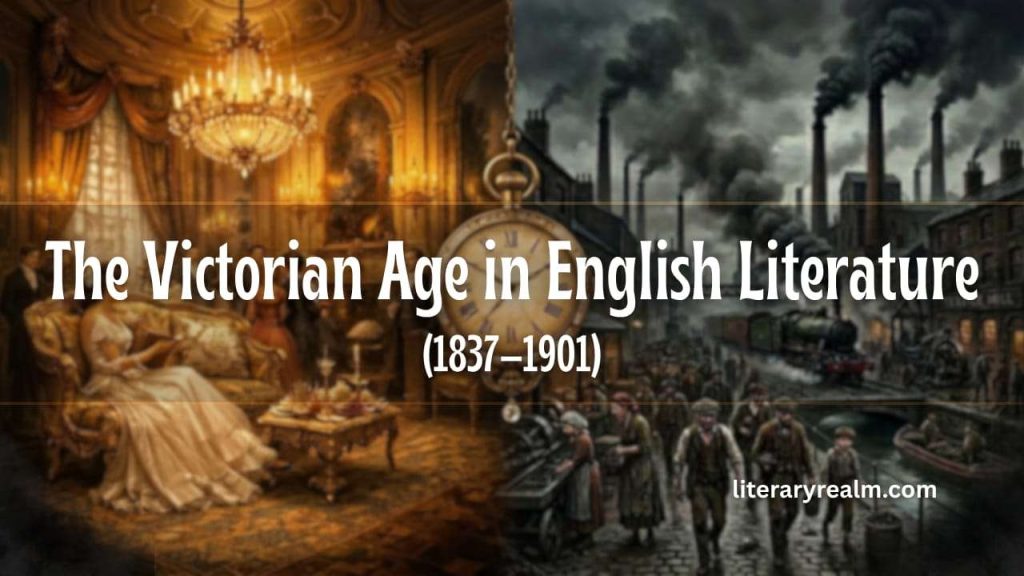
Historical Context of the Victorian Era
The historical context of the Victorian era is essential to understanding the development of literature during this period. The age coincided with the reign of Queen Victoria (1837–1901), a time marked by political stability, imperial expansion, and rapid transformation. Britain emerged as a dominant global power, and this confidence, alongside its social tensions, is clearly reflected in Victorian literary works.
Politically, Victorian Britain experienced relative stability, allowing for gradual reforms. However, socially and economically, the nation underwent dramatic change due to the Industrial Revolution. Rapid industrialization led to urbanization, the expansion of factories, and a shift from rural to urban life. While this brought economic growth, it also led to widespread poverty, overcrowded living conditions, and harsh working environments.
One of the most disturbing consequences of industrialization was child labour. Children were often employed in factories, mines, and workshops under dangerous and exploitative conditions, working long hours for minimal wages. This harsh reality became a powerful theme in Victorian literature, as writers exposed the suffering of children and criticized society’s moral failures. Such depictions not only raised awareness but also contributed to social reform movements.
Economically, the rise of capitalism supported the growth of a strong middle class, which played a significant role in shaping literary culture. Education reforms, particularly the Elementary Education Act of 1870, increased literacy rates and expanded the reading public. As a result, literature became more accessible and began to reflect middle-class values, moral concerns, and social responsibilities.
These historical developments had a direct impact on literature. Victorian writers responded to contemporary issues such as class inequality, industrial hardship, and child exploitation, using their works to critique society and explore the tension between progress and human suffering. Thus, the literature of this period serves as both a reflection of its age and a powerful instrument of social commentary.
Characteristics of Victorian Literature
The Victorian Age in English Literature is distinguished by its strong emphasis on morality, social responsibility, and realism. Writers of this period sought not only to entertain but also to instruct and reform society. Literature became a powerful medium for addressing ethical concerns, social inequalities, and the responsibilities of individuals within a rapidly changing world. As industrialization and urbanization reshaped British life, authors responded by creating works that reflected real social conditions and moral dilemmas.
Victorian literature is also notable for its complex characters and detailed descriptions. Authors paid close attention to the psychological depth of their characters, portraying individuals who struggled with internal conflicts, moral choices, and societal expectations. These characters often represent broader social types, allowing writers to explore issues such as class division, gender roles, and human suffering in nuanced, realistic ways.
Another defining feature is the dual focus on social issues and human psychology. Victorian writers were deeply concerned with external realities—such as poverty, education, and labor conditions—while simultaneously examining inner emotional and mental states. This combination gave rise to richly layered narratives that balanced social critique with personal experience.
Realism and Moral Responsibility
Realism is a central characteristic of Victorian literature. Writers aimed to depict life accurately, focusing on everyday experiences rather than idealized or fantastical elements. This realism was closely tied to a sense of moral responsibility, as authors used their works to highlight ethical issues and encourage social reform. Literature often served as a critique of injustice, urging readers to reflect on their roles within society and to uphold moral values.
Romantic vs. Victorian Literature
A key way to understand Victorian literature is by comparing it with the earlier Romantic period. Romantic writers emphasized imagination, emotion, and the beauty of nature, often focusing on individual freedom and idealism. In contrast, Victorian writers adopted a more realistic and practical approach. While they did not entirely abandon emotion, they grounded their works in the realities of contemporary life, addressing social problems and moral concerns more directly. This shift marks a movement from idealism to realism in literary expression.
Use of Symbolism and Imagery
Victorian writers made effective use of symbolism and imagery to convey deeper meanings and social commentary. Objects, settings, and characters often carry symbolic significance, representing broader themes such as industrialization, moral decay, or social progress. Through vivid imagery, authors illustrated complex ideas and evoked emotional responses, thereby enhancing the impact of their critique on society.
Major Themes in Victorian Literature
Victorian literature is defined by its engagement with the profound social, economic, and intellectual changes of nineteenth-century Britain. Writers of the era use their works to interrogate distinct themes of social class, industrialization, gender roles, and the religion-science debate, illuminating the dominant moral and philosophical anxieties that pervaded their society.
Social Criticism and Class Conflict
One of the most dominant themes in Victorian literature is social class and inequality. The rapid growth of industrial cities created a sharp divide between the wealthy and the poor, leading to widespread social injustice. Writers used literature as a tool to expose these inequalities and advocate for reform.
For instance, Charles Dickens depicts the struggles of the lower classes in works such as Oliver Twist and Hard Times, highlighting poverty, child labor, and institutional neglect. Elizabeth Gaskell, in novels like Mary Barton, presents working-class realities and labor conflicts. These works positioned Victorian literature as a tool of social criticism.
Gender and Feminism
Gender roles and the position of women form another significant theme in Victorian literature. Society during this period largely confined women to domestic roles, limiting their opportunities for education, employment, and independence. However, many writers challenged these restrictions by portraying strong, complex female characters.
Authors such as Elizabeth Gaskell and the Brontë sisters explored the struggles women faced in patriarchal society. Novels such as Jane Eyre question traditional gender expectations and emphasize a woman’s desire for autonomy and self-respect. These works contributed to early feminist discourse by highlighting inequality and advocating for greater freedom and recognition for women.
Science, Religion, and Moral Dilemmas
The Victorian era was also marked by significant intellectual conflict, particularly between religion and scientific progress. The publication of On the Origin of Species by Charles Darwin challenged traditional Christian beliefs about creation and human existence. This led to widespread uncertainty and moral questioning.
Victorian literature reflects this tension by exploring themes of faith, doubt, and ethical responsibility. Writers grappled with questions about the nature of truth, the role of religion, and the impact of scientific discovery on human values. These conflicts often appear in characters who struggle to reconcile traditional beliefs with modern knowledge.
In conclusion, the major themes of social inequality, industrialization, gender roles, and the conflict between religion and science demonstrate the depth and complexity of Victorian literature. These themes not only capture the spirit of the age but also continue to resonate with modern readers, highlighting the enduring significance of The Victorian Age in English Literature.
Prominent Victorian Writers
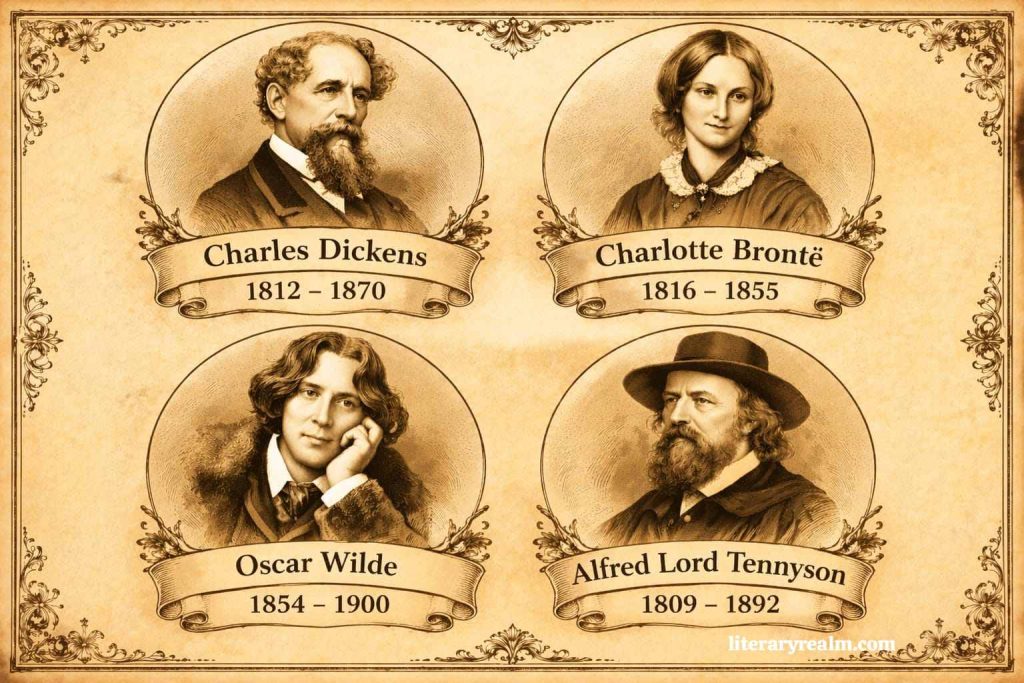
The Victorian Age in English Literature is distinguished by a group of writers whose works vividly capture the social, moral, and psychological concerns of nineteenth-century Britain. These authors not only shaped the literary standards of their time but also offered enduring insights into society and human nature. Their novels and poetry often address poverty, inequality, gender roles, and moral responsibility, blending realism with profound emotional and intellectual depth.
Charles Dickens
Dickens remains one of the most influential voices of the Victorian era, particularly known for highlighting social injustice and the struggles of the poor.
Key novels: Great Expectations, Oliver Twist
Major themes: Poverty, child labour, social reform
In Oliver Twist, Dickens powerfully captures the desperation of impoverished children with the famous plea, “Please, sir, I want some more.” Similarly, Great Expectations explores personal growth and social mobility, reflecting Victorian concerns with class, morality, and ambition.
William Makepeace Thackeray
Thackeray is celebrated for his sharp satire and critical portrayal of Victorian society. Unlike Dickens’ emotional appeal, Thackeray employs irony to highlight social vanity and hypocrisy.
Key work: Vanity Fair
Literary focus: Satire of ambition, moral corruption, and class pretension
He observes, “The world is a looking-glass, and gives back to every man the reflection of his own face,” emphasizing self-interest and superficiality in social interactions.
Brontë sisters
The Brontë sisters—Charlotte, Emily, and Anne—infused Victorian fiction with emotional intensity and an emphasis on individuality. Their works challenged social norms and explored women’s inner lives.
Key works: Jane Eyre, Wuthering Heights
Major themes: Individuality, emotional depth, feminism
In Jane Eyre, Charlotte Brontë writes, “I am no bird; and no net ensnares me,” reflecting the desire for independence. Emily Brontë’s Wuthering Heights captures a passionate connection with the line, “Whatever our souls are made of, his and mine are the same.”
Alfred Lord Tennyson & Robert Browning
Victorian poetry flourished with Tennyson and Browning, exploring emotion, morality, and psychological depth.
Literary focus: Nature, symbolism, moral reflection, psychological insight
Tennyson’s Ulysses inspires resilience with, “To strive, to seek, to find, and not to yield.” Browning’s dramatic monologues, like My Last Duchess, reveal character psychology: “I gave commands; Then all smiles stopped together.”
Thomas Hardy
Hardy’s novels often depict the tragic consequences of social structures and the indifference of fate.
Key work: Tess of the d’Urbervilles
Major themes: Fate, social injustice, human suffering
Hardy writes poignantly, “The President of the Immortals… had ended his sport with Tess,” underscoring the harsh, arbitrary forces shaping human lives.
Together, these writers reveal the depth, diversity, and moral consciousness of the Victorian Age in English Literature. Their vivid social critique and psychological insight make the era’s literature enduringly significant.
Literary Genres in the Victorian Age
The Victorian Age in English literature witnessed an extraordinary diversification of literary genres, reflecting the era’s social, cultural, and intellectual transformations. Writers experimented across novels, poetry, drama, and essays, addressing both the personal and societal challenges of their time. This period also marked the expansion of literacy and the rise of mass readership, enabling literature to reach a wider audience and gain a profound influence on public opinion.
The Rise of the Novel
The novel emerged as the dominant literary form of the Victorian era. Social realism became a key feature, as writers such as Charles Dickens and Elizabeth Gaskell explored issues of poverty, industrialization, and class divisions. Serialized publication, appearing in magazines or newspapers, made novels more accessible and created suspense that kept readers eagerly awaiting each installment. The novel’s structure enabled the authors to develop complex characters and detailed narratives, giving readers a deep understanding of human experience. Works like Great Expectations and North and South not only entertained but also prompted social reflection, making the novels powerful media for both storytelling and social commentary.
Victorian Poetry
Victorian poetry balanced narrative, lyricism, and philosophical exploration. Poets like Alfred Lord Tennyson and Robert Browning experimented with dramatic monologues and narrative poetry to examine personal dilemmas and societal issues. Tennyson’s Ulysses reflects the tension between duty and desire for adventure, while Browning’s My Last Duchess explores psychological complexity and social conventions. Victorian poetry often grappled with questions of morality, faith, and human experience, blending emotional depth with technical sophistication. The use of vivid imagery, intricate rhyme schemes, and varied meters enhanced the lyric appeal, engaging readers on both intellectual and emotional levels.
Drama and Essays
Although less prominent than novels and poetry, drama and essays played a significant role in shaping public discourse. Victorian drama often reflected moral and social concerns, highlighting conflicts within families, class structures, and gender expectations. Essays provided a platform for literary criticism, philosophical thought, and social commentary. Writers like Matthew Arnold and Thomas Carlyle used essays to influence debates on culture, religion, and education. Together, drama and essays contributed to the intellectual vibrancy of the era, encouraging reflection and dialogue among readers and audiences.
In essence, Victorian literary genres collectively mirrored the complexities of the age—balancing entertainment, moral inquiry, and social critique—establishing the period as one of the most dynamic in English literary history.
Key Literary Movements within the Victorian Era
The Victorian Age in English literature was shaped by a series of interconnected literary movements, each reflecting the 19th century’s social, cultural, and philosophical currents. While Romanticism’s lingering influence emphasized emotion and individualism, new movements like Realism, Naturalism, the Pre-Raphaelite Brotherhood, and Aestheticism responded to changing industrial, urban, and artistic landscapes. These movements collectively transformed literary expression and provided writers with diverse approaches to explore human experience.
Realism and Naturalism
Realism and Naturalism became defining movements in English literature during the Victorian Age, emphasising accurate, unembellished depictions of everyday life. Realist authors like George Eliot portrayed middle-class society with psychological depth, moral dilemmas, and social observation. Naturalism, influenced by scientific theories and determinism, presented human behaviour as shaped by environment and heredity. Writers such as Thomas Hardy examined the harsh realities of rural life and the limits of human agency, creating narratives that were both socially conscious and emotionally compelling. Through detailed characterization and vivid depiction of circumstances, these movements sought to mirror life as it truly was, engaging readers in moral reflection and social critique.
The Pre-Raphaelite Brotherhood
The Pre-Raphaelite movement, active in both art and literature, brought a renewed focus on medievalism, symbolism, and meticulous attention to detail. In English literature during the Victorian Age, Pre-Raphaelite poets like Dante Gabriel Rossetti and Christina Rossetti fused lyrical beauty with vivid imagery and emotional intensity. Their work emphasized visual and sensual detail, moral idealism, and a romanticized view of nature and history. By challenging contemporary norms of literary expression, the Pre-Raphaelites enriched Victorian literature with aesthetic experimentation and imaginative storytelling.
Aestheticism and “Art for Art’s Sake”
Late Victorian literature saw the rise of Aestheticism, promoting beauty and artistic expression as ends in themselves. Oscar Wilde epitomized this movement through his plays, essays, and novels, famously championing the philosophy of “art for art’s sake.” During the Victorian Age, Aestheticism marked a shift away from moral instruction toward the celebration of style, wit, and innovation, influencing both literary and visual arts and leaving a lasting impact on modern artistic sensibilities.
Through these movements, the Victorian Age in English literature balanced social awareness, moral inquiry, and artistic innovation, producing works that remain central to understanding 19th-century literary culture.
Legacy of Victorian Literature
The Victorian Age in English literature left a profound and lasting impact on modern literature, shaping narrative forms, thematic concerns, and literary values that continue to resonate today. Its novels, poetry, and essays introduced storytelling techniques that modern writers still draw on, including complex characterisation, social realism, and serialised narrative structures. The focus on moral dilemmas, social critique, and human psychology created a literary foundation that allows contemporary authors to explore ethical and societal questions in nuanced ways.
Victorian literature also instilled enduring themes and values. Issues such as social inequality, industrialization, gender roles, and the tension between tradition and progress remain relevant, reflecting the era’s engagement with real-world challenges. Narrative styles like the dramatic monologue, multi-perspective storytelling, and detailed descriptive writing continue to influence both fiction and poetry. The careful attention to language, imagery, and symbolism from this period set high standards for literary craft, inspiring successive generations of writers to balance artistic expression with intellectual and emotional depth.
Beyond creative writing, the Victorian Age in English literature has had a lasting effect on education and literary studies. Works by authors such as Charles Dickens, Thomas Hardy, and Alfred Lord Tennyson are standard texts in curricula worldwide, providing insight into the historical, cultural, and social contexts of the 19th century. Literary criticism, theory, and historical studies frequently draw on Victorian texts to examine narrative innovation, moral philosophy, and aesthetic evolution.
In essence, the legacy of Victorian literature endures not only in the works themselves but also in the values, techniques, and perspectives they impart. The Victorian Age in English literature remains a touchstone for understanding the development of modern narrative forms and continues to inform both literary creation and academic scholarship.
Conclusion
The Victorian Age in English literature stands as one of the most influential periods in literary history, marked by a remarkable blend of innovation, social awareness, and artistic excellence. This era produced a wealth of novels, poetry, essays, and drama that continue to shape the literary landscape today. Writers such as Charles Dickens, Alfred Lord Tennyson, Thomas Hardy, and the Pre-Raphaelites not only captured the social, moral, and emotional currents of their time but also pioneered narrative techniques and stylistic approaches that remain foundational to modern literature.
Themes explored during the Victorian era—social justice, morality, human psychology, industrialization, and the tension between tradition and progress—resonate with readers across generations. Literary movements like Realism, Naturalism, Aestheticism, and the Pre-Raphaelite Brotherhood introduced diverse perspectives and artistic philosophies, enriching both creative writing and critical study. The period’s emphasis on character development, moral inquiry, and intricate narrative structures continues to inspire authors, poets, and scholars worldwide.
For students and literature enthusiasts, the Victorian Age in English literature offers a rich field for exploration, providing insight into 19th-century society, culture, and human experience. Studying these works fosters a deeper appreciation of literary craft and historical context while encouraging reflection on contemporary issues.
In summary, the Victorian era’s literary contributions are far more than historical artifacts; they remain living documents of human thought, emotion, and imagination. By engaging with the novels, poetry, essays, and drama of this period, readers gain both intellectual enrichment and aesthetic pleasure. The Victorian Age in English literature continues to challenge, inspire, and captivate, making it an essential study for anyone seeking to understand the enduring power and relevance.