
The Renaissance Period of English Literature, which lasted from the late 1400s to the early 1600s, changed how people wrote in England. During the Tudor and early Stuart times, writers became interested in classical ideas, humanism, and new ways of creating art. While medieval literature was mostly about religion and moral lessons, Renaissance writers focused more on human experience, intelligence, and creativity.
This era introduced new styles and topics into English literature and continues to influence how people write today. From Edmund Spenser’s sonnets to William Shakespeare’s famous plays, the Renaissance has left a mark that continues to inspire writers around the world.
Historical and Cultural Context of the Renaissance in England
The Renaissance originated in Italy in the 14th century and gradually spread across Europe, reaching England by the late 15th century. Several factors influenced its arrival and development:
Political Stability and Patronage
The reign of Henry VII and later Elizabeth I brought relative political stability, which encouraged artistic and literary pursuits. The court and nobility became patrons of literature, sponsoring writers, dramatists, and poets.
Humanism and Education
The Renaissance period of English Literature was deeply influenced by humanism, a philosophy that emphasized human potential, rationality, and the study of classical texts. Universities and grammar schools expanded, increasing literacy and the spread of ideas.
Printing Revolution
In about 1440, Johannes Gutenberg invented the printing press, which changed how people shared information. In 1476, William Caxton brought this invention to England. The press made it possible to produce books more quickly and cheaply, so more people could afford them. As a result, reading became more common, and new ideas spread faster, helping learning and culture to grow.
Cultural Exchange
Travel, trade, and diplomacy with Italy, France, and other European countries introduced English writers to classical works, Renaissance philosophy, and new literary forms. This exchange made English literature and inspired experimentation.
Literary Forms During the Renaissance Period of English Literature
The Renaissance was marked by innovation in three major literary forms: poetry, drama, and prose. Each evolved significantly under the influence of humanism and classical inspiration.
1. Poetry in the Renaissance Period of English Literature
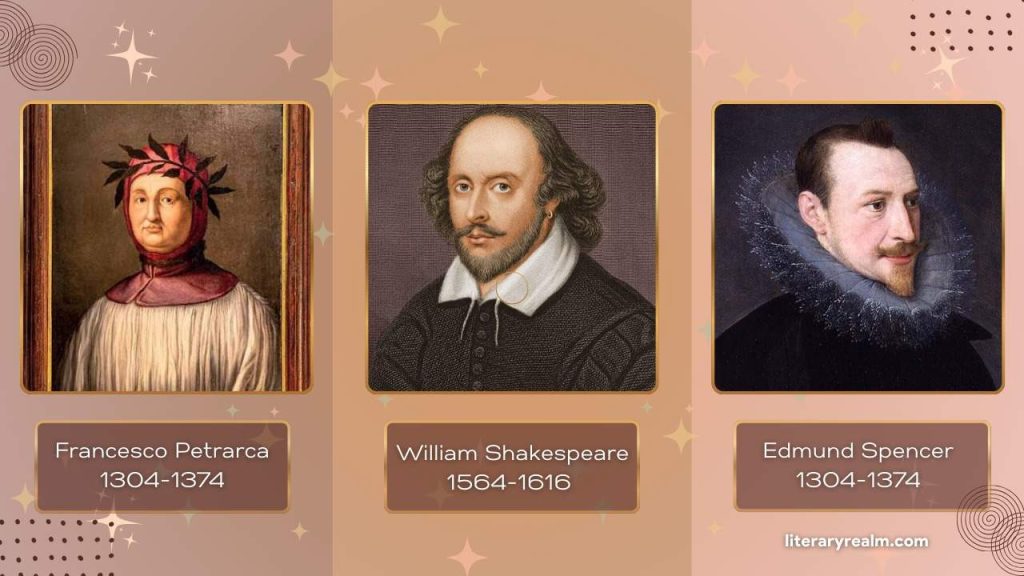
Renaissance poetry often explored personal feelings, strong emotions, and ideas from ancient writers. Several key features made poetry from this period stand out:
Development of the Sonnet
Sonnets became popular in the Renaissance after Sir Thomas Wyatt brought this form to English literature in the early 1500s. Many early English sonnets were translations of Petrarchan sonnets, which later poets changed and adapted. The sonnet was first created by the Italian poet Giacomo da Lentini and made famous by Petrarch. The word ‘sonnet’ comes from the Italian ‘sonneto,’ which means ‘little song’ or ‘little sound.’
A sonnet is a poem with 14 lines. In the Renaissance, three main types of sonnets were especially popular:
- Petrarchan Sonnet
- Shakespearean Sonnet.
- Spenserian sonnet.
Petrarchan Sonnet:This type of sonnet greatly influenced English poetry. It has 14 lines divided into two parts: an eight-line octave and a six-line sestet. The rhyme scheme gives it a musical quality, usually ABBAABBA for the octave and CDECDE for the sestet.
Shakespearean Sonnet: Sir Thomas Wyatt first introduced sonnets in England, but Shakespeare made them very popular. He wrote 154 sonnets about beauty, love, time, and mortality, often sharing his own thoughts. Shakespearean sonnets have 14 lines, arranged in three quatrains and a final couplet.
A quatrain is a group of four lines, so three quatrains means three stanzas of four lines each. A couplet is two lines that rhyme. The rhyme scheme for this sonnet is ABAB CDCD EFEF GG.
Spenserian Sonnets: Named after Edmund Spenser, these sonnets are similar to Shakespearean sonnets but have a different rhyme scheme: ABAB BCBC CDCD EE.
Allegorical and Epic Poetry
An epic poem is a long poem that tells stories about myths, history, or legends. Earlier epics focused on kings, queens, and heroes. During the Renaissance, writers revived classical styles and mixed in some medieval traditions. These poems changed from the 14th to 16th centuries and reflected the humanist ideas and cultural changes of the time.
The main themes of epic poetry during this time include national identity, chivalry, bravery, honor, loyalty, courtly love, protecting the weak, and religious conflicts. Epic poems from this period often have complex plots, heroic main characters, and supernatural elements from both Christian and Pagan traditions. These long stories are usually split into several books or sections and employ formal verse forms such as ottava rima and blank verse. Through their stories, epics explored philosophical ideas and questions.
Examples: Paradise Lost by John Milton, The Faerie Queen by Edmund Spencer, etc.
Pastoral Poetry in The Renaissance Era
Pastoral poetry is a kind of poem that focuses on nature and country life. It follows the traditions of Greek and Roman poets who admired simple country living. Pastoral poems often compare the calm countryside with the busy, sometimes corrupt city. Inspired by writers Virgil and Spenser, these poems explore themes of love, politics, and mortality.
Examples of pastoral poetry in the Renaissance period of English literature: Christopher Marlowe’s “The Passionate Shepherd to His Love” and Edmund Spenser’s The Shepheardes Calender
Metaphysical Poetry in The Renaissance Period
Metaphysical poetry was a new style that showed the intellectual depth of Renaissance English poets. It first appeared in the early 1600s. This poetry often uses extended metaphors and clever comparisons, called conceits, which compare very different things in creative ways. Metaphysical poets shared deep thoughts and philosophical ideas using wit and wordplay. Their poems often broke traditional poetry rules. Common themes include love, death, and religion.
Example: John Donne- Holy sonnets, the Flea. George Herbert- The Collar, The Pulley. Andrew Marvell- To His Coy Mistress.
2. Drama in the Renaissance Period of English Literature
Drama is one of the oldest forms of literature. During the Renaissance, a time of new beginnings, drama returned to classical styles and became very popular. It was a major source of entertainment and allowed people to discuss new ideas.
Renaissance drama developed in the 1500s and 1600s. It is usually divided into two main periods.
- Elizabethan Drama
- Jacobean Drama
Elizabethan drama, which appeared during Queen Elizabeth I’s reign, from 1558 to 1603, is known for its universal themes and its shift from religious stories to more secular topics. It explored complex characters and featured genres such as tragedy, comedy, and history. The Elizabethan period is often called the golden age of English literature.
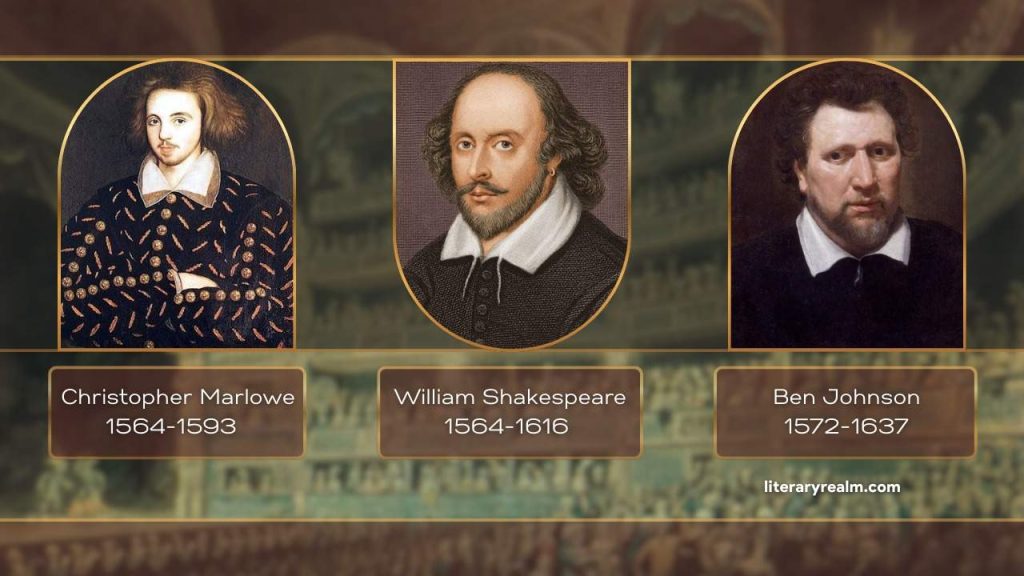
Prominent playwrights of this age are:
- William Shakespeare
- Christopher Marlow
- Ben Johnson
William Shakespeare is known as the most influential playwright of all time. He wrote 37 plays across many genres, including tragedies, comedies, histories, and romances. He created famous characters like Hamlet, Macbeth, and Othello. His plays explore themes like ambition, human nature, jealousy, and love.
Christopher Marlowe, who lived a very short life, made a huge impact on literature. His well-known plays include Doctor Faustus and Tamburlaine the Great. He often wrote about supernatural themes, power, and ambition. Marlowe also helped bring blank verse into English drama.
Ben Jonson, who was born in 1572, was an important writer of this period. He wrote both satirical plays and comedies. His literary works are Volpone and The Alchemist.
Jacobean Drama, written during the reign of James I (1603–1625), often focuses on themes of corruption, violence, and social decay. Besides Shakespeare and Ben Jonson, writers such as John Webster, Thomas Middleton, William Rowley, and John Ford also made important contributions.
In short, themes of Renaissance drama include:
- Exploration of universal themes
- Reflection of the contemporary age and tradition.
- Challenging theatrical norms that formed the structure of plays.
3. Prose in the Renaissance Period of English Literature
Prose expanded to include not only chronicles and religious texts, but also essays, letters, political writings, and philosophical works.
The Renaissance was a time when people once again became interested in classical literature and humanist ideas. Prose writing during this period began in the 14th century and continued into the 17th century. The word “prose” comes from the Latin “prosa oratio,” meaning “straightforward speech.” Prose is written in clear language that follows the flow of thought. It includes many types, such as essays, treatises, fiction, nonfiction, letters, and philosophical works.
Humanist Prose
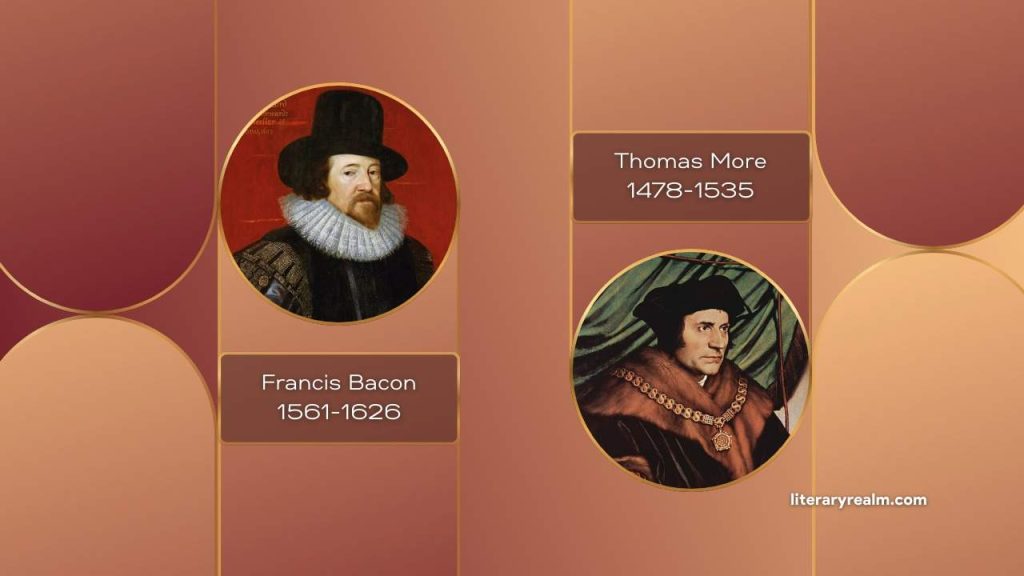
- Sir Thomas More’s Utopia explored social ideals, governance, and morality, reflecting humanist thought.
- Francis Bacon advanced the essay as a literary form by combining logic, careful observation, and moral reflection.
Translation and Exploration
Writers translated classical texts and works from other languages, making knowledge available in English. John Florio and William Caxton helped bring Renaissance ideas to English readers through their translations.
Quote Example:

Major Writers and Their Contributions
William Shakespeare (1564–1616)
- Master of tragedy, comedy, and history
- Introduced complex characters, psychological depth, and universal themes
- Innovated iambic pentameter and poetic imagery
Christopher Marlowe (1564–1593)
- Pioneer of blank verse and tragic drama
- Explored human ambition, morality, and desire
Edmund Spenser (1552–1599)
- Creator of epic allegorical poetry
- Blended classical references, morality, and imaginative narrative
Sir Thomas More (1478–1535)
- Wrote political and philosophical prose
- Advocated social reform and humanist ideals
Sir Philip Sidney (1554–1586)
- Advanced sonnet sequences and literary theory
- The Defence of Poesy argued for the moral and intellectual value of literature.
Transformative Impacts of the Renaissance Period of English Literature
Innovation in Literary Forms
The Renaissance Period of English Literature introduced a major transformation in literary form, marking a clear departure from the rigid structures of medieval writing. Influenced by classical Greek and Roman models, writers began experimenting with form, structure, and style in poetry, prose, and drama. Literature became more flexible and expressive, allowing writers to explore personal feelings and complex ideas. Poetry moved beyond religious themes, prose became clearer and more thoughtful, and drama reached new heights of artistic achievement.
This innovation can be seen most clearly in the development of new literary forms, such as:
- The sonnet allowed poets to explore love, time, beauty, and philosophical ideas within a disciplined yet expressive structure.
- The use of blank verse and soliloquy in drama gave characters psychological depth and emotional realism.
These formal advancements reshaped English literature and set enduring standards for artistic creativity.
Expansion of Themes
One of the biggest changes during the Renaissance was the new variety of themes in literature. While medieval writing mostly focused on religion and moral order, Renaissance writers looked more at the human world. Literature began to show real experiences, emotions, ambitions, and conflicts. Writers explored love as both passion and desire, and wrote about political power and personal ambition. They also examined human relationships, moral choices, and social responsibilities with more realism and understanding.
At the heart of this thematic transformation were:
- The influence of humanism, which emphasized individual experience and human potential.
- a growing interest in human psychology, including inner conflict, motivation, and ethical struggle.
This expansion of themes made literature more relatable, complex, and intellectually stimulating.
Language Enrichment
The Renaissance played a crucial role in enriching the English language, enabling it to express complex ideas with elegance and precision. Writers consciously expanded English’s vocabulary by borrowing from Latin and Greek, introducing terms related to philosophy, politics, art, and science. Literary language became more ornate and expressive, reflecting both classical learning and creative experimentation. Authors paid close attention to rhythm, imagery, and rhetorical effect, making language itself a central artistic tool. This linguistic enrichment is especially evident in:
- the increased use of metaphor, imagery, and symbolism to convey abstract ideas;
- The coinage of new words and flexible sentence structures to enhance expressive range.
As a result, English evolved into a mature literary language capable of rivaling classical traditions.
Theater as a Cultural Hub
During the Renaissance period of English literature, theater emerged as a powerful cultural and social institution, bringing literature to the public. Playhouses were popular places where people from all social classes could experience literature together. Drama was no longer confined to written texts but became a dynamic, living art shaped by performance and audience response. Plays reflected contemporary social issues, political problems, and moral debates, making theater a key place for public discussion.
The cultural importance of Renaissance theater is highlighted by:
- its communal nature, which united diverse audiences;
- Its role in addressing social and political realities through dramatic storytelling.
Through theater, literature gained immediate social influence and cultural relevance.
Foundation for Modern Literature
The Renaissance Period of English Literature laid the groundwork for modern English literary traditions. The formal experimentation, thematic depth, and human-centered perspective of Renaissance works strongly influenced later writers. Restoration dramatists drew on Renaissance drama, Romantic poets focused on emotion and imagination, and Victorian writers built on Renaissance realism and moral inquiry. The literary techniques and values from the Renaissance became lasting parts of English literature.
Its lasting influence can be traced through:
- the continued importance of complex character development;
- The integration of intellectual inquiry with artistic expression.
Thus, the Renaissance stands as a foundational era in literary history.
Intellectual Engagement
One of the biggest impacts of the Renaissance Period of English Literature was its encouragement of deep thought. Renaissance writers did not simply instruct readers on what to think; they invited them to question, analyze, and reflect. Literature became a way to explore philosophical ideas, ethical conflicts, and social rules. Writers presented ambiguous situations and conflicting viewpoints, encouraging readers to debate and think for themselves.
This intellectual depth is evident in:
- the questioning of authority, tradition, and moral certainty;
- The presentation of open-ended moral dilemmas rather than fixed conclusions.
Through this approach, literature became a powerful tool for critical thinking, aligning with the Renaissance belief in reason, knowledge, and the power of people to shape their own lives.
Conclusion
The Renaissance Period of English Literature was a pivotal era that transformed English literary culture. It brought new life to poetry, drama, and prose, introduced humanist ideas, and laid the foundation for modern English literature. Writers like Shakespeare, Spenser, and More explored human experience, expanded literary forms, and made the English language.
This period remains an important part of English literary history, demonstrating the enduring power of creativity, intelligence, and the exchange of ideas across cultures.
FAQS
What is the Renaissance Period of English Literature?
The Renaissance Period of English Literature, from the 14th to the 17th century, was a time of cultural and literary renewal in England. Writers focused on humanism, classical learning, and innovation in poetry, drama, and prose.
When did the Renaissance period begin in England?
The period started in the late 15th century, after the printing press was introduced, and continued until the early 17th century. It had a big impact on important literary works and writers.
Who were the key writers of the English Renaissance?
Key writers from this time were William Shakespeare, Christopher Marlowe, Edmund Spenser, and John Milton, who transformed English drama, poetry, and prose.
What were the main features of Renaissance literature?
Emphasis on humanism and individuality
Revival of classical Greek and Roman ideas
Innovation in literary forms such as sonnets, allegories, and blank verse
Exploration of love, nature, and human emotion
How did the Renaissance change English literature?
It introduced new literary styles, themes, and genres, encouraged creative freedom, and made literature more accessible through printed books, shaping the future of English writing.
What is the importance of the Renaissance in English literature today?
The Renaissance laid the foundation for modern English literature, inspiring generations of writers with its focus on creativity, human experience, and literary experimentation.