
Percy Bysshe Shelley, a central figure of the Romantic movement, is renowned for his lyrical mastery and philosophical insight. Ode to a Skylark, composed in 1820, is widely regarded as one of his most evocative and enduring poems. Unlike ordinary descriptions of nature, this lyrical ode blends admiration for the skylark with profound reflections on human emotion, artistic creativity, and spiritual transcendence.
The poem opens with an expression of wonder at the skylark’s melodious song, which Shelley perceives as a pure, spontaneous, and uplifting force. The central idea, in essence, is the contrast between the bird’s effortless joy and the limitations and sorrows inherent in human life. The skylark becomes a symbol of ideal happiness, artistic inspiration, and spiritual freedom.
To a Skylark – Summary
In Ode to a Skylark, the speaker observes a skylark in flight, captivated by the beauty and continuity of its song. Shelley does not merely describe the bird physically; he elevates it into a symbol of perfection, a “blithe Spirit” whose joy seems uninterested in earthly concerns. The skylark’s song evokes a sense of wonder and longing in the poet, who contrasts the bird’s innate happiness with the emotional struggles of human existence.
The poem emphasises the spontaneous and effortless nature of beauty and creativity. For Shelley, the skylark is not simply a creature of nature but a metaphor for the ideal poet, whose inspiration flows freely and naturally. In this way, the poem reflects Shelley’s belief in the transformative power of imagination and in art’s ability to transcend ordinary human suffering.
Stanza-wise Summary of To a Skylark
The poem has twenty-one stanzas, each with five lines. Each stanza moves the poem from simple praise of the skylark to deeper, more thoughtful ideas.
Stanza 1
Hail to thee, blithe Spirit!
Bird thou never wert,
That from Heaven, or near it,
Pourest thy full heart
In profuse strains of unpremeditated art
Shelley begins the poem by calling the skylark a blithe spirit, meaning a joyful being who ignores human sadness and sings from pure happiness.
Its melodious song is so enchanting that it leaves the speaker in wonder whether the skylark is from heaven or near it. He called its song an unpremeditated art, meaning an unplanned art, a song that is sung purely filled with happiness.
Stanza 2
Higher still and higher
From the earth thou springest
Like a cloud of fire;
The blue deep thou wingest,
And singing still dost soar, and soaring ever singest.
In this part, the skylark soars higher and higher, singing nonstop, unaffected by pain or sadness. In the poem, the skylark seems more like a heavenly spirit than just an ordinary bird.
Shelley again referred to it as a cloud of fire, presenting the bird as fierce and powerful, who’s unstoppable, singing and soaring higher and higher.
Stanza 3
In the golden lightning
Of the sunken sun,
O’er which clouds are bright’ning,
Thou dost float and run;
Like an unbodied joy whose race is just begun.
The skylark represents pure joy and happiness. It flies so high that it reaches the brightest spot, where the golden light of the setting sun still shines. The skylark doesn’t just reflect happiness—it is the perfect example of happiness itself.
Stanza 4
The pale purple even
Melts around thy flight;
Like a star of Heaven,
In the broad day-light
Thou art unseen, but yet I hear thy shrill delight,
By now, the skylark has flown so high that it can’t be seen in the pale purple sky. Shelley compares the skylark to stars during the day: the stars are still there, but we can’t see them. In the same way, the skylark is out of sight, but its song lets us know it’s still there.
Stanza 5
Keen as are the arrows
Of that silver sphere,
Whose intense lamp narrows
In the white dawn clear
Until we hardly see, we feel that it is there.
In this stanza, Shelley continues comparing the skylark to aspects of nature, praising its strong presence and song. He calls the moon a silver sphere whose light fades in the daytime, but we know it’s still there, just as the skylark is. The speaker uses a simile to compare the skylark’s presence to arrows—hard to see in daylight, just as the moon is hidden when the sun is out.
Stanza 6
All the earth and air
With thy voice is loud,
As, when night is bare,
From one lonely cloud
The moon rains out her beams, and Heaven is overflow’d.
The sixth stanza elaborates on the bird’s everlasting singing. Everyone on earth and in the air is witnessing the skylark’s mesmerizing song. The bird shines brightest, like the moon at night, and its song feels full of something heavenly.
Stanza 7
What thou art we know not;
What is most like thee?
From rainbow clouds there flow not
Drops so bright to see
As from thy presence showers a rain of melody.
In the seventh stanza, the speaker wonders if the skylark is just a bird or something more divine. He asks what could compare to its beauty, which he never knew existed. He imagines colourful rainbow clouds dropping shining raindrops, but even these are not as bright or beautiful as the skylark’s song. The song is described as a “rain of melody,” pouring down from the sky in a steady stream. The skylark is hidden, but its music fills the air like a gentle, heavenly rain. These lines show that the skylark’s song is pure joy, coming naturally and easily. Since Shelley can’t find anything that matches the bird or its music, it shows that people can’t reach that level of happiness. The skylark stands for spiritual perfection.
Stanza 8
Like a Poet hidden
In the light of thought,
Singing hymns unbidden,
Till the world is wrought
To sympathy with hopes and fears it heeded not:
In the first line, Shelley again used a simile, comparing the skylark’s disappearance in the sky to a poet whose thoughts and imagination are hidden. Singing hymns unbidden means the song of the skylark is unintentional and arises from a flow of emotion, like true poetry, which isn’t forced but expresses genuine emotion. Till…it heeded not, these lines indicate that a poet has the power of evoking emotions in human beings that are often neglected. The skylark is hidden, but its song still echoes, awakening profound emotions in the poet’s mind.
Stanza 9
Like a high-born maiden
In a palace-tower,
Soothing her love-laden
Soul in secret hour
With music sweet as love, which overflows her bower:
In stanza 9, the skylark is compared to a “high-born maiden” singing alone in a tower. The maiden comforts her “love-laden soul” with sweet music that fills her room. This image shows deep emotion and sensitivity. The maiden’s song is private and honest, coming from real feeling. In the same way, the skylark sings unseen in the sky, sharing its natural, heartfelt melody. But while the maiden is trapped in a tower, the skylark is free in the open air. This difference makes the bird’s freedom and happiness stand out even more, since people’s feelings are often limited by their situations.
Stanza 10
Like a glow-worm golden
In a dell of dew,
Scattering unbeholden
Its aëreal hue
Among the flowers and grass, which screen it from the view:
In stanza 10, Shelley compares the skylark to a golden glow-worm shining in a valley full of dew. The glow-worm spreads its light “unbeholden,” meaning it shines even if no one notices. Flowers and grass hide it from view. This image shows quiet, self-contained beauty. Like the glow-worm, the skylark creates something bright and special without needing attention. Its song exists whether or not people are listening. Shelley suggests that real beauty doesn’t need to be seen or praised—it simply exists.
Stanza 11
Like a rose embower’d
In its own green leaves,
By warm winds deflower’d,
Till the scent it gives
Makes faint with too much sweet those heavy-winged thieves:
Stanza 11 shows the skylark as a rose hidden among green leaves. When warm winds blow its petals away, the rose gives off an even stronger scent that overwhelms the bees, called “heavy-winged thieves.” This image shows richness and sweetness. Even as the rose fades, its smell grows stronger. In the same way, the skylark’s music fills the air with sweetness. The focus here is on natural beauty so powerful that it affects everything nearby.
Stanza 12
Sound of vernal showers
On the twinkling grass,
Rain-awaken’d flowers,
All that ever was
Joyous, and clear, and fresh, thy music doth surpass.
In stanza 12, Shelley broadens his imagery to include the sounds and freshness of spring: vernal showers falling on sparkling grass and rain-awakened flowers. These images symbolise renewal, vitality, joy, and purity. Spring is traditionally associated with freshness and happiness. Yet Shelley declares that the skylark’s music surpasses all these delightful natural experiences. Even the most joyful and refreshing aspects of nature cannot equal the bird’s song. This statement serves as the climax of the series of comparisons, showing that no earthly sound or image can fully capture the skylark’s perfection.
Stanza 13
Teach us, Sprite or Bird,
What sweet thoughts are thine:
I have never heard
Praise of love or wine
That panted forth a flood of rapture so divine.
Shelley starts this part by asking where the skylark’s happiness comes from. He wonders what inspires its “happy strain” and what thoughts or experiences lead to such pure music. Is it love, nature, or something spiritual? These questions show the poet’s deep curiosity. He sees that the skylark’s joy must come from something beyond normal human feelings. This stanza moves from describing the bird to asking deeper questions.
Stanza 14
Chorus Hymeneal,
Or triumphal chant,
Match’d with thine would be all
But an empty vaunt,
A thing wherein we feel there is some hidden want.
Here, Shelley keeps asking whether the skylark feels love, and, if so, what kind of love it is. He suggests the bird’s love is free from pain and jealousy, unlike human love, which is often mixed with fear and worry. The skylark’s happiness seems untouched by these problems, making its emotions seem purer and more peaceful than ours.
Stanza 15
What objects are the fountains
Of thy happy strain?
What fields, or waves, or mountains?
What shapes of sky or plain?
What love of thine own kind? what ignorance of pain?
In this stanza, Shelley thinks about human limits. He notices that even when people are happy, they still remember sadness and death. We know about “things more true and deep” than just happiness, like pain and loss. This stops our joy from being complete. The skylark, on the other hand, seems to sing without any sadness at all.
Stanza 16
With thy clear keen joyance
Languor cannot be:
Shadow of annoyance
Never came near thee:
Thou lovest: but ne’er knew love’s sad satiety.
Shelley famously states that “our sweetest songs are those that tell of saddest thought.” This means that human art often arises from pain and melancholy. Suffering deepens emotional understanding and gives rise to powerful expression. Unlike the skylark, whose song seems purely joyful, human creativity is intertwined with loss and longing. The stanza highlights a key Romantic idea: sorrow intensifies artistic depth.
Stanza 17
Waking or asleep,
Thou of death must deem
Things more true and deep
Than we mortals dream,
Or how could thy notes flow in such a crystal stream?
The poet admits that even if people could get rid of hate, pride, and fear, they still wouldn’t reach the skylark’s level of happiness. This means human imperfection is a basic part of who we are, not just a result of our situation. The skylark lives in a way that people can’t fully achieve, no matter how much they try to improve.
Stanza 18
We look before and after,
And pine for what is not:
Our sincerest laughter
With some pain is fraught;
Our sweetest songs are those that tell of saddest thought.
Shelley acknowledges that he has never encountered any sound—whether from nature or humanity—that equals the skylark’s song. No joyful celebration or triumphant expression can compare. The stanza emphasises the skylark’s unique and superior music. It is beyond imitation and beyond earthly comparison.
Stanza 19
Yet if we could scorn
Hate, and pride, and fear;
If we were things born
Not to shed a tear,
I know not how thy joy we ever should come near.
Here, Shelley suggests that the skylark’s song must flow from an inner vision of truth and beauty. It seems to express knowledge of life’s deeper mysteries. The bird’s music feels wiser than human wisdom because it is instinctive rather than analytical. The skylark symbolises intuitive understanding, something humans struggle to achieve.
Stanza 20
Better than all measures
Of delightful sound,
Better than all treasures
That in books are found,
Thy skill to poet were, thou scorner of the ground!
The poet now expresses his longing directly. He asks the skylark to teach him “half the gladness” it knows. Even a portion of such pure inspiration would enable him to produce extraordinary poetry. This is a pivotal moment: Shelley connects the skylark’s joy to poetic creativity. He sees the bird as the embodiment of ideal artistic inspiration.
Stanza 21
Teach me half the gladness
That thy brain must know,
Such harmonious madness
From my lips would flow
The world should listen then, as I am listening now.
In the final stanza, Shelley imagines that if he could learn from the skylark, his poetry would flow with overwhelming power. The world would listen to him as attentively as he now listens to the bird. The poem concludes not with despair but with aspiration. The skylark remains an unattainable ideal, symbolising spiritual and artistic perfection. The human condition may be limited, but the desire to transcend those limits defines the Romantic spirit.
Central Theme of To a Skylark
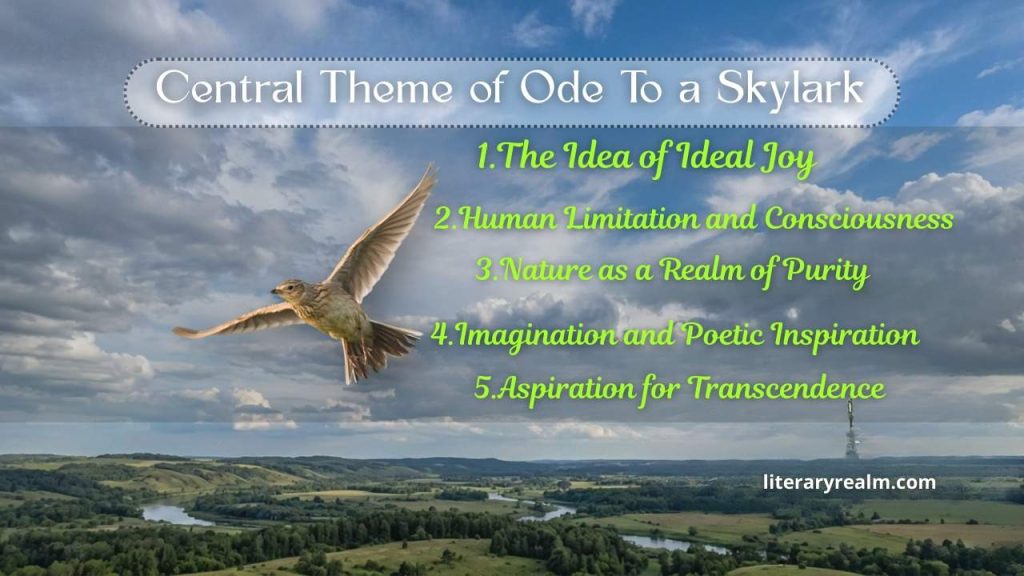
In any comprehensive analysis of Ode to a Skylark, the poem’s central concern is the pursuit of ideal joy and the human longing for transcendence. In To a Skylark, Percy Bysshe Shelley presents the skylark not merely as a bird but as a symbolic embodiment of spiritual purity, artistic perfection, and unbounded happiness. Through a series of rich comparisons and philosophical reflections, the poem explores the contrast between the skylark’s effortless joy and the complex, often painful, condition of human existence.
1. The Idea of Ideal Joy
At the heart of the poem lies the concept of ideal or absolute joy. The skylark sings spontaneously, without visible cause, and without any trace of sorrow. Its song appears complete, self-sufficient, and untouched by fear, regret, or loss.
Shelley portrays this joy as something almost supernatural. The bird is described as a “blithe Spirit,” suggesting that it exists on a plane beyond ordinary physical life. Its happiness is instinctive and pure, not shaped by memory or anxiety about the future. This portrayal establishes the skylark as a symbol of a higher state of being—one that humans can admire but cannot fully experience.
2. Human Limitation and Consciousness
Another key aspect of Ode to a Skylark is Shelley’s view of human limits. Unlike the skylark, people are very aware of death, pain, and their own flaws. Even when celebrating, there’s always a sense of loss or sadness in the background. Human beings are always longing for the things they do not have. They feel profound emotions, but their self-consciousness can make these feelings overwhelming at times. People are aware of the brevity of life. Nothing lasts forever, so even the happiest moments will fade. This awareness prevents human beings from fully enjoying pure happiness like the skylark.
Shelley famously observes that “our sweetest songs are those that tell of saddest thought,” suggesting that human creativity is rooted in melancholy. Our emotions are layered and complex; joy is rarely pure. It is often intertwined with longing or memory. This contrast highlights the burden of human consciousness. While awareness gives depth to experience, it also prevents complete, unshadowed happiness.
3. Nature as a Realm of Purity
The poem also reflects a Romantic belief in the spiritual superiority of nature. During the Romantic period, the Romantics embraced a belief in pantheism, which led them to glorify nature in their writings. They believed that God’s presence exists everywhere in nature. As a result, nature has a significant effect on human healing. Moreover, it plays an important role in reflecting human thoughts and emotions. The skylark, as a creature of the natural world, exists in harmony with the universe. Its song flows freely through the sky, unrestricted by social conventions or internal conflict.
By contrast, humans are constrained by societal expectations, pride, fear, and emotional instability. Shelley uses this opposition to emphasise how far removed humanity is from the simplicity and freedom that characterise the skylark’s existence.
4. Imagination and Poetic Inspiration
Another central theme is imagination as a means of transcendence. Imagination has no boundaries. Poets use their imagination to portray their emotions creatively, and this becomes another form of poetic expression. The skylark flies higher and higher into the sky until it can no longer be seen, yet its song seems to remain forever in the poet’s mind. He imagines the bird’s song and wonders what kind of earthly creature it might be.
The skylark functions as a metaphor for the ideal poet. Its music flows effortlessly, without conscious strain. It does not calculate or revise; it simply sings. This natural spontaneity represents the highest form of artistic expression.
Shelley wishes he could learn “half the gladness” that inspires the skylark’s song. He thinks that even a little of this pure inspiration would make his poetry truly powerful. In this way, imagination becomes the link between human limits and spiritual growth. People can’t reach the skylark’s perfect joy, but they can get close through creativity.
5. Aspiration for Transcendence
Ultimately, the poem is not an expression of despair but of aspiration. Shelley recognises the gap between human reality and the skylark’s ideal state. Yet the very act of yearning signifies hope. The desire to transcend suffering through imagination and art reflects the Romantic conviction that poetry can elevate the human spirit.
Thus, the central theme of To a Skylark revolves around the tension between earthly limitation and heavenly ideality. The skylark symbolises perfect joy, intuitive wisdom, and artistic purity, while humanity represents self-awareness, emotional depth, and struggle. Through this contrast, Shelley crafts a profound meditation on the possibilities—and boundaries—of human experience.
Symbolism of the Skylark
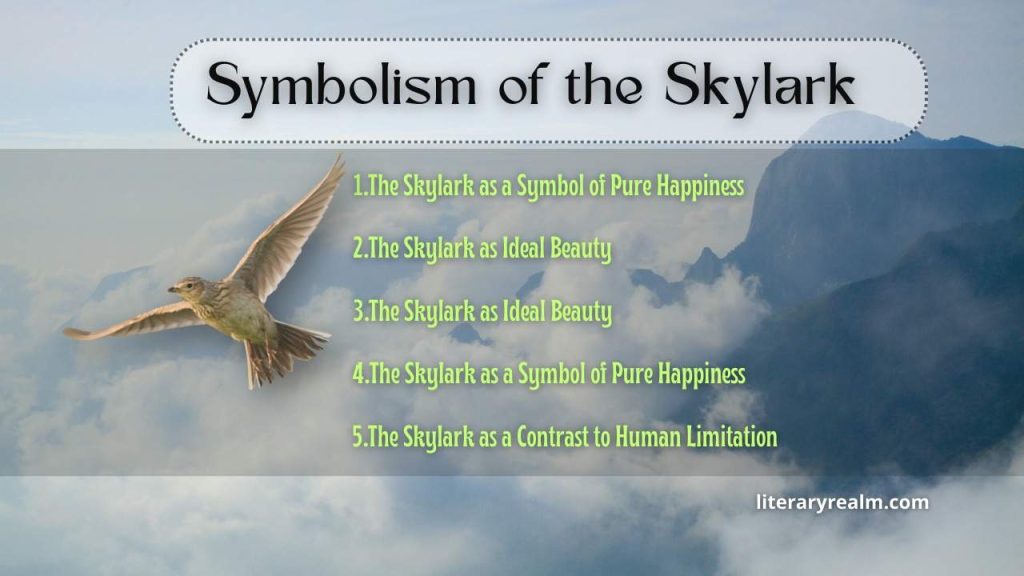
In any in-depth Ode To a Skylark Analysis, the skylark must be understood as a profound symbol rather than a literal bird. In “To a Skylark,” Percy Bysshe Shelley elevates the skylark into a philosophical and artistic symbol. It becomes a vehicle for Shelley to explore joy, beauty, creativity, and the limitations of human existence.
1. The Skylark as a Symbol of Pure Happiness
One of the most well-known symbolic meanings of the skylark is pure happiness. The bird sings continuously and effortlessly, without any sign of sorrow, regret, or fear. Shelley describes it as a “blithe Spirit,” implying that it belongs to a higher realm of existence beyond earthly suffering.
Unlike human joy, which is often overshadowed by anxiety or the awareness of mortality, the skylark’s happiness appears absolute. It does not carry emotional burdens from the past nor fear for the future. In this sense, the skylark symbolises a state of spiritual wholeness—an ideal form of joy that humans long for but cannot fully attain.
2. The Skylark as Ideal Beauty
The skylark also stands for perfect beauty. Its song is balanced, natural, and harmonious. Shelley often points out that the bird is hidden while it sings, which makes its meaning even stronger. Its beauty doesn’t depend on looks or being noticed—it exists in its sound and spirit.
This invisibility reinforces the idea that true beauty lies within and transcends the physical. The skylark’s music surpasses all earthly sounds—spring rain, fragrant roses, or romantic melodies. It embodies aesthetic perfection, untouched by decay or imperfection.
3. The Skylark as Poetic Inspiration
A crucial dimension in any serious Ode To a Skylark Analysis is the bird’s symbolic connection to poetic creativity. The skylark becomes a metaphor for the ideal poet. Its song flows naturally, without conscious effort or calculation. It does not struggle for expression; inspiration arises instinctively.
Shelley, as a poet, longs to learn the secret of this effortless creativity. He believes that if he could capture even a portion of the skylark’s spontaneous joy, his own poetry would move the world. Thus, the bird symbolises the highest form of artistic inspiration—pure, abundant, and unrestrained by doubt.
4. The Skylark as a Contrast to Human Limitation
Most importantly, the skylark symbolises a state very different from being human. People are limited by death, society’s rules, pride, fear, and complicated feelings. Even our happiest moments have a touch of sadness.
The skylark, however, seems free from these constraints. It exists beyond the burdens of self-consciousness. Through this contrast, Shelley highlights the tragic yet profound nature of human awareness. While humans possess depth of thought and emotional richness, they lack the skylark’s perfect simplicity and unshadowed joy.
Romantic Elements in To a Skylark
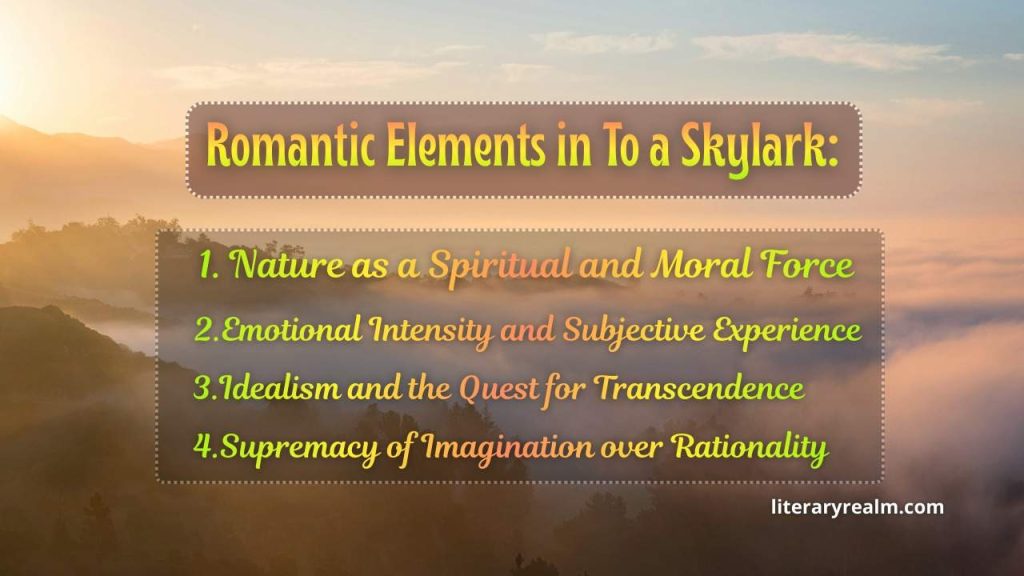
In this analysis of Ode to a Skylark, the poem clearly emerges as a quintessential product of Romanticism. In To a Skylark, Percy Bysshe Shelley incorporates the central ideals of the Romantic movement—reverence for nature, emotional intensity, imaginative transcendence, and philosophical idealism. The poem does not merely describe a bird; it transforms a natural phenomenon into a profound meditation on existence and artistic aspiration.
1. Nature as a Spiritual and Moral Force
One of the defining Romantic features of the poem is the elevation of nature to a sacred dimension. The skylark is not portrayed as an ordinary creature but as a “blithe Spirit,” suggesting something ethereal and divine. Nature becomes a source of revelation, offering insight that surpasses human knowledge.
Shelley presents the natural world as pure and harmonious, in contrast to human life, which is burdened by sorrow and limitation. The skylark’s song inspires awe and philosophical reflection, reinforcing the Romantic belief that nature possesses spiritual authority and transformative power.
2. Emotional Intensity and Subjective Experience
Romantic poetry prioritises emotion over detached reasoning, and this quality is central to the poem. Shelley’s admiration for the skylark is deeply personal and emotionally charged. His tone shifts from wonder to yearning, from celebration to introspection.
The poem is not a scientific observation of a bird but an emotional response to it. Shelley’s longing to understand and emulate the skylark reveals his inner struggle. This focus on subjective feeling—rather than objective analysis—reflects a fundamental Romantic principle: truth is discovered through emotional experience.
3. Idealism and the Quest for Transcendence
Another prominent Romantic element is idealism. The skylark symbolises a state of perfection—pure joy, complete freedom, and spiritual elevation. Shelley contrasts this ideal condition with humanity’s flawed nature.
The poet aspires to transcend human limitations and attain the purity of the bird. This longing reflects the Romantic pursuit of something higher than material reality. The skylark symbolises a perfect world without suffering, and Shelley’s desire to get closer to it reveals the Romantic hope of going beyond life’s limits.
4. Supremacy of Imagination over Rationality
In any serious Ode To a Skylark Analysis, imagination must be recognized as central to the poem’s vision. Shelley does not attempt to explain the skylark’s song through logic or empirical reasoning. Instead, he relies on imaginative similes and symbolic language to approach its mystery.
The poem suggests that rational thought cannot fully grasp truth or happiness. The skylark’s music embodies intuitive wisdom, something accessible only through imaginative insight. For Shelley, imagination is the highest faculty of the human mind—it allows individuals to glimpse realities beyond the tangible world.
Literary Devices Used in To a Skylark
When looking closely at Ode to a Skylark, it’s important to notice Shelley’s skill with language. In To a Skylark, Shelley uses many poetic techniques to make the poem more beautiful and thoughtful. The language isn’t just fancy; each device helps turn the skylark into a symbol of higher meaning and perfect art.
1. Simile and Extended Comparison
One of the most striking features of the poem is Shelley’s extensive use of similes. He often compares the skylark to bright and beautiful things, like a “cloud of fire,” a “poet hidden in the light of thought,” a “high-born maiden,” and a “glow-worm golden.”
These comparisons serve multiple purposes:
- They emphasize the skylark’s brilliance and radiance.
- They suggest hidden creativity and emotional depth.
- They attempt to approximate something that is ultimately indescribable.
The repeated use of “like” underscores the poet’s struggle to define the skylark directly. Each simile brings the reader closer to understanding its essence, yet none can fully capture it. This technique reinforces the idea that the skylark transcends ordinary language.
2. Metaphor and Symbolism
Besides similes, Shelley uses metaphors to make the skylark a symbol. By calling it a “blithe Spirit,” he turns the bird into something more than just a physical creature. It becomes an embodiment of joy, freedom, and spiritual vitality.
The skylark itself functions as an extended metaphor for:
- Ideal happiness
- Poetic inspiration
- Transcendent consciousness
Through metaphor, Shelley shifts the poem from natural description to philosophical meditation.
3. Personification
Personification plays a significant role in transforming the poem’s tone. The skylark is addressed as though it has feelings, thoughts, and purpose. It is not merely singing; it is expressing a state of being.
By attributing spiritual qualities to the bird, Shelley elevates it to near-divine status. This device strengthens the Romantic tendency to spiritualize nature, presenting it as morally and emotionally superior to humanity.
4. Imagery (Visual and Auditory)
Shelley’s imagery is vivid and appeals to many senses. He uses visual images such as glowing fire, dew-filled valleys, blooming roses, and spring rain to create a rich, natural backdrop. At the same time, auditory imagery dominates the poem. The skylark’s song is described as overflowing, pouring, and surpassing all earthly sounds.
This combination allows readers not only to visualise the scene but also to imaginatively “hear” the music. The strong sensory details make the poem feel more real and increase its emotional effect.
5. Alliteration and Musical Rhythm
The poem’s sound patterns mirror its subject. Shelley employs alliteration, internal rhyme, and carefully structured stanza forms to create a flowing, melodious rhythm.
The consistent stanza pattern and lyrical cadence echo the skylark’s continuous song. This harmonious interplay between form and content demonstrates technical mastery. The poem does not merely describe music—it embodies musicality in its structure.
Tone and Mood of the Poem
When analysing ” Ode to a Skylark, looking at tone and mood shows the poem’s emotional structure. In To a Skylark, Shelley shifts the tone as the poem progresses, leading the reader from admiration to deep longing. This tonal progression deepens the thematic contrast between human limitation and ideal transcendence.
1. Tone of Admiration and Wonder
At first, the tone is celebratory and filled with astonishment. Shelley addresses the skylark with reverence, calling it a “blithe Spirit,” and marvels at the effortless beauty of its song. The language is elevated and radiant, reflecting genuine awe.
The poet’s voice carries excitement and admiration as he attempts to describe the bird’s brilliance through a succession of luminous similes. This initial tone establishes the skylark as an extraordinary presence—something almost divine in its purity and freedom.
2. Shift to Introspection and Longing
As the poem progresses, the tone gradually becomes more reflective. Shelley moves from praising the skylark to questioning the source of its joy. His wonder transforms into yearning. He begins to compare the bird’s pure happiness with the complexities of human experience.
This introspective tone introduces a subtle melancholy. The poet recognises that human joy is always mixed with pain and awareness of mortality. His desire to learn “half the gladness” of the skylark reveals both aspiration and limitation. The tone, therefore, becomes contemplative—balancing admiration with a quiet sense of unattainable ideality.
3. The Mood: Awe, Inspiration, and Melancholic Reflection
The poem’s mood is shaped by its musical rhythm, vivid imagery, and emotional intensity. Readers experience a sense of elevation as the skylark soars and sings invisibly overhead. The imagery of light, spring, and overflowing melody creates an atmosphere of inspiration and wonder.
But under this uplifting quality lies a contemplative undercurrent. The contrast between the skylark’s perfection and human imperfection evokes a gentle melancholy. The mood is not despairing, but thoughtfully reflective—encouraging readers to consider both the beauty of ideal joy and the sadness of human limits.
Message or Moral of To a Skylark
The poem’s overarching message centres on humanity’s aspiration to transcend suffering and achieve ideal joy. Shelley underscores the role of poetry and imagination as vehicles for spiritual and emotional elevation. The skylark exemplifies the possibility of pure happiness and effortless artistic expression, serving as a reminder of what humans can aspire to, even if full attainment remains elusive.
Critical Appreciation of To a Skylark
Ode to a Skylark continues to be admired for its musical and lyrical beauty, philosophical depth, and universal appeal. The poem’s structure, rhythm, and vivid imagery capture the essence of the skylark’s song, creating an immersive reading experience. Philosophically, the poem addresses the human desire for joy, freedom, and creative perfection, reflecting Shelley’s intellectual and emotional engagement with the Romantic ideals of imagination, emotion, and transcendence. Its lasting significance lies in its connection to the timeless human desire for joy, creative inspiration, and a deeper spiritual bond.
Conclusion
Ode to a Skylark stands as a brilliant testament to Percy Bysshe Shelley’s genius, exemplifying the Romantic era’s deep engagement with nature, emotion, and the transcendent power of imagination. Through the symbolic skylark, Shelley elevates everyday experience into a profound meditation on joy, artistic inspiration, and human limitation. The bird’s effortless flight and melodious song become metaphors for purity, freedom, and the heights of creative transcendence, contrasting sharply with the constraints of mortal life. The poem’s lyrical beauty and musicality reflect the very qualities it celebrates, inviting readers to feel and contemplate the intensity of both nature and imagination.
Shelley’s work resonates strongly alongside that of other prominent Romantic poets, such as William Wordsworth, who celebrated the restorative power of nature; John Keats, whose odes explored beauty, mortality, and desire; and Lord Byron, who often examined human passion, rebellion, and melancholy. Like his contemporaries, Shelley combines emotional intensity with philosophical reflection, yet his unique focus on the imaginative and the ideal elevates his poetry to a visionary level. The skylark becomes not only a symbol of joy but also a representation of the poet’s aspiration to transcend earthly suffering and approach a higher plane of insight and inspiration.
Ultimately, Ode to a Skylark endures because it masterfully intertwines musicality, intellectual depth, and emotional resonance. Shelley’s celebration of the skylark continues to inspire admiration, reflection, and wonder across generations, encouraging readers to contemplate the possibilities of human creativity, the pursuit of happiness, and the sublime beauty of the natural world. By capturing the essence of the Romantic spirit, the poem reminds us of the power of imagination to elevate, transform, and illuminate life’s most profound truths.
FAQs
What is Ode To a Skylark about?
Ode To a Skylark is a lyrical poem by Percy Bysshe Shelley that celebrates the skylark as a symbol of pure joy, inspiration, and transcendent beauty. In most Ode To a Skylark analysis, the bird is interpreted not as a literal creature but as a spiritual presence representing poetic imagination and ideal happiness.
What is the central theme of Ode To a Skylark?
The central theme contrasts human suffering with the skylark’s divine bliss. An effective Ode To a Skylark analysis highlights themes such as:
The limitations of human experience
The pursuit of ideal joy
The power of imagination
The role of the poet in society
Why is the skylark considered a symbol in the poem?
In literary interpretations, the skylark symbolizes pure, unbodied joy and artistic inspiration. Shelley describes it as a “blithe Spirit,” suggesting it represents something beyond physical reality. Most critical analyses view the skylark as an embodiment of ideal beauty and poetic creativity.
What type of poem is Ode To a Skylark?
It is a Romantic ode written during the Romantic period. The poem reflects key Romantic characteristics such as:
Deep emotional intensity
Reverence for nature
Emphasis on imagination
Individual expression
A detailed analysis of Ode to a Skylark often connects it to the broader Romantic ideology of transcending material reality.
What is the rhyme scheme and structure of the poem?
Ode To a Skylark is composed of 21 carefully crafted stanzas, each containing five lines. The rhyme scheme follows ABABB. This distinctive stanzaic structure enhances the poem’s musical quality, mirroring the skylark’s melodious song.
Why is Ode To a Skylark important in Romantic literature?
The poem is considered one of the finest odes of the Romantic era because it perfectly captures Romantic ideals—nature worship, emotional intensity, and the quest for transcendence. Alongside works by poets like John Keats and William Wordsworth, Shelley’s ode remains a cornerstone of Romantic poetic achievement.