
Francis Bacon as an Essayist: Exploring His Timeless Wisdom
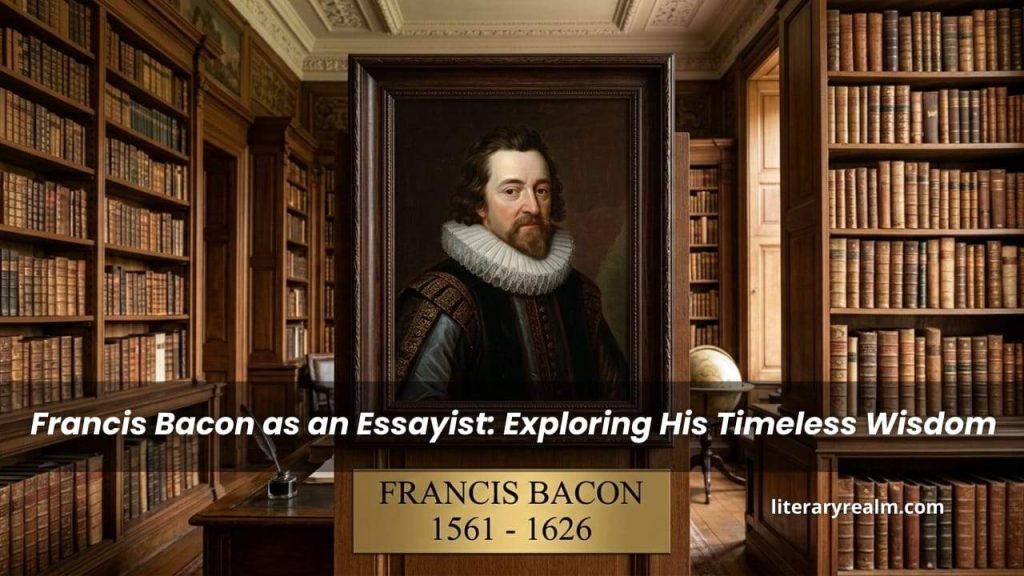
When discussing the evolution of English prose, the name of Francis Bacon inevitably emerges as one of the most influential figures. Francis Bacon, as an essayist, represents a turning point in literary history, introducing a new style that combined intellectual depth, practical wisdom, and remarkable brevity. His concise essays reflect on morality, politics, education, friendship, and human nature. Bacon published his first collection of essays in 1597, starting with ten pieces. He added more essays in 1612 and 1625, making his work an important part of English literature. His essays reveal how he used careful observation and practical thinking to understand human behavior. Today, both readers and scholars appreciate how Bacon could express complex ideas in short, powerful statements. This article examines Francis Bacon as an essayist, focusing on the features of his essays, the themes he explored, his distinctive writing style, and why his work still matters. Life and Background of Francis Bacon Francis Bacon (1561–1626) was an English philosopher, statesman, and essayist whose ideas greatly influenced the development of modern thought. He was born in London on January 22, 1561, into a politically prominent family. His father, Nicholas Bacon, served as a senior official under Elizabeth I, exposing him to public life and governance from an early age. Bacon received his education at Trinity College, Cambridge and later studied law at Grey’s Inn. Alongside his legal career, he became actively involved in politics and eventually rose to high office during the reign of James I.Although Bacon held important political positions, his lasting reputation rests on his intellectual and literary contributions. His essays reflect careful observation of society, politics, and human behaviour, offering practical insights into everyday life. He also promoted a new, systematic approach to knowledge based on observation and experimentation, ideas that influenced the development of the Scientific Method. Because of the clarity and depth of his writing, Bacon remains one of the most influential prose writers in English literature. The Historical Context of Francis Bacon’s Essays To understand Francis Bacon as an Essayist, it is essential to consider the intellectual climate of the Renaissance period. The Renaissance was marked by a renewed interest in classical learning, scientific inquiry, and humanism.Bacon lived in the late 1500s and early 1600s. As a philosopher and statesman, he helped develop empirical thinking and the scientific method, which informed his approach to essay writing. The essay was relatively new in England, popularized earlier by the French writer Michel de Montaigne. However, Bacon transformed the essay into something distinct. While Montaigne’s essays were personal and reflective, Bacon’s essays were practical, instructive, and philosophical.In this way, Francis Bacon turned the essay into a way to analyze ideas and guide society. Key Characteristics of Francis Bacon as an Essayist Brevity and Concise One of the most remarkable qualities of Francis Bacon as an Essayist is his extraordinary brevity and conciseness. Bacon believed that wisdom should be expressed in a compact and powerful form rather than through long explanations. His essays often consist of short, dense sentences that contain deep philosophical meaning. This compressed style requires readers to pause and reflect on every statement.Bacon’s mastery of brevity is evident in his frequent use of aphorisms, short yet profound observations that summarize complex truths. In his famous essay Of Studies, Bacon writes: This single sentence reveals the different roles that learning plays in intellectual development.Similarly, Bacon explains the practical value of education when he notes: Through such concise expressions, Francis Bacon, as an essayist, demonstrates how powerful ideas can be communicated with remarkable economy of words.Another example appears when Bacon remarks that, This brief statement captures a complex analysis of human attitudes toward knowledge. Such sentences illustrate Bacon’s ability to condense wide-ranging reflections into memorable lines.Because of this stylistic precision, Francis Bacon, as an Essayist, remains a model of intellectual clarity and disciplined prose. Aphoristic Style A key feature of Bacon’s essays is his aphoristic style. He often expressed his insights in short, striking statements that encapsulated deep philosophical observations. These aphorisms give his essays a memorable and authoritative tone.In the essay Of Truth, Bacon begins with one of his most famous reflections: Through this striking opening line, Bacon immediately introduces the philosophical complexity of truth and humanity’s reluctance to confront it.He observes the human tendency toward illusion: This reflects Bacon’s belief that people sometimes prefer comforting falsehoods over difficult truths.Another notable aphorism from the same essay states: Here Bacon suggests that truth is valuable but often less attractive than the glittering illusions people prefer.Through such aphorisms, Francis Bacon, as an essayist, transforms philosophical reflections into concise maxims. These statements remain memorable because they combine intellectual depth with elegant simplicity. The aphoristic quality of his writing ensures that his insights continue to resonate with readers centuries later. Practical Wisdom A key aspect that distinguishes Francis Bacon as an Essayist is his emphasis on practical wisdom. Rather than focusing solely on abstract philosophy, Bacon wrote essays that offer guidance for everyday life. His reflections on topics such as ambition, friendship, leadership, and personal conduct reveal his desire to provide readers with useful advice.In the essay Of Studies, Bacon highlights the practical function of learning by stating: This observation shows that knowledge must be balanced with real-world practice.In Of Friendship, Bacon emphasises the emotional and psychological value of human relationships when he writes: This insight reflects his understanding of the importance of emotional support in human life.Similarly, Bacon remarks in Of Ambition: Here, he compares ambition to a powerful force that motivates individuals but must be controlled carefully.Through such observations, Francis Bacon, as an essayist, presents practical, realistic, and applicable wisdom for everyday human experience. His essays function almost like guides for navigating life’s complexities. Objective and Analytical Tone Another important characteristic of Francis Bacon as an Essayist is his objective and analytical tone. Bacon rarely writes from an emotional or personal standpoint. Instead, he approaches subjects with a philosophical mindset, carefully examining human behaviour and social dynamics.In Of Revenge, Bacon offers a balanced view: He acknowledges
Renaissance Period of English Literature: England’s Voice Awakens

Discover how the Renaissance Period of English Literature awakened England’s literary voice, reshaped writing styles, and transformed themes and thought.