
My Last Duchess Critical Analysis explores the psychological complexity and artistic brilliance of Robert Browning’s famous dramatic monologue. This poem presents a powerful Duke who reveals far more about himself than he intends as he describes a portrait of his late wife. Through subtle language and controlled narration, Browning exposes themes of power, jealousy, and manipulation.
Written in the Victorian era, the poem reflects social hierarchies and gender dynamics that still resonate with modern readers. The Duke of Ferrara serves as both narrator and subject of analysis, allowing readers to examine his mindset through his own words rather than external commentary. This technique makes the poem deeply engaging and open to interpretation.
This article is designed for students and literature enthusiasts seeking a clear, structured understanding of the poem. It will cover key themes, symbolism, literary devices, and critical interpretations in a simplified yet academically sound manner.
By the end of this analysis, readers will gain not only a deeper appreciation of the poem but also practical insights useful for exams, essays, and advanced literary discussions and interpretations.
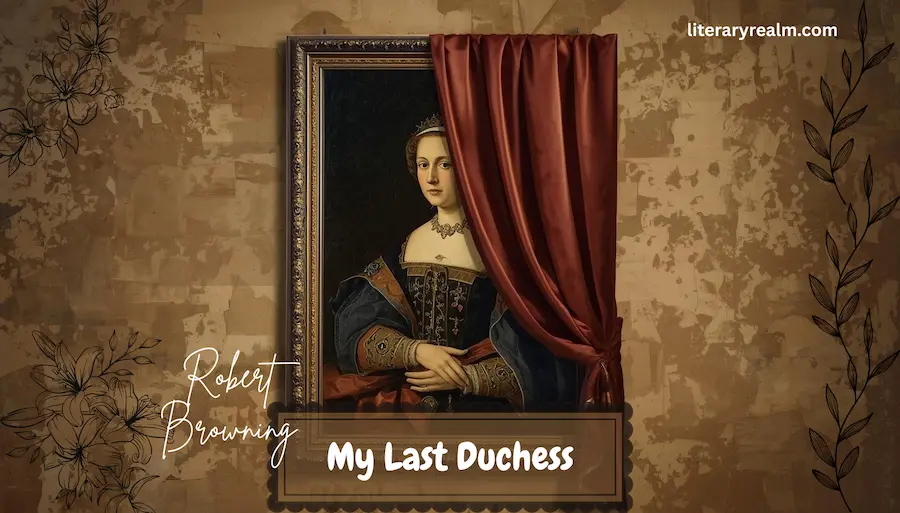
Overview of My Last Duchess
“My Last Duchess” is a remarkably dramatic monologue by Robert Browning, a Victorian-era writer known for exploring morality, social hierarchy, and human psychology. Browning uses this poetic form to allow a single speaker to reveal his personality indirectly through speech, making the poem both engaging and psychologically complex.
The speaker of the poem is the Duke of Ferrara, an aristocratic figure, addressing an envoy who has come to arrange his next marriage. Through this one-sided conversation, the Duke draws attention to a portrait of his former wife, the Duchess. As he speaks about her, his words unintentionally expose his controlling and possessive nature.
The poem is set in Renaissance Italy, but its themes transcend time, making it relevant for modern readers and students. Browning’s use of dramatic monologue allows readers to interpret the Duke’s character without the author’s direct judgment, adding depth and ambiguity to the narrative.
Quick Summary:
The Duke shows a painting of his late Duchess and describes her behaviour in a seemingly calm tone. However, as he continues, his words reveal jealousy and dissatisfaction. The poem subtly suggests that the Duchess met a tragic fate due to the Duke’s actions.
Summary of My Last Duchess
The poem starts with the Duke of Ferrara presenting a portrait of his late Duchess to a visitor. He speaks with pride about the painting, noting its lifelike quality and emphasizing that he alone controls access to it by drawing a curtain. This immediately establishes his desire for control and authority.
As the Duke continues his narration, he describes the Duchess as a kind and appreciative woman who found joy in simple things. She smiled easily and expressed gratitude for small gestures, such as receiving cherries or admiring a beautiful sunset. However, instead of valuing these qualities, the Duke criticises her for treating everyone equally kindly. He believes she failed to prioritize his noble status and prestigious name.
The Duke admits that he was displeased with her behaviour but chose not to confront her directly, as he considered such action beneath his dignity. Instead, he hints at taking a more decisive and extreme step. He states that he “gave commands,” after which “all smiles stopped together,” implying that he arranged for her death.
Following this revelation, the Duke quickly shifts the conversation back to his next marriage. This transition highlights his practical and transactional approach to relationships, where emotional connection is secondary to status and control.
The poem concludes with the Duke pointing out another piece of art, reinforcing his tendency to treat people as objects. Overall, the summary reveals how the Duke’s own words expose his cruelty, making the poem a powerful exploration of power, psychology, and moral corruption.
My Last Duchess Critical Analysis
Character Analysis of the Duke
At the centre of any My Last Duchess Critical Analysis stands the Duke of Ferrara, a figure defined by control, pride, and psychological complexity. Through his speech, he reveals himself as a man deeply invested in authority and status. His aristocratic pride is evident in his repeated emphasis on his “nine-hundred-years-old name,” suggesting that lineage, rather than emotional connection, forms the foundation of his identity. This fixation on heritage underscores his belief in hierarchical superiority.
The Duke’s controlling nature is most visible in his treatment of the Duchess. He dictates who can view her portrait, symbolizing his desire to regulate perception and access. Even after her death, he continues to exert dominance, indicating that his need for control transcends life itself. This behaviour reflects a broader obsession with ownership, where relationships are reduced to possessions.
Psychologically, the Duke is both composed and unsettling. He speaks in a calm, measured tone, yet his words carry disturbing implications. His refusal to “stoop” and communicate openly with the Duchess reveals an inability to engage in mutual understanding. Instead, he internalizes resentment until it manifests in decisive, irreversible action.
Power dynamics are central to his character. He views himself as inherently superior and expects absolute submission. The Duchess’s failure to conform to this expectation becomes, in his mind, a justification for punishment. However, the irony lies in the fact that his attempt to present himself as rational ultimately exposes his cruelty and insecurity.
Thus, the Duke emerges as a complex character whose authority masks deep psychological instability. His narrative invites readers to question not only his actions but also the societal structures that enable such unchecked power.
Portrayal of the Duchess
In contrast to the Duke, the Duchess is portrayed as a figure of warmth, innocence, and natural kindness. Although she never speaks directly, her presence is constructed through the Duke’s descriptions, allowing readers to interpret her character independently. This indirect portrayal is essential to understanding the poem’s tension.
The Duchess’s defining trait is her ability to find joy in simple pleasures. Whether appreciating a sunset or expressing gratitude for small gifts, she embodies a genuine and spontaneous appreciation of life. Her smiles are not reserved for the Duke alone, which becomes a central point of conflict. What the Duke perceives as a lack of discrimination is, in reality, an expression of her open-hearted nature.
This misinterpretation reveals more about the Duke than the Duchess. His inability to understand her perspective transforms her virtues into perceived flaws. He expects exclusivity and reverence, while she offers kindness universally. This fundamental difference in outlook highlights the emotional disconnect between them.
Symbolically, the Duchess represents suppressed freedom. Her lively spirit contrasts sharply with the rigid expectations imposed by the Duke. Her fate suggests the consequences of individuality within a controlling environment. By reducing her to a portrait, the Duke effectively silences her voice and confines her identity.
Despite her limited presence, the Duchess remains a powerful figure. She challenges the Duke’s authority simply by being herself, and in doing so, becomes a symbol of resistance against oppressive control. Her portrayal invites readers to consider the cost of such resistance within hierarchical structures.
Use of Dramatic Monologue
One of the poem’s defining features is its use of dramatic monologue, a form perfected by Robert Browning. This technique allows a single speaker to address a silent listener, revealing character through speech rather than direct narration. In My Last Duchess, this form becomes a powerful tool for psychological exploration.
The one-sided conversation creates an illusion of control, as the Duke appears to guide the narrative. However, this structure also exposes his vulnerabilities. Without interruption, he inadvertently reveals his thoughts, motivations, and moral contradictions. The absence of the listener’s voice forces readers to engage actively, interpreting meaning from what is said—and what is implied.
A key aspect of this technique is the indirect revelation of psychology. The Duke does not explicitly confess wrongdoing, yet his words strongly suggest his involvement in the Duchess’s death. This subtlety enhances the poem’s tension, as readers must piece together the truth from fragmented clues.
The speaker’s reliability becomes a central question. While the Duke presents his perspective as reasonable, inconsistencies and underlying hostility challenge his credibility. His attempt to justify his actions ultimately undermines him, exposing a distorted sense of morality.
Through dramatic monologue, Browning transforms the poem into a psychological case study. The Duke’s voice dominates the text, yet it is precisely this dominance that reveals his flaws. The technique not only shapes the narrative but also deepens the reader’s engagement with the poem’s themes and characters.
Major Themes in My Last Duchess
Power and Control
Power and control form the foundation of the poem’s thematic structure. The Duke’s authority extends beyond social status into personal relationships, where he expects complete obedience. His control over the Duchess is both physical and symbolic, culminating in her reduction to a portrait. This transformation allows him to dictate how she is remembered and perceived.
The poem critiques the abuse of power by illustrating its destructive consequences. The Duke’s inability to tolerate independence leads to irreversible action, highlighting the dangers of unchecked authority. His control is not rooted in strength but in insecurity, revealing the fragility beneath his dominance.
Jealousy and Possession
Jealousy drives the Duke’s actions. Unlike conventional jealousy, which arises from betrayal, his stems from perceived inadequacy. The Duchess’s equal appreciation of all things challenges his desire for exclusivity, leading him to interpret her behaviour as disrespect.
Possession is closely linked to this jealousy. The Duke views the Duchess not as a partner but as an object that must reflect his status. Her individuality becomes a threat, prompting him to assert control in extreme ways. This dynamic underscores the destructive nature of possessive love.
Art vs Reality
The contrast between art and reality plays a significant role in the poem. The portrait represents an idealised version of the Duchess—silent, obedient, and permanently fixed. In reality, she was lively and expressive, qualities the Duke found intolerable.
Art becomes a means of control, allowing the Duke to reshape reality according to his preferences. By confining the Duchess to a painting, he eliminates unpredictability and preserves a version of her that aligns with his expectations. This theme questions about the relationship between representation and truth.
Patriarchy and Authority
The poem reflects the patriarchal structures of its setting, in which male authority dominates both the social and the personal spheres. The Duke embodies this system, exercising power without accountability. His actions are framed within a context that normalizes hierarchical relationships and suppresses dissent.
The Duchess’s fate illustrates the consequences of challenging such authority. Her subtle independence disrupts established norms, leading to her silencing. Browning’s portrayal invites readers to critique these structures and consider their implications.
Symbolism in My Last Duchess
Symbolism enriches the poem by adding layers of meaning to its narrative elements. Each symbol reflects the Duke’s mindset and reinforces the central themes.
The portrait of the Duchess stands as the most significant symbol. It represents the Duke’s ultimate control over her identity. While she was once lively and autonomous, the painting reduces her to a static image that he can display at will. This transformation highlights the tension between life and representation, as well as the desire to dominate memory.
The curtain covering the portrait further emphasizes restricted access. The Duke alone decides when it is drawn, controlling who can see the Duchess and under what circumstances. This act symbolizes his authority over both perception and knowledge. It also suggests secrecy, implying that the truth about the Duchess’s fate is deliberately concealed.
The Duke’s commands function as a subtle yet powerful symbol of dominance. Although never explicitly detailed, they carry significant weight, indicating the extent of his authority. The phrase implies action without explanation, reinforcing the idea that his power operates beyond moral scrutiny.
Together, these symbols create a cohesive framework that deepens the poem’s meaning. They illustrate how control extends beyond physical actions into memory, perception, and narrative. Through symbolism, the poem reveals the complexities of power and the ways it shapes both reality and representation.
Literary Devices and Techniques
A strong My Last Duchess Critical Analysis must examine the literary devices that shape the poem’s meaning and psychological depth. Robert Browning employs a range of techniques that subtly reveal the Duke’s character while enhancing thematic complexity.
Irony is one of the poem’s most powerful devices. The Duke intends to present himself as refined and reasonable, yet his words expose cruelty and moral blindness. This contrast between intention and interpretation creates dramatic irony, allowing readers to perceive truths that the speaker himself fails to recognize.
Enjambment plays a crucial role in maintaining the poem’s natural, conversational tone. Lines flow into one another without strict pauses, mimicking the rhythm of speech. This technique allows the Duke’s thoughts to unfold continuously, reinforcing the illusion of spontaneity while subtly revealing his inner psychology.
Imagery is used effectively to create vivid mental pictures, particularly through references to art and visual detail. The portrait of the Duchess is described with lifelike precision, emphasizing both her beauty and the Duke’s fixation on appearance. These images contribute to the poem’s exploration of art versus reality.
Rhyming couplets form the structural backbone of the poem. Although the rhyme scheme follows a strict AA, BB pattern, it is carefully disguised through enjambment. This combination creates a balance between order and fluidity, reflecting the Duke’s controlled yet revealing speech.
Tone and diction further enhance the poem’s impact. The Duke’s tone remains calm and polite, even when hinting at disturbing actions. His choice of formal, measured language reinforces his aristocratic identity while masking underlying aggression.
Together, these literary devices work cohesively to deepen the poem’s meaning, transforming a simple narrative into a complex psychological study.
Structure and Form
The structure and form of the poem play a significant part in shaping its meaning and delivery. “My Last Duchess” is written in rhyming couplets, following a consistent AA, BB pattern. This regular rhyme scheme creates a sense of order and control, mirroring the Duke’s personality and his desire for dominance.
However, the strictness of the rhyming couplets is softened by the use of enjambment. Lines often run into one another without pause, creating a fluid, conversational rhythm. This blending of structure and flow reflects the dual nature of the Duke’s speech—carefully controlled yet seemingly natural.
The poem is composed in iambic pentameter, a metrical pattern consisting of ten syllables per line with alternating unstressed and stressed beats. This rhythm provides a steady, balanced pace, reinforcing the Duke’s narration’s formal tone. At the same time, subtle variations prevent the meter from becoming monotonous, adding realism to speech.
One of the most striking aspects of the poem’s form is its conversational yet controlled flow. While the Duke appears to speak casually, his language is highly structured, revealing his calculated nature. The form allows Browning to present a voice that feels authentic while still maintaining poetic precision.
Overall, the structure and form enhance both characterization and theme. They reflect the Duke’s obsession with order and authority while gradually revealing his psychological complexity.
Critical Interpretation
A nuanced My Last Duchess Critical Analysis requires moving beyond summary into deeper interpretive frameworks. Robert Browning crafts a poem that supports multiple critical readings, each revealing new dimensions of meaning.
From a psychological perspective, the Duke can be read as a deeply insecure individual masked by aristocratic authority. His obsession with control suggests a fragile ego that cannot tolerate independence in others. Rather than engaging in open communication, he internalises his dissatisfaction and resolves conflicts through absolute measures. His calm tone contrasts sharply with the implications of his actions, indicating a disconnection between emotion and expression. This psychological detachment makes him both compelling and unsettling, as he remains unaware of the moral gravity of his behaviour.
A feminist interpretation highlights the power imbalance between the Duke and the Duchess. She represents a woman whose individuality and emotional openness challenge patriarchal expectations. Her appreciation for simple pleasures and her equal kindness toward others disrupt the hierarchical structure that the Duke seeks to maintain. His response—silencing her permanently—reflects the suppression of female autonomy within male-dominated systems. The Duchess’s transformation into a portrait symbolises how women are often reduced to objects, valued for appearance rather than identity or voice.
The historical context further enriches interpretation. Although the poem is set in Renaissance Italy, it was written during the Victorian era, a time when questions of morality, gender roles, and social hierarchy were widely debated. By situating the narrative in a distant historical setting, Browning creates a layer of separation that allows readers to critique these issues indirectly. The Renaissance backdrop emphasises aristocratic power and artistic patronage, while Victorian readers would recognise parallels in their own society.
This dual context invites readers to consider how authority operates across different periods. The Duke’s behaviour, though extreme, reflects broader cultural attitudes toward power and gender. Browning’s ability to blend psychological depth with historical commentary ensures that the poem remains relevant beyond its immediate setting.
Ultimately, critical interpretation reveals the poem as more than a character study. It becomes a reflection on human psychology, societal structures, and the enduring consequences of unchecked authority and control.
Why My Last Duchess is a Powerful Poem
“My Last Duchess” remains a powerful and enduring poem because of its timeless themes, psychological realism, and artistic mastery. Robert Browning combines these elements to create a work that continues to resonate with modern readers.
One reason for its lasting impact is the universality of its themes. Issues such as power, control, jealousy, and inequality are not confined to a specific historical period. They remain relevant across cultures and societies, allowing readers from different backgrounds to connect with the poem’s message. This timeless quality ensures its continued significance in both academic and personal contexts.
The poem’s psychological realism also contributes to its strength. The Duke is not portrayed as a simple villain but as a complex individual whose actions stem from insecurity and pride. His calm and measured speech makes his character more believable, while the subtle revelation of his motives invites readers to engage critically with his perspective. This depth transforms the poem into a compelling study of human behaviour.
Artistic mastery further elevates the poem. Browning’s use of dramatic monologue, controlled structure, and layered symbolism demonstrates a high level of technical skill. Every element, from rhythm to diction, works together to reveal character and theme without explicit explanation.
Together, these qualities make “My Last Duchess” a remarkable example of poetic craftsmanship. Its ability to combine intellectual depth with emotional impact secures its place among the most studied and admired poems in English literature.
Conclusion
This My Last Duchess Critical Analysis demonstrates how Robert Browning transforms a seemingly simple monologue into a profound exploration of power, psychology, and artistic control. Through the Duke’s voice, the poem reveals the dangers of unchecked authority, the distortion of love into possession, and the reduction of human identity to objects of display.
The analysis highlights how themes such as power, jealousy, patriarchy, and the tension between art and reality are intricately woven into the poem’s structure. The Duke’s character, with his calm yet unsettling tone, becomes a lens through which readers examine deeper moral and psychological questions. At the same time, the Duchess, though silent, emerges as a symbol of suppressed individuality and freedom.
The enduring importance of the poem lies in its ability to engage readers beyond surface meaning. It invites interpretation, challenges assumptions, and exposes the complexities of human behaviour without offering simple judgments. This interpretive openness ensures that the poem remains relevant across different contexts and generations.
Ultimately, “My Last Duchess” stands as a masterful work that combines technical precision with emotional depth, encouraging readers to deeply reflect on the relationship between power, perception, and truth.
Frequently Asked Questions
Why is My Last Duchess considered a dramatic monologue?
My Last Duchess is considered a dramatic monologue because the entire poem is spoken by a single character—the Duke of Ferrara—to a silent listener. Through his speech, the Duke unintentionally reveals his personality, motives, and moral flaws. Rather than describing the character directly, Robert Browning allows readers to judge the Duke from his own words, making the poem a classic example of the dramatic monologue.
What does the Duke reveal about himself in My Last Duchess?
Although the Duke intends to present himself as noble and refined, he reveals himself to be controlling, jealous, arrogant, and emotionally detached. His obsession with status and his inability to accept the Duchess’s independent nature expose his insecurity. By the end of the poem, readers realize that the Duke’s own words reveal more about his character than about his late wife.
Why does the Duke keep the Duchess’s portrait behind a curtain?
The Duke keeps the Duchess’s portrait behind a curtain because he wants complete control over who can see it. The curtain symbolizes his desire to possess and dominate the Duchess even after her death. While she could not be controlled in life, the portrait allows him to decide when and how others may view her, reinforcing one of the poem’s central ideas about power and possession.
What is the central message of My Last Duchess?
The central message of My Last Duchess is that the desire for absolute power and control can destroy human relationships. Through the Duke’s possessiveness and pride, Robert Browning criticizes arrogance, patriarchal authority, and the treatment of people as possessions. The poem also encourages readers to question appearances, since the Duke’s polite language conceals his disturbing nature.
Why is My Last Duchess still studied today?
My Last Duchess remains widely studied because its themes of power, gender, jealousy, manipulation, and psychological complexity are still relevant. The poem also demonstrates Browning’s mastery of the dramatic monologue, symbolism, and characterization, making it an important work for understanding Victorian poetry and literary analysis.
What should students focus on when analyzing My Last Duchess?
When analyzing My Last Duchess, students should focus on the Duke’s characterization, the use of dramatic monologue, major themes, symbolism, irony, and Browning’s portrayal of power and control. Paying attention to how the Duke’s language unintentionally exposes his personality is essential for developing a strong literary interpretation and writing effective exam answers or essays.