
The Victorian Age, spanning Queen Victoria’s reign from 1837 to 1901, stands as one of the most influential periods in English literature. Tennyson, as a representative poet of the Victorian Age, is celebrated for reflecting the era’s ideals and concerns, embodying its tensions, aspirations, and moral consciousness. This was a time of profound societal and cultural change: industrialization transformed cities, scientific discoveries challenged traditional beliefs, and social reforms reshaped individual roles. Writers responded to these shifts by exploring themes of morality, social responsibility, faith, and the complexities of human emotion, creating literature that mirrored both the achievements and anxieties of the age.
Amidst these transformations, Alfred Lord Tennyson emerged as a central literary figure whose works captured the intellectual and emotional spirit of the era. His poetry is marked by lyrical elegance, philosophical depth, and a reflective tone that resonates with the concerns of Victorian society. From meditative elegies to narrative retellings of myth, Tennyson addressed the interplay between personal grief and public duty, faith and doubt, tradition and progress. These qualities positioned him not only as a master poet but also as a chronicler of the Victorian ethos, offering readers a profound understanding of the era’s cultural and moral preoccupations.
Tennyson’s celebrated works, such as In Memoriam A.H.H. and Idylls of the King, exemplify the breadth of his engagement with Victorian themes. While In Memoriam meditates on loss and faith, Idylls of the King explores ideals of honor, duty, and justice through the Arthurian legend, reflecting societal aspirations and anxieties. Through these works, Tennyson’s poetry became a vehicle for both aesthetic enjoyment and philosophical reflection, bridging the personal and the societal in a way that epitomizes the Victorian literary spirit.
By examining Alfred Lord Tennyson’s contributions, readers gain insight into the moral, cultural, and intellectual currents that defined his time. His enduring influence highlights why he remains a quintessential figure in Victorian literature, celebrated for capturing the era’s essence with unmatched lyrical and thematic mastery.
Socio-Historical Background of the Victorian Era and Its Influence on Poetry
The Victorian era (1837–1901), during Queen Victoria’s reign, was a period of profound transformation in British society and culture. Rapid industrialization, urban expansion, and technological innovation reshaped daily life, influencing not only the economy but also the moral and intellectual concerns of the time. These sweeping changes created a fertile ground for literature, as writers explored the tensions between progress, tradition, and human experience.
Politically, Britain enjoyed relative stability, which allowed social reforms to take root gradually. At the same time, the Industrial Revolution fundamentally altered the social fabric. Cities expanded rapidly, factories proliferated, and large numbers of the population shifted from rural areas to urban centers in search of employment. While these developments brought economic growth, they also resulted in overcrowded housing, poor working conditions, and widespread poverty. Victorian writers often highlighted these realities, using literature as a tool for social critique and reflection.
Child labor was one of the most urgent social issues. Many children worked in factories, mines, and workshops under dangerous conditions, often for long hours and minimal pay. Literature of the era, including poetry and novels, became a means of exposing these injustices and advocating for reform. At the same time, the rise of the middle class and increased literacy—especially after reforms like the Elementary Education Act of 1870—expanded the reading public and shaped literary themes, emphasizing morality, duty, and social responsibility.
It was in this context that Alfred Lord Tennyson emerged as a poet whose work exemplifies Victorian sensibilities. His poetry often reflects themes of grief, faith, duty, and the struggle between tradition and change. Tennyson, as a representative poet of the Victorian Age, is celebrated for reflecting the era’s ideals and concerns, combining lyrical beauty with philosophical depth. Understanding the socio-historical backdrop of the Victorian era helps readers fully appreciate how Tennyson’s works capture the emotional and intellectual currents of 19th-century England.
Tennyson’s Life and Literary Career
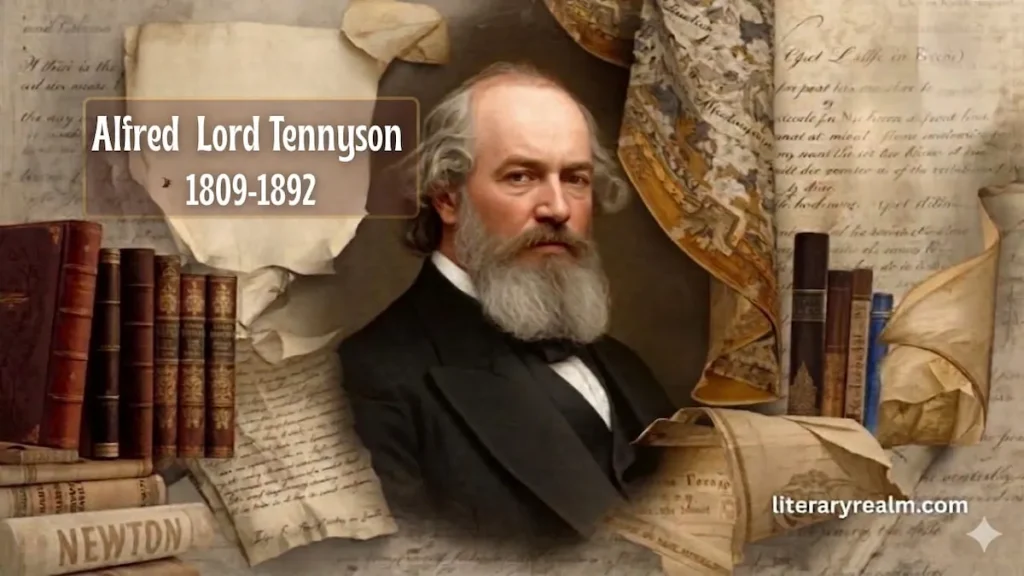
Alfred Lord Tennyson remains one of the most celebrated figures of Victorian literature, and understanding his life and literary career is essential to appreciating Tennyson as a representative poet of the Victorian Age. His poetry not only reflects the moral, social, and intellectual concerns of his time but also showcases his mastery of language, narrative, and lyrical expression. From his early life to his tenure as Poet Laureate, Tennyson’s journey illustrates the evolution of a poet whose works continue to resonate across generations.
Early Life and Education
Alfred Tennyson was born on August 6, 1809, in Somersby, Lincolnshire, into a family with a strong literary and clerical background. His father, a rector, encouraged his children’s education and fostered a love of literature. Growing up in the English countryside, Tennyson developed a deep appreciation for nature, a quality that would later become a hallmark of his poetry. The rural environment and familial support allowed him to cultivate a reflective and sensitive temperament, attuned to both emotional and philosophical questions.
Tennyson’s formal education began at local schools and later at Louth Grammar School, where he demonstrated early literary talent. He eventually attended Trinity College, Cambridge, where he joined a circle of young poets known as the “Apostles.” During his college years, Tennyson began experimenting with poetic form, themes, and imagery, laying the foundation for his future works. The combination of classical education, exposure to contemporary literary movements, and personal loss—such as the death of close friends—shaped Tennyson’s poetic sensibilities, particularly his exploration of grief, faith, and moral responsibility.
Major Works
Tennyson’s literary output spans a wide range of themes and forms, reflecting the concerns of Victorian society.
In Memoriam A.H.H. (1850) is perhaps his most profound and personal work, composed in recalling the memories of his close friend Arthur Henry Hallam. This long elegiac poem grapples with grief, the inevitability of death, and the reconciliation of faith and doubt. Its meditative tone and philosophical depth exemplify the Victorian preoccupation with mortality and spiritual questioning.
The Charge of the Light Brigade (1854), written in response to the famous military blunder during the Crimean War, showcases Tennyson’s narrative skill and patriotism. The poem celebrates courage and heroism while reflecting on the tragic consequences of duty and obedience. Its rhythmic cadence and vivid imagery have made it one of the most enduring war poems in English literature.
Idylls of the King (1859–1885) is Tennyson’s ambitious retelling of the Arthurian legends. Through these narrative poems, he explores themes of honor, chivalry, and moral duty, juxtaposing personal desire with societal expectations. The work reflects Victorian ideals, including the importance of ethical conduct, social responsibility, and the conflict between individual ambition and collective good.
Poet Laureate
After the death of William Wordsworth in 1850, Tennyson was appointed Poet Laureate of England, a role that solidified his position as the nation’s official voice. As Poet Laureate, Tennyson composed works that celebrated national achievements, commemorated public events, and offered moral reflection, thereby influencing public taste and opinion. His position allowed him to reach a broad audience, making his poetry a central part of Victorian cultural life.
Tennyson’s tenure as Poet Laureate also reinforced his reputation as a moral and intellectual guide for the public. Through ceremonial poems and public addresses, he became a symbol of literary authority, bridging the personal and political, the emotional and civic, in ways that resonated with the Victorian ethos.
Through his early education, groundbreaking works, and role as Poet Laureate, Alfred Lord Tennyson exemplifies the qualities that define Tennyson as a representative poet of the Victorian Age: lyrical brilliance, engagement with contemporary concerns, and a profound reflection of the social and moral ideals of his time. His life and career offer invaluable insight into the intellectual, emotional, and cultural currents that shaped Victorian literature.
Why Tennyson Represents the Victorian Age
Alfred Lord Tennyson is widely regarded as the poet who best embodies the spirit of the Victorian Age. His works reflect the intellectual, emotional, and moral preoccupations of 19th-century England, offering readers both lyrical beauty and profound insight into societal values. He is celebrated for expressing the era’s ideals and concerns, including the tension between tradition and modernity, faith and doubt, and personal emotion and public responsibility. Through his poetry, Tennyson engaged with the defining questions of his time, making him an essential figure for understanding Victorian literature and culture.
Reflection of Victorian Values
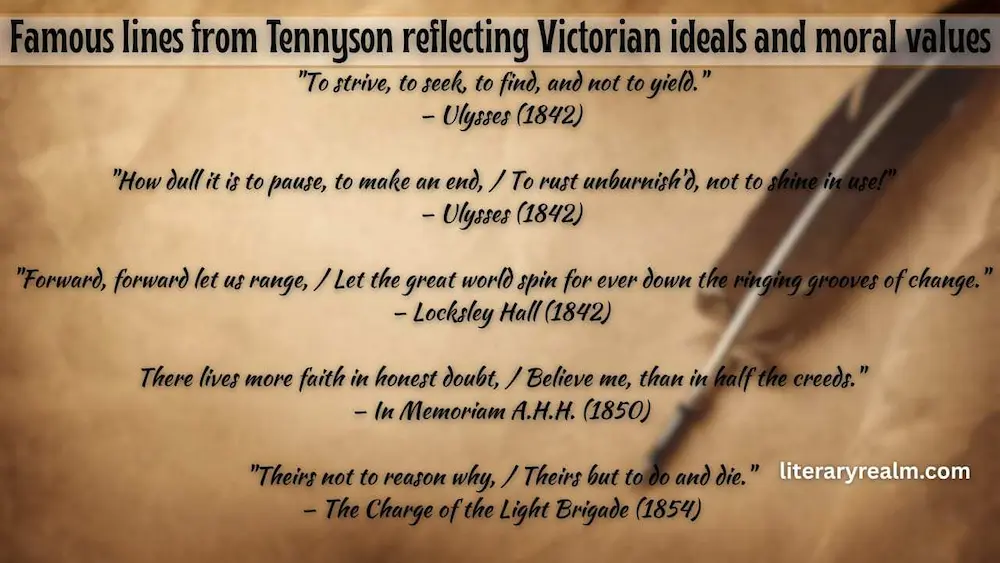
Tennyson’s poetry is deeply infused with the moral and ethical ideals that characterized Victorian society. Themes of duty, morality, and personal honor recur throughout his works, reflecting the era’s emphasis on social responsibility and ethical conduct. In In Memoriam A.H.H., Tennyson mourns the death of his close friend while exploring the struggle to maintain faith and perseverance amidst grief. Lines such as:
I hold it true, whate’er befall;
In Memoriam A. H. H.
I feel it, when I sorrow most;
‘Tis better to have loved and lost
Than never to have loved at all.
Alfred Lord Tennyson
illustrate not only the poet’s personal sorrow but also the Victorian emphasis on moral reflection, endurance, and the cultivation of character. Through elegiac meditations like this, Tennyson captured the inner life of the individual while echoing the societal belief in duty, moral integrity, and emotional resilience. His focus on ethical dilemmas, personal honor, and social duty made his poetry a mirror of the values that governed Victorian life.
Engagement with Science and Progress
The Victorian Age was a period of rapid scientific advancement and industrial progress, which challenged traditional religious and philosophical beliefs. Tennyson’s works often grappled with the implications of these changes, reflecting the anxieties and hopes of his contemporaries. The publication of Darwin’s On the Origin of Species in 1859 prompted widespread debate about faith, human purpose, and the natural order. In response, Tennyson’s poetry blends doubt with hope, portraying the tension between emerging scientific understanding and spiritual reassurance.
For example, In Memoriam contains lines where the poet wrestles with uncertainty:
Tho’ Nature, red in tooth and claw
In Memoriam– Alfred Lord Tennyson
With ravine, shriek’d against his creed
Here, Tennyson acknowledges the harsh realities revealed by scientific observation while simultaneously seeking solace and moral meaning through reflection and perseverance. Similarly, his narrative and lyric poetry engage with industrialization, societal transformation, and progress, offering a balanced view that neither wholly rejects nor blindly celebrates change. This nuanced engagement with modernity situates Tennyson as a poet fully attuned to the intellectual currents of the Victorian Age.
Popularity and National Influence
Tennyson’s poetry resonated profoundly with Victorian readers, earning him unparalleled popularity and influence. Appointed Poet Laureate in 1850, he became the official literary voice of England, shaping national taste and reflecting the collective consciousness of his society. His works were widely read in homes, schools, and public events, and his ability to address both private emotion and public ideals allowed his poetry to engage readers across social classes.
Beyond his immediate audience, Tennyson’s impact extended to contemporary writers and the broader literary culture. Poets and novelists alike drew inspiration from his thematic complexity, lyrical style, and moral engagement. By articulating the hopes, anxieties, and ethical concerns of his time, Tennyson created a body of work that served both as art and social commentary. His ability to unify aesthetic brilliance with reflection on societal values solidifies his place as the quintessential poet of the Victorian Age.
Through his reflection of Victorian ideals, engagement with scientific and social progress, and national influence, Tennyson exemplifies the literary, moral, and cultural ethos of his era. As a representative poet, he offers a timeless lens through which modern readers can explore 19th-century English society, thought, and emotion. His poetry endures as a testament to the complexities, aspirations, and values of Victorian England, making him an indispensable figure in the study of English literature.
Major Themes in Tennyson’s Poetry
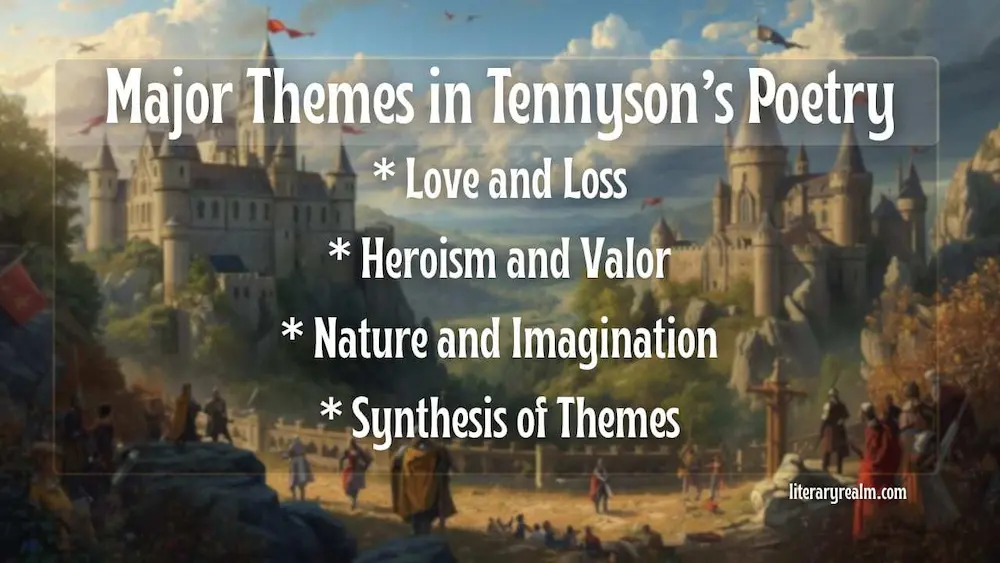
Alfred Lord Tennyson’s poetry stands as a profound reflection of the intellectual, emotional, and moral currents of the Victorian Age. As a representative poet, he is celebrated for blending personal emotion with societal reflection. Across his works, recurring themes such as love and loss, heroism, and the imaginative exploration of nature demonstrate both the depth and versatility of his poetry. By examining these themes, readers can better understand how Tennyson’s work captures the values, anxieties, and aspirations of 19th-century England.
Love and Loss
One of the most prominent themes in Tennyson’s poetry is love intertwined with loss, grief, and remembrance. His elegiac masterpiece, In Memoriam A.H.H., written in memory of his close friend Arthur Henry Hallam, exemplifies this preoccupation. The poem navigates the complex emotional terrain of mourning, examining the pain of absence and the struggle to reconcile sorrow with faith.
Capturing both the intensity of personal grief and the universal human experience of loss. In the Victorian context, this theme resonated deeply with readers who faced high mortality rates, social upheaval, and the uncertainties of a rapidly changing world. Tennyson’s exploration of love and loss demonstrates his ability to transform personal emotion into a reflection of broader human concerns, emphasizing perseverance, memory, and moral resilience.
Heroism and Valor
Tennyson also explored themes of heroism, courage, and patriotism, most notably in The Charge of the Light Brigade. Written in response to the ill-fated military engagement during the Crimean War, the poem celebrates the bravery and discipline of soldiers despite the disastrous outcome. Lines such as:
Theirs not to reason why,
The Charge of the Light Brigade- Alfred Tennyson
Theirs but to do and die:
highlight the tension between duty and fate, a moral and ethical preoccupation central to Victorian society. Here, Tennyson elevates heroism as both a personal and societal ideal, emphasizing courage, honor, and self-sacrifice. His depiction of valor resonated strongly with contemporary readers, reinforcing national pride while acknowledging the costs of blind obedience and the fragility of human life.
Nature and Imagination
Another dominant theme in Tennyson’s poetry is the imaginative and symbolic use of nature, often intertwined with myth and legend. In Idylls of the King, Tennyson retells Arthurian legends through allegorical storytelling, exploring moral ideals, social responsibility, and human emotion. Nature in these works serves not only as a backdrop but also as a reflective and symbolic medium, illustrating themes of heroism, virtue, and the passage of time.
Tennyson’s vivid imagery, such as the noble landscapes of Camelot or the turbulent seas surrounding Arthur’s knights, creates a world where imagination and reality merge. These works reflect the Victorian fascination with medievalism, moral instruction, and aesthetic beauty, while also engaging with timeless human concerns. By blending nature, legend, and moral allegory, Tennyson demonstrates the enduring power of poetry to address both personal reflection and societal ideals.
Synthesis of Themes
Across love and loss, heroism and valor, and nature and imagination, Tennyson’s poetry consistently merges personal experience with broader societal reflection. His exploration of grief, courage, and moral ideals mirrors the complexities of Victorian life, while his lyrical and narrative skills ensure that these themes resonate aesthetically and emotionally. The integration of these motifs underscores why Tennyson, as a representative poet of the Victorian Age, is celebrated for reflecting the era’s ideals and concerns, offering readers both artistic pleasure and insight into the moral and cultural consciousness of his time.
Tennyson’s thematic focus also illustrates the Victorian commitment to literature as a vehicle for moral reflection, social commentary, and emotional engagement. By combining personal emotion with imaginative storytelling and ethical reflection, his works remain enduring exemplars of Victorian literary values. Readers encounter in Tennyson a poet capable of capturing the human experience in all its complexity while articulating the ideals, struggles, and aspirations of an entire era.
Literary Style and Techniques
Alfred Lord Tennyson’s enduring reputation as a representative poet of the Victorian Age is closely tied to his distinctive literary style and mastery of poetic techniques. His works exemplify the aesthetic and intellectual qualities of Victorian poetry, combining formal elegance with emotional and philosophical depth. Tennyson’s skillful manipulation of lyricism, meter, and rhyme, along with his use of symbolism and allegory, enabled him to explore complex themes and create works of striking musicality and resonance.
Lyricism, Meter, and Rhyme
Tennyson’s poetry is renowned for its lyrical quality, which arises from meticulous attention to meter, rhythm, and rhyme. His use of varied meters, including iambic tetrameter and pentameter, creates a musical cadence that enhances the emotional impact of his verse. Poems such as The Lady of Shalott and The Charge of the Light Brigade demonstrate how carefully controlled rhythm can evoke urgency, reflection, or solemnity. Rhyme schemes, whether regular or irregular, further contribute to the aesthetic harmony of his work, reinforcing both meaning and mood.
Symbolism, Imagery, and Allegory
Tennyson frequently employs rich symbolism, vivid imagery, and allegorical storytelling to convey moral, philosophical, and emotional truths. In Idylls of the King, Arthurian legends serve as allegories for honor, duty, and social ideals, while landscapes, castles, and natural elements often symbolize human virtues or spiritual dilemmas. Similarly, in In Memoriam A.H.H., imagery drawn from nature—such as seasons, rivers, and light—mirrors the stages of grief and the search for meaning, reinforcing the reflective and philosophical dimensions of his poetry.
Elegiac Tone and Emotional Depth
A hallmark of Tennyson’s style is his elegiac tone, particularly evident in mourning poems like In Memoriam. Through measured cadence, somber imagery, and contemplative diction, he conveys grief, remembrance, and moral reflection with profound sensitivity. This elegiac quality allows readers to engage with the universal experience of loss while contemplating broader questions of faith, morality, and human resilience. Tennyson’s emotional depth is consistently paired with philosophical insight, creating poetry that resonates intellectually as well as emotionally.
Integration of Philosophy and Emotion
Tennyson’s technique unites aesthetic beauty with reflective thought, allowing him to address personal, societal, and metaphysical concerns simultaneously. His careful balance of musicality, imagery, and allegory ensures that philosophical reflections are never abstract or detached; they are always grounded in vivid emotion and human experience. This combination of form, content, and moral engagement exemplifies why Tennyson, as a representative poet of the Victorian Age, is celebrated for reflecting the era’s ideals and concerns, making his work both timeless and emblematic of Victorian literary achievement.
Legacy of Tennyson in Victorian Literature
Alfred Lord Tennyson’s contributions to English literature extend far beyond his lifetime, establishing him as a defining figure of the Victorian Age. Tennyson, as a representative poet of the Victorian Age, is celebrated for reflecting the era’s ideals and concerns, and his legacy continues to shape both literary scholarship and popular understanding of 19th-century English poetry. Through his influence on subsequent writers, his role as the moral and emotional voice of his time, and the continued critical engagement with his works, Tennyson remains central to the study of Victorian literature.
Influence on Later Poets and Victorian Writers
Tennyson’s mastery of lyricism, narrative poetry, and moral reflection set a standard for his contemporaries and future generations of poets. His blending of personal emotion with societal reflection inspired figures such as Robert Browning, Matthew Arnold, and later modern poets who sought to balance philosophical inquiry with aesthetic excellence. By integrating themes of duty, grief, heroism, and the moral consequences of human action, Tennyson provided a model for exploring the ethical and emotional dimensions of literature. His skill in marrying form and content influenced Victorian literary culture, encouraging writers to consider both technical precision and thematic depth in their work.
The Voice of the Victorian Age
Tennyson’s poetry resonated deeply with his contemporaries, earning him recognition as the unofficial voice of his era. Appointed Poet Laureate in 1850, he addressed public events, national tragedies, and personal loss with a blend of elegance and moral reflection, making his work both accessible and aspirational. Poems such as The Charge of the Light Brigade and In Memoriam encapsulate the collective Victorian experience—patriotism, grief, moral duty, and spiritual questioning—allowing Tennyson to articulate the concerns and ideals of his society. In doing so, he became the literary embodiment of Victorian sensibilities, blending cultural, emotional, and philosophical reflection in ways few other writers achieved.
Modern Critical Perspectives and Relevance
Tennyson’s works continue to be studied and celebrated for their lyrical beauty, moral engagement, and historical significance. Modern critics examine his negotiation of faith, science, and social change, highlighting his relevance to contemporary debates about duty, loss, and progress. His poetry also serves as a lens through which readers can explore Victorian cultural values, social structures, and intellectual currents. The enduring interest in Tennyson’s work demonstrates how his themes, imagery, and narrative techniques continue to resonate across time, offering insight into both the Victorian Age and universal human experience.
In sum, Tennyson’s literary legacy lies not only in his mastery of poetic form but also in his ability to reflect the intellectual, moral, and emotional currents of his era. Tennyson, as a representative poet of the Victorian Age, is celebrated for reflecting the era’s ideals and concerns, and his work remains a cornerstone of Victorian literary studies, inspiring readers and writers alike with its elegance, depth, and enduring relevance.
Conclusion
Alfred Lord Tennyson remains one of the most enduring and influential figures of Victorian literature. Through his mastery of lyricism, narrative depth, and philosophical reflection, he captured the complexities of 19th-century England, exploring themes of duty, grief, heroism, and the tension between tradition and modernity. His works reflect both the personal and societal concerns of his era, blending emotional resonance with moral and intellectual inquiry.
Tennyson, a representative poet of the Victorian Age, continues to inspire readers through his reflections on Victorian ideals, emotions, and literary brilliance. From the elegiac meditation of In Memoriam to the patriotic fervour of The Charge of the Light Brigade and the allegorical grandeur of Idylls of the King, Tennyson’s poetry mirrors the intellectual, cultural, and ethical currents that defined the Victorian Age. His engagement with scientific progress, social responsibility, and human emotion further illustrates why he occupies a central place in the literary canon of his time.
By examining Tennyson’s life, major works, literary style, and thematic preoccupations, readers gain a comprehensive understanding of how a single poet can embody the ideals, anxieties, and aspirations of an entire era. His ability to combine aesthetic beauty with moral and philosophical reflection ensures that his poetry remains both relevant and inspiring to contemporary audiences.
For anyone seeking to explore the rich landscape of Victorian literature, delving into Tennyson’s works provides a window into the era’s soul. Through his verse, one can appreciate not only the artistry of the period but also the enduring human concerns that continue to resonate across time. Engaging with Tennyson’s poetry offers a deeper appreciation of the Victorian literary tradition and the cultural ideals that shaped it.
FAQs: Tennyson as a Representative Poet of the Victorian Age
Why is Tennyson considered a representative poet of the Victorian Age?
Alfred Lord Tennyson is considered a representative poet of the Victorian Age because his poetry reflects the era’s major concerns, including duty, morality, grief, faith, scientific progress, social responsibility, and the tension between tradition and modernity. His works combine personal emotion with broader Victorian cultural and intellectual concerns.
What are the major Victorian themes in Tennyson’s poetry?
The major Victorian themes in Tennyson’s poetry include love and loss, grief, faith and doubt, duty, heroism, patriotism, moral responsibility, scientific progress, and the conflict between tradition and change. Works such as In Memoriam A.H.H., The Charge of the Light Brigade, and Idylls of the King illustrate these concerns.
How does Tennyson reflect Victorian values in his poetry?
Tennyson reflects Victorian values through his emphasis on duty, morality, perseverance, social responsibility, courage, and self-discipline. His poetry also responds to scientific and social changes of the period, particularly the tension between religious faith and emerging scientific ideas.
What are the major characteristics of Tennyson’s poetic style?
Tennyson’s poetic style is characterized by lyrical beauty, musicality, careful use of meter and rhyme, vivid imagery, symbolism, allegory, and emotional depth. He often combines philosophical reflection with expressive language, creating poetry that is both aesthetically refined and intellectually engaging.
Which works best represent Tennyson as a Victorian poet?
In Memoriam A.H.H., The Charge of the Light Brigade, and Idylls of the King are among the works that best represent Tennyson as a Victorian poet. They explore grief and faith, heroism and duty, and moral ideals and social responsibility, respectively, reflecting important concerns of Victorian society.