Francis Bacon as an Essayist: Exploring His Timeless Wisdom
When discussing the evolution of English prose, the name of Francis Bacon inevitably emerges as one of the most influential figures. Francis Bacon, as an essayist, represents a turning point in literary history, introducing a new style that combined intellectual depth, practical wisdom, and remarkable brevity. His concise essays reflect on morality, politics, education, friendship, and human nature.
Bacon published his first collection of essays in 1597, starting with ten pieces. He added more essays in 1612 and 1625, making his work an important part of English literature. His essays reveal how he used careful observation and practical thinking to understand human behavior. Today, both readers and scholars appreciate how Bacon could express complex ideas in short, powerful statements.
This article examines Francis Bacon as an essayist, focusing on the features of his essays, the themes he explored, his distinctive writing style, and why his work still matters.
Francis Bacon (1561–1626) was an English philosopher, statesman, and essayist whose ideas greatly influenced the development of modern thought. He was born in London on January 22, 1561, into a politically prominent family. His father, Nicholas Bacon, served as a senior official under Elizabeth I, exposing him to public life and governance from an early age.
Bacon received his education at Trinity College, Cambridge and later studied law at Grey’s Inn. Alongside his legal career, he became actively involved in politics and eventually rose to high office during the reign of James I. Although Bacon held important political positions, his lasting reputation rests on his intellectual and literary contributions. His essays reflect careful observation of society, politics, and human behaviour, offering practical insights into everyday life. He also promoted a new, systematic approach to knowledge based on observation and experimentation, ideas that influenced the development of the Scientific Method.
Because of the clarity and depth of his writing, Bacon remains one of the most influential prose writers in English literature.
The Historical Context of Francis Bacon’s Essays
To understand Francis Bacon as an Essayist, it is essential to consider the intellectual climate of the Renaissance period. The Renaissance was marked by a renewed interest in classical learning, scientific inquiry, and humanism. Bacon lived in the late 1500s and early 1600s. As a philosopher and statesman, he helped develop empirical thinking and the scientific method, which informed his approach to essay writing.
The essay was relatively new in England, popularized earlier by the French writer Michel de Montaigne. However, Bacon transformed the essay into something distinct. While Montaigne’s essays were personal and reflective, Bacon’s essays were practical, instructive, and philosophical. In this way, Francis Bacon turned the essay into a way to analyze ideas and guide society.
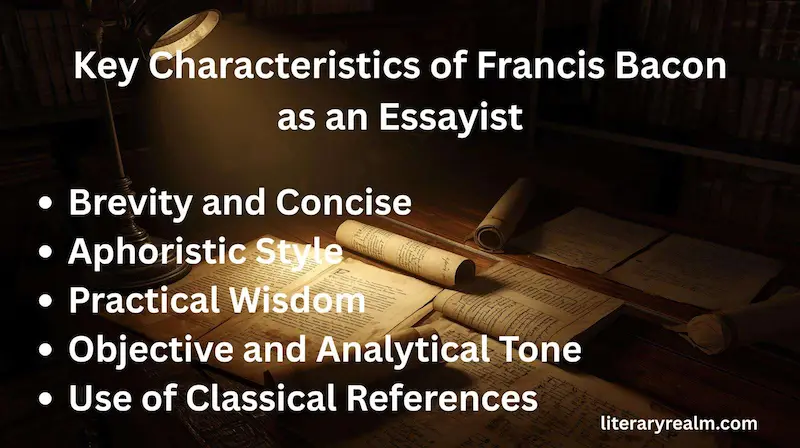
Key Characteristics of Francis Bacon as an Essayist
Brevity and Concise
One of the most remarkable qualities of Francis Bacon as an Essayist is his extraordinary brevity and conciseness. Bacon believed that wisdom should be expressed in a compact and powerful form rather than through long explanations. His essays often consist of short, dense sentences that contain deep philosophical meaning. This compressed style requires readers to pause and reflect on every statement. Bacon’s mastery of brevity is evident in his frequent use of aphorisms, short yet profound observations that summarize complex truths. In his famous essay Of Studies, Bacon writes:
“Reading maketh a full man; conference a ready man; and writing an exact man.”
This single sentence reveals the different roles that learning plays in intellectual development. Similarly, Bacon explains the practical value of education when he notes:
“Studies serve for delight, for ornament, and for ability.”
Through such concise expressions, Francis Bacon, as an essayist, demonstrates how powerful ideas can be communicated with remarkable economy of words. Another example appears when Bacon remarks that,
“Crafty men contemn studies, simple men admire them, and wise men use them.”
This brief statement captures a complex analysis of human attitudes toward knowledge. Such sentences illustrate Bacon’s ability to condense wide-ranging reflections into memorable lines. Because of this stylistic precision, Francis Bacon, as an Essayist, remains a model of intellectual clarity and disciplined prose.
Aphoristic Style
A key feature of Bacon’s essays is his aphoristic style. He often expressed his insights in short, striking statements that encapsulated deep philosophical observations. These aphorisms give his essays a memorable and authoritative tone. In the essay Of Truth, Bacon begins with one of his most famous reflections:
“What is truth? said jesting Pilate; and would not stay for an answer.”
Through this striking opening line, Bacon immediately introduces the philosophical complexity of truth and humanity’s reluctance to confront it. He observes the human tendency toward illusion:
“A mixture of a lie doth ever add pleasure.”
This reflects Bacon’s belief that people sometimes prefer comforting falsehoods over difficult truths. Another notable aphorism from the same essay states:
“Truth may perhaps come to the price of a pearl, that showeth best by day.”
Here Bacon suggests that truth is valuable but often less attractive than the glittering illusions people prefer. Through such aphorisms, Francis Bacon, as an essayist, transforms philosophical reflections into concise maxims. These statements remain memorable because they combine intellectual depth with elegant simplicity. The aphoristic quality of his writing ensures that his insights continue to resonate with readers centuries later.
Practical Wisdom
A key aspect that distinguishes Francis Bacon as an Essayist is his emphasis on practical wisdom. Rather than focusing solely on abstract philosophy, Bacon wrote essays that offer guidance for everyday life. His reflections on topics such as ambition, friendship, leadership, and personal conduct reveal his desire to provide readers with useful advice. In the essay Of Studies, Bacon highlights the practical function of learning by stating:
“Studies perfect nature, and are perfected by experience.”
This observation shows that knowledge must be balanced with real-world practice. In Of Friendship, Bacon emphasises the emotional and psychological value of human relationships when he writes:
“A principal fruit of friendship is the ease and discharge of the fullness and swellings of the heart.”
This insight reflects his understanding of the importance of emotional support in human life. Similarly, Bacon remarks in Of Ambition:
“Ambition is like choler, which is a humour that maketh men active, earnest, full of alacrity.”
Here, he compares ambition to a powerful force that motivates individuals but must be controlled carefully. Through such observations, Francis Bacon, as an essayist, presents practical, realistic, and applicable wisdom for everyday human experience. His essays function almost like guides for navigating life’s complexities.
Objective and Analytical Tone
Another important characteristic of Francis Bacon as an Essayist is his objective and analytical tone. Bacon rarely writes from an emotional or personal standpoint. Instead, he approaches subjects with a philosophical mindset, carefully examining human behaviour and social dynamics. In Of Revenge, Bacon offers a balanced view:
“Revenge is a kind of wild justice.”
He acknowledges the natural human desire for retaliation while also implying that it belongs outside the bounds of civilized law. He further advises restraint by observing:
“It is a prince’s part to pardon.”
This statement reflects Bacon’s belief that true power lies in forgiveness rather than retaliation. In Of Simulation and Dissimulation, Bacon analyses human behaviour with similar objectivity when he writes:
“Dissimulation is but a faint kind of policy or wisdom.”
Through such statements, he examines social strategies without emotional bias. These examples demonstrate how Francis Bacon, as an essayist, employs logical reasoning and detached observation. His analytical tone gives his essays intellectual authority and philosophical depth, encouraging readers to reflect critically on human conduct.
Use of Classical References
Another significant trait of Francis Bacon as an Essayist is his frequent use of classical and historical references. Bacon was deeply influenced by the intellectual traditions of ancient Greece and Rome, and he often incorporated classical ideas into his essays. In Of Truth, Bacon illustrates his philosophical reflections with historical examples, writing:
“Truth is the sovereign good of human nature.”
This idea echoes classical philosophical traditions that emphasized the moral value of truth. Similarly, in Of Studies, Bacon highlights the importance of balanced learning when he advises:
“Read not to contradict and confute; nor to believe and take for granted; nor to find talk and discourse; but to weigh and consider.”
This statement reflects the disciplined, intellectual approach characteristic of classical philosophy. Another example appears when Bacon warns against excessive specialization:
“Some books are to be tasted, others to be swallowed, and some few to be chewed and digested.”
This famous metaphor demonstrates his ability to combine classical wisdom with vivid imagery. Through such reflections, Francis Bacon, as an essayist, integrates classical intellectual traditions with Renaissance humanism. His use of historical and philosophical references enriches his arguments and gives his essays a timeless scholarly quality.
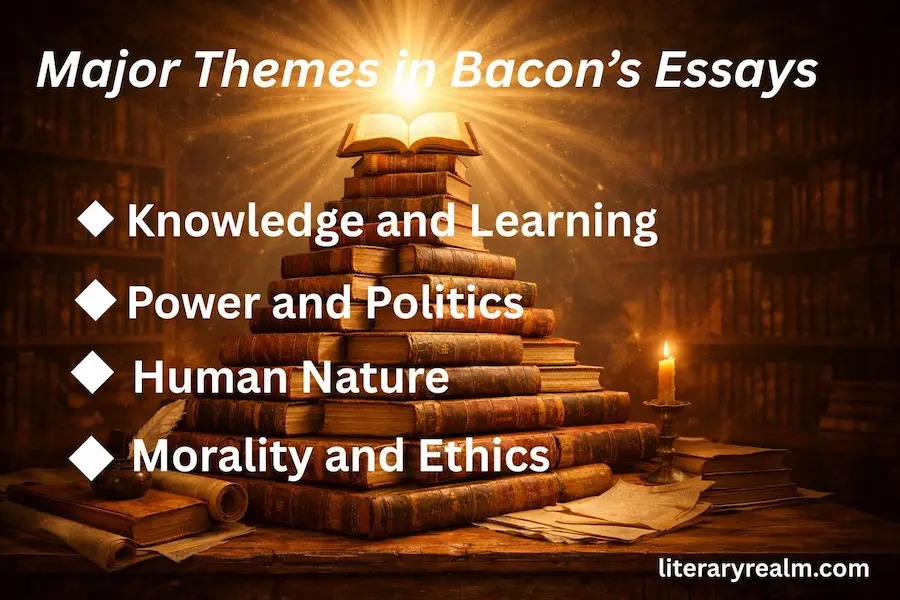
Major Themes in Bacon’s Essays
Knowledge and Learning
One of the central ideas in Francis Bacon’s essays is the importance of knowledge and intellectual development. Bacon regarded learning as an essential force that shapes both individual character and the progress of society. In his view, education was not merely a formal activity but a lifelong pursuit that strengthened judgment, broadened understanding, and refined human abilities.
Bacon emphasizes that learning enhances personal satisfaction, improves social awareness, and strengthens the ability to think and act effectively. He believed that reading expands knowledge, discussion sharpens reasoning, and writing clarifies thought. Together, these activities develop a disciplined and well-educated mind.
At the same time, Bacon warns against accepting ideas blindly. He encourages readers to approach knowledge thoughtfully and critically. According to him, the true value of study lies not in memorizing information but in examining ideas carefully and applying them wisely in practical life.
Through these reflections, Bacon presents knowledge as a powerful tool that promotes intellectual growth and social advancement. His essays encourage readers to cultivate curiosity, disciplined thinking, and a balanced approach to learning.
Power and Politics
Another significant theme explored by Francis Bacon as an Essayist is the nature of power and politics. His statesmanship influenced his reflections on leadership, ambition, and governance. His essays reveal a deep understanding of the motivations that shape political behavior and the strategies required for effective leadership. Having served under Elizabeth I and later James I, Bacon gained firsthand experience of political life. This experience allowed him to analyze the dynamics of ambition and authority with remarkable insight. In his essay Of Ambition, Bacon observes the powerful influence of ambition when he writes:
“Ambition is like choler, which is a humour that maketh men active, earnest, full of alacrity.”
Through this metaphor, he suggests that ambition can energise individuals and drive them toward achievement. At the same time, Bacon warns against the dangers of uncontrolled ambition. He notes that ambitious individuals must be carefully managed because
“It is good for princes if they use ambitious men.”
This observation reflects his pragmatic understanding of political leadership. Through such insights, Francis Bacon, as an essayist, offers a realistic, analytical perspective on politics. His essays demonstrate how ambition, power, and leadership interact within the structures of society and governance.
Human Nature
Another recurring theme in Francis Bacon’s essays is the study of human nature. Bacon explores the emotions, motivations, and desires that influence human behavior. By examining feelings such as ambition, jealousy, friendship, love, and revenge, he seeks to understand how individuals respond to different life situations.
In Of Friendship, Bacon emphasizes the emotional value of companionship. He observes:
“A principal fruit of friendship is the ease and discharge of the fullness and swellings of the heart.”
This reflection highlights the psychological importance of sharing one’s thoughts and emotions with trusted friends. Bacon also remarks that
“Whosoever is delighted in solitude is either a wild beast or a god.”
This famous observation underscores the inherently social nature of human beings.
His observations reveal a deep awareness of the complexities of human character. Bacon recognizes that people are often driven by both rational thought and powerful emotions. These conflicting forces shape decisions and actions, sometimes leading individuals toward wisdom and at other times toward error.
In several essays, Bacon examines the human tendency toward resentment and retaliation. While he acknowledges that such impulses arise naturally from emotional experiences, he also suggests that uncontrolled reactions can disrupt social order and personal peace. For this reason, he often encourages moderation, patience, and rational judgment.
Through these discussions of human emotion and motivation, Bacon presents human nature as a subject worthy of careful analysis. His essays invite readers to reflect on their own behavior and to develop greater self-awareness.
Morality and Ethics
Moving from human nature to questions of conduct, moral reflection forms another significant theme in the writings of Francis Bacon. His essays frequently explore the ethical principles that guide individuals in their personal and social lives. Bacon believes that moral integrity is essential for both individual character and the stability of society.
Bacon often discusses virtues such as honesty, moderation, careful thinking, and self-control. He believes these traits help people make good choices and stay balanced. For Bacon, having good character is not just an idea—it should be shown in daily life.
In Of Goodness, Bacon celebrates compassion and moral virtue when he states:
“Goodness, of all virtues and dignities of the mind, is the greatest.”
This remark reveals his belief that kindness and generosity represent the highest qualities of human character.
He also reflects on the complicated relationship people often have with the truth. Human beings sometimes avoid difficult realities because they prefer comfortable illusions. Bacon encourages readers to value honesty and intellectual integrity, suggesting that truth is fundamental to moral development and social trust.
Through his ethical reflections, Bacon depicts morality as a guiding force for responsible and thoughtful behavior.
Style and Language in Bacon’s Essays
Francis Bacon’s literary style is one of the most distinctive features of his work. His essays are known for their clarity, brevity, and intellectual precision. Instead of long and elaborate explanations, Bacon expresses complex ideas through short, carefully structured statements that carry significant meaning.
A defining characteristic of his writing is its conciseness. Bacon believed that powerful ideas should be communicated in a direct and disciplined manner. As a result, his essays often contain compact sentences that encourage readers to pause and reflect on the deeper implications of his observations.
Another important aspect of his style is the balanced structure of his sentences. Bacon frequently arranges his ideas in symmetrical patterns that create rhythm and emphasis. This balanced construction gives his prose a sense of order and logical harmony.
Bacon also uses metaphors and comparisons effectively to explain abstract ideas. By linking philosophical concepts with familiar images or experiences, he makes his reflections easier to understand and more memorable.
The overall tone of his essays is formal and authoritative. Bacon writes with the voice of a thinker who carefully observes human life and draws thoughtful conclusions. Despite the intellectual depth of his ideas, his language remains controlled and purposeful.
Because of these qualities, Bacon’s essays are admired as models of disciplined, thoughtful prose. This enduring admiration sets the stage for evaluating his influence and legacy.
Influence and Legacy of Francis Bacon as an Essayist
In light of his stylistic contributions, Francis Bacon’s literary and intellectual influence is significant in the development of English prose. Bacon played an important role in shaping the essay as a respected form of literary and philosophical expression.
Before his contributions, the essay had not fully developed as a major literary genre in English literature. Bacon demonstrated that short prose reflections could effectively explore complex ideas about politics, society, knowledge, and human behavior. His ability to combine philosophical insight with practical advice made his essays both intellectually stimulating and widely accessible.
One of the reasons for Bacon’s lasting influence is the originality of his method. Instead of presenting lengthy theoretical arguments, he preferred brief observations that readers could easily remember and apply. This concise approach allowed him to communicate deep insights in a clear and engaging manner.
Many later writers and thinkers adopted similar techniques of concise expression and analytical reflection. As a result, Bacon is often regarded as one of the pioneers of modern English essay writing.
Ultimately, the enduring legacy of his work lies in intellectual depth and clarity. His essays inspire readers to examine important questions about knowledge, morality, ambition, and human relationships, reinforcing their lasting value.
Why Bacon’s Essays Remain Relevant Today
Although Francis Bacon’s essays were written more than four centuries ago, they remain relevant to modern readers, in part because their lasting significance arises from the universal themes and timeless insights they contain.
Bacon focuses on fundamental aspects of human life rather than temporary social issues. His reflections on knowledge, ambition, truth, friendship, and morality address experiences common to people across every age and culture. Because these themes are universal, his ideas continue to resonate with contemporary audiences.
Another reason for the continued relevance of his essays is their concise structure. In an era when readers often prefer clear and direct writing, Bacon’s brief yet meaningful reflections feel surprisingly modern. His style allows readers to grasp important ideas quickly while still encouraging deeper thought.
His essays also offer practical wisdom applicable to modern life. Bacon emphasizes the importance of balancing theoretical knowledge with real-world experience. This principle remains central to education, professional development, and personal growth today.
Moreover, Bacon’s writing encourages critical thinking. By analyzing human behavior and social values, he invites readers to question assumptions and examine ideas carefully.
For these reasons, his essays remain valuable not only as literary works but also as guides for thoughtful reflection and intellectual development. This ongoing relevance supports Bacon’s lasting place in literature and philosophy.
Conclusion
The importance of Francis Bacon as an essayist lies in his remarkable ability to present profound ideas with clarity, precision, and intellectual discipline. His essays explore essential themes such as knowledge, morality, human behavior, and social responsibility.
Through concise expression and thoughtful analysis, Bacon transformed the essay into a powerful medium for philosophical reflection. His balanced style, insightful observations, and practical wisdom continue to influence readers and writers alike.
Even centuries after they were written, Bacon’s essays remain a valuable source of intellectual inspiration. For students, scholars, and literature enthusiasts, studying his work offers a deeper understanding of both human nature and the art of thoughtful writing.
FAQs: Francis Bacon as an Essayist
Why is Francis Bacon called the father of English essays?
Francis Bacon is often called the father of the English essay because he popularised the essay form in English literature. His essays combined philosophical insight with practical advice, setting a model that later essayists followed.
What are the main characteristics of Bacon’s essays?
The key characteristics of Bacon’s essays include brevity, concise expression, aphoristic statements, practical wisdom, an analytical tone, and references to classical literature and philosophy.
What are the major themes in Bacon’s essays?
Major themes in Bacon’s essays include knowledge and learning, power and politics, human nature, morality and ethics, friendship, ambition, and truth.
Why are Bacon’s essays considered aphoristic?
Bacon’s essays are described as aphoristic because they contain short, memorable statements that express deep truths about life and human behavior.
Why are Bacon’s essays still relevant today?
Bacon’s essays remain relevant because they discuss timeless issues such as leadership, knowledge, ethics, and human nature. His observations continue to provide valuable insights for modern readers.