
Samuel Taylor Coleridge stands among the most intellectually profound figures of the Romantic era. When we examine Coleridge as a Supernatural Poet, we see a writer who transformed supernatural elements into instruments of philosophical inquiry and psychological exploration. Unlike mere Gothic sensationalism, his supernaturalism is deeply symbolic, morally resonant, and intellectually sophisticated.
As a leading voice of Romanticism, Coleridge, as a supernatural poet, sought to transcend rationalism and restore imagination to its rightful place in literature. His poems are not just about ghosts or strange visions; they reveal spiritual struggles, moral dilemmas, and deeper questions about life. By examining Coleridge’s supernatural poetry, readers encounter a fusion of intellectual depth, creative imagination, and moral symbolism that distinguishes him from his contemporaries.
The Concept of Supernaturalism in Romantic Poetry
Literary supernaturalism involves incorporating phenomena beyond natural laws—spirits, curses, prophetic dreams, and mystical landscapes—into a narrative framework. In Romantic poetry, especially in Coleridge’s work, the supernatural is treated with more philosophical and psychological depth than in earlier Gothic writing.
Realism focuses on what can be observed and social reality, but supernatural poetry looks at psychological and deeper, unseen truths. Romantic poets believed that imagination could reveal deeper truths than reason alone. For context, William Wordsworth focused on the spiritual power of nature and ordinary rural life. In contrast, Coleridge, as a supernatural poet, ventured into the shadowy territories of dream, mystery, and metaphysical terror, expanding the boundaries of English Romantic poetry and establishing his distinctive voice in the supernatural mode.
Coleridge’s Theory of Supernaturalism
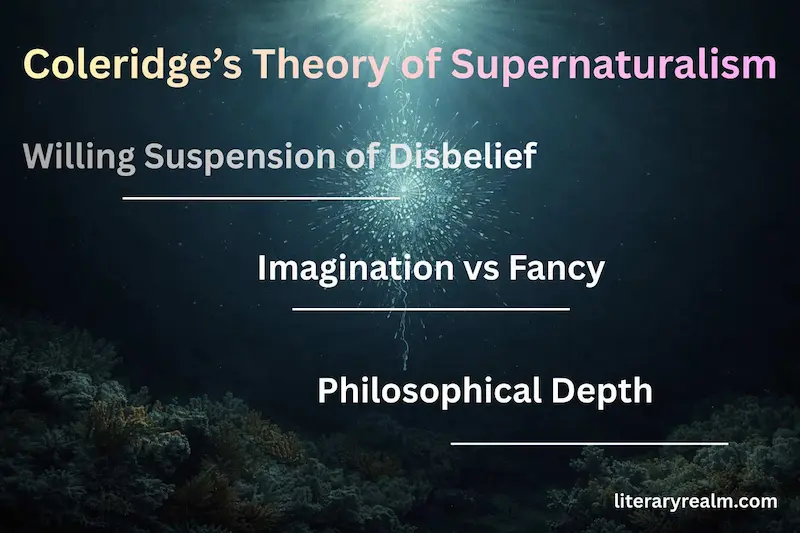
To understand Coleridge as a supernatural poet requires engaging with his literary theory, which underpins his use of supernatural and mystical imagery.
Willing Suspension of Disbelief in Coleridge’s Supernatural Poetry
Coleridge introduced the concept of “willing suspension of disbelief” in Biographia Literaria. He believed that if a poet makes supernatural events feel emotionally real, readers will set aside their doubts and accept them as true for a while. This principle is fundamental to analysing Coleridge’s supernatural poetry and explains why his ghostly and mystical elements resonate deeply with readers.
Imagination vs Fancy: Coleridge as a Supernatural Poet
Coleridge drew a clear distinction between fancy, which merely rearranges old ideas, and imagination, a creative force that brings together reality and spirit. For Coleridge, as a supernatural poet, imagination was almost divine—capable of reconciling opposites, exploring metaphysical truths, and elevating supernatural storytelling into a philosophical and moral experience. This distinction is central to his supernatural poetry and reflects his intellectual depth.
Philosophical Depth in Coleridge’s Supernatural Writings
Coleridge was influenced by German philosophy, theology, and metaphysics. He used supernatural events as symbols for moral, spiritual, and psychological truths. His poems show feelings like anxiety, guilt, spiritual searching, and the struggle between sin and redemption. This makes him a leading supernatural poet of the Romantic era.
Supernatural Elements in Major Poems by Coleridge
The Rime of the Ancient Mariner: Coleridge’s Supernatural Masterpiece
The Rime of the Ancient Mariner reflects the peak of Coleridge as a supernatural poet.
- Ghostly Ship: The ghostly ship that appears on the motionless sea is one of the most frightening supernatural images in The Rime of the Ancient Mariner. It moves forward without wind or tide, making the scene even more unsettling. On the ship are Death and Life-in-Death, who play dice to decide the sailors’ fate. This moment adds to the Gothic mood and brings in the idea of higher judgment. The ship is more than just a scary sight; it stands for powerful forces beyond human control. Through this image, the poem uses the supernatural to explore fate, justice, and the vulnerability of human life.
- Curse and Redemption: The Mariner’s impulsive killing of the albatross initiates the poem’s central moral crisis. What seems like a random act soon reveals profound symbolic weight. Nature itself reacts: the wind ceases, the sea grows stagnant, and unbearable thirst torments the crew. The curse that follows is deeply connected to the violation of natural harmony. The albatross, once a symbol of guidance and goodwill, becomes a burden hung around the Mariner’s neck, a visible sign of guilt. Supernatural punishment in the poem operates as a moral consequence rather than arbitrary terror. It reflects a universe governed by ethical laws, where human actions disturb the spiritual balance of the natural world.
- Moral Symbolism: Beyond fear and Gothic imagery, the poem’s supernatural elements ultimately serve a redemptive function. The Mariner’s suffering leads to a transformative moment when he blesses the sea creatures “unaware,” signalling inner spiritual awakening. The lifting of the curse does not erase his guilt but assigns him lifelong penance through storytelling. His narrative becomes a moral lesson for others, emphasising reverence for all living beings. In this profound blending of mystical terror and psychological realism, we clearly see Coleridge as a Supernatural Poet, using supernatural machinery not for spectacle alone but as a vehicle for spiritual insight, repentance, and moral regeneration.
Kubla Khan: Dream Vision and Mystical Supernaturalism
Kubla Khan demonstrates Coleridge’s use of the supernatural through dream-like scenes and mystical images.
- Dream Vision: Written after what was said to be an opium-influenced dream, Kubla Khan sits between conscious creativity and subconscious insight. The poem does not follow a clear story but instead presents a series of vivid, shifting images. This dreamlike approach lets reality and imagination blend, creating a world that feels both real and unreal. Rather than just describing a place, the poet tries to capture the feeling of dreaming. Sudden changes in tone and structure highlight the instability of perception, underscoring the Romantic interest in altered states of mind. The dream vision hints that poetic inspiration comes from deep within the unconscious. In this way, the poem explores how imagination can transcend logic and reach mysterious places beyond normal experience.
- Mysticism: The sacred river Alph and the “caverns measureless to man” bring a mystical quality that goes beyond what we can see. These images suggest spiritual depth and endless mystery, hinting at hidden forces beneath the surface of reality. The river’s path from a bright, fertile land to a dark, endless sea stands for a journey from life into the unknown. This can be seen as a move into the subconscious or even toward a higher truth. The mix of light and dark, pleasure dome and chasm, harmony and chaos, shows a world made up of opposites. The supernatural in the poem is not frightening, but instead inspires a sense of wonder. Seeing Coleridge as a Supernatural Poet helps us understand how he uses mystical symbols to turn landscapes into spiritual stories, making nature reflect unseen cosmic forces.
- Exotic Imagery: The Eastern setting of Xanadu intensifies the poem’s atmosphere of wonder and strangeness. Romantic poets were deeply intrigued by distant cultures and unfamiliar landscapes, often associating them with mystery and imaginative freedom. In Kubla Khan, the exotic environment is lush, dramatic, and richly textured, filled with gardens, incense-bearing trees, and tumultuous chasms. These details create sensory abundance while distancing the reader from ordinary reality. The unfamiliar geography enhances the poem’s dreamlike quality, suggesting a world untouched by Western rationalism. This fascination with the exotic reflects a broader Romantic impulse to escape industrial modernity and rediscover spiritual depth through imaginative exploration. The landscape thus becomes symbolic rather than merely decorative, embodying both creative power and the sublime allure of the unknown.
Christabel: Gothic Supernaturalism with Psychological Complexity
Christabel highlights Coleridge with Gothic and psychological depth.
- Gothic Atmosphere: In Christabel, the atmosphere is meticulously crafted through shadowy forests, midnight encounters, and dimly lit interiors that evoke dread and uncertainty. The poem’s setting operates not merely as background but as an active force shaping emotional tension. Moonlight, silence, and sudden interruptions create a sensory landscape where danger feels imminent yet undefined. This technique aligns closely with Coleridge’s role as a Supernatural Poet, whose artistry lies in suggestion rather than in explicit horror. The supernatural elements are hinted at through subtle gestures, Geraldine’s mysterious weakness, her strange influence, and unexplained reactions, intensifying suspense. The Gothic environment thus mirrors psychological unrest, making fear both external and internal.
- Psychological Ambiguity: The enduring fascination of Christabel lies in its profound psychological ambiguity. Geraldine’s nature is never definitively explained; she may be a supernatural being, a demonic force, or a symbolic embodiment of temptation and moral corruption. This uncertainty deepens interpretive complexity and sustains narrative tension. In examining Coleridge, we observe how the supernatural functions less as spectacle and more as a psychological metaphor. Geraldine’s hold over Christabel suggests inner vulnerability and the fragility of innocence. By refusing to offer a clear resolution, the poem compels readers to question perception, morality, and reality itself. The tension arises not from overt horror but from lingering doubt, making the poem intellectually and emotionally unsettling.
Psychological and Moral Dimensions of the Supernatural
A defining feature of Coleridge as a supernatural poet is that the supernatural is symbolic rather than merely decorative. His ghosts, curses, and mystical visions externalise:
- Inner guilt
- Spiritual alienation
- Fear and subconscious anxiety
- Moral transgression
For instance, the Mariner’s torment reflects psychological isolation, while the supernatural punishment mirrors internal remorse. In this way, Coleridge’s supernatural poetry anticipates modern psychological literature, using external phenomena to dramatize inner conflict. His supernatural works are metaphysical dramas rather than simple Gothic thrillers.
Difference Between Coleridge and Other Romantic Poets
While Wordsworth emphasized serenity, moral lessons, and nature’s restorative power, Coleridge, as a supernatural poet, explored darker mysticism, existential unease, and visionary terror. Wordsworth’s spirituality is luminous and pastoral; Coleridge’s is shadowed, mysterious, and psychologically complex. Where Wordsworth finds divinity in rustic life, Coleridge, as a supernatural poet, locates it in dream, terror, and mystical experience.
Conclusion: Reassessing Coleridge as a Supernatural Poet
In reassessing Coleridge as a supernatural poet, his originality becomes unmistakable. He did not merely include supernatural elements for dramatic effect; he philosophically grounded them in imagination, theology, and psychological realism.
His theory of “willing suspension of disbelief,” distinction between imagination and fancy, and masterful use of symbolic narrative establish him as a pioneer of Romantic supernaturalism. Through Coleridge’s supernatural poetry, the supernatural becomes a profound exploration of the human soul.
Frequently Asked Questions
Why is Coleridge called a supernatural poet?
Samuel Taylor Coleridge is called a supernatural poet because he uses ghosts, curses, dreams, mystical visions, and unexplained events to explore psychological, moral, and philosophical ideas. In poems such as The Rime of the Ancient Mariner, Kubla Khan, and Christabel, the supernatural is not merely used for horror or entertainment but reveals deeper questions about guilt, imagination, spirituality, fear, and human experience.
How does Coleridge use the supernatural in his poetry?
Coleridge uses the supernatural to create mystery while exploring deeper psychological and moral experiences. In The Rime of the Ancient Mariner, supernatural events represent guilt, punishment, and redemption. In Kubla Khan, dreamlike and mystical imagery explores imagination and the unknown, while Christabel uses supernatural ambiguity to create psychological tension and uncertainty.
What is Coleridge’s theory of the supernatural in poetry?
Coleridge believed that supernatural elements could be made convincing when readers willingly suspend their disbelief. His concept of the “willing suspension of disbelief” explains how readers can temporarily accept extraordinary events when they are presented with emotional and psychological credibility. His distinction between imagination and fancy also helps explain his sophisticated use of supernatural imagery.
Which poems best represent Coleridge as a supernatural poet?
The Rime of the Ancient Mariner, Kubla Khan, and Christabel best represent Coleridge as a supernatural poet. The Rime of the Ancient Mariner combines supernatural events with moral and spiritual symbolism, Kubla Khan presents a dreamlike and mystical world, and Christabel uses Gothic atmosphere and psychological ambiguity.
How is Coleridge different from Wordsworth as a Romantic poet?
Coleridge and Wordsworth both valued imagination and the spiritual dimensions of experience, but their poetic approaches differ. Wordsworth generally presents nature as a source of moral growth, emotional restoration, and spiritual insight, whereas Coleridge explores darker forms of mystery, supernatural experience, psychological uncertainty, and visionary imagination.