
Romantic poetry is one of the most influential literary movements in English literature, celebrated for its emotional depth, vivid imagination, love of nature, and emphasis on individual freedom. Emerging in the late eighteenth century, Romantic poetry transformed how poets expressed human experience by shifting the focus away from rigid rules and logical reasoning toward emotion, creativity, and personal expression. Instead of following strict literary conventions, Romantic poets embraced spontaneity, inspiration, and the beauty found in both nature and ordinary life.
The movement arose during a period of significant political, social, and industrial change. Revolutions challenged traditional systems of power, while rapid industrialisation altered people’s relationship with nature and society. In response, Romantic poets sought comfort in the natural world, celebrated the power of imagination, and explored the complexities of human emotions. Their works continue to inspire readers because they address timeless themes such as love, freedom, hope, beauty, and the connection between humanity and nature.
Understanding the Characteristics of Romantic Poetry is essential for students, literature enthusiasts, competitive exam candidates, and anyone studying English literary history. These defining features reveal not only how Romantic poets wrote but also why their works remain relevant centuries later.
In this comprehensive guide, you will learn what Romantic poetry is, why it emerged, its historical background, and the major characteristics that distinguish it from earlier literary traditions. By the end, you will have a clear understanding of the Romantic Movement and the core principles that shaped some of the greatest poems in English literature.
What Is Romantic Poetry?
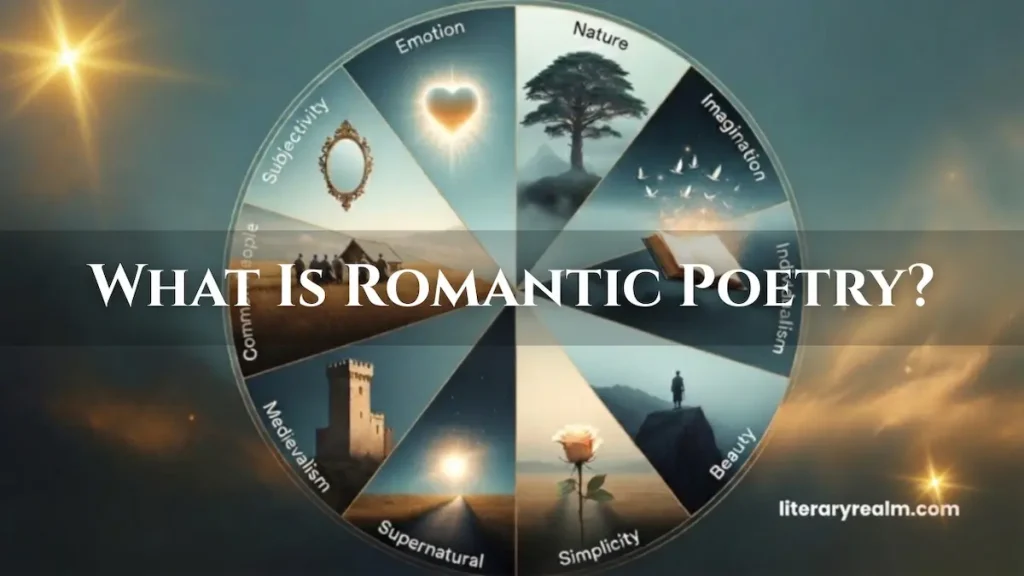
Romantic poetry is a literary style that emphasizes emotion, imagination, individuality, and the beauty of nature over logic, reason, and strict artistic rules. It developed as part of the broader Romantic Movement, which transformed literature, art, philosophy, and music throughout Europe during the late 18th and early 19th centuries. Rather than focusing on social conventions or classical ideals, Romantic poets celebrated personal experiences, deep emotions, and the limitless power of human creativity.
The origins of Romantic poetry can be traced to the late 1700s, particularly in Britain. Many literary historians consider the publication of Lyrical Ballads (1798) by William Wordsworth and Samuel Taylor Coleridge as the formal beginning of English Romanticism. This groundbreaking collection introduced a fresh poetic style that valued everyday language, common people, and genuine emotional experiences instead of artificial poetic diction.
Historically, Romantic poetry emerged during a time of dramatic political and social transformation. Events such as the French Revolution inspired ideas of liberty, equality, and human rights, while the Industrial Revolution rapidly changed society by replacing rural life with expanding cities and factories. Romantic poets reacted to these changes by turning toward nature, imagination, and the inner life of the individual.
The Romantic Movement was not limited to poetry alone. It influenced painting, music, architecture, and philosophy, promoting creativity, freedom, emotional expression, and appreciation for the natural world. Romantic writers believed that imagination was a powerful force capable of revealing truths beyond rational thinking. They often explored themes such as childhood innocence, spirituality, supernatural experiences, solitude, beauty, and humanity’s emotional connection with nature.
Romantic poetry also marked a clear departure from Neoclassicism, the literary movement that preceded it. While Neoclassical writers admired order, balance, reason, discipline, and adherence to classical rules, Romantic poets valued emotional authenticity, originality, intuition, and artistic freedom. Instead of imitating ancient Greek and Roman models, they encouraged poets to trust their imagination and personal vision.
In essence, Romantic poetry revolutionised English literature by placing the human heart, imagination, and natural world at the centre of poetic expression, creating works that continue to resonate with readers around the globe.
Why Did Romantic Poetry Emerge?
The emergence of Romantic poetry was not accidental. It developed as a response to profound political, social, intellectual, and economic changes that transformed Europe during the late eighteenth century. Romantic poets believed that literature should express genuine human emotions rather than follow rigid artistic conventions. Several major historical events and cultural shifts contributed to the birth of this influential literary movement.
One of the most significant influences was the French Revolution (1789). Its ideals of freedom, equality, and fraternity inspired many Romantic poets to celebrate individual freedom and challenge oppressive social and political systems. Although some poets later became disillusioned by the Revolution’s violence, its emphasis on human rights and personal liberty remained central to Romantic thought.
The Industrial Revolution also played a significant role in shaping Romantic poetry. Rapid industrialization transformed rural landscapes into crowded industrial cities filled with factories, machines, and pollution. Many Romantic poets viewed these developments as harmful to both nature and the human spirit. They responded by glorifying the beauty, peace, and healing power of the natural world, portraying nature as a refuge from the pressures of modern industrial life.
Another important reason for the rise of Romantic poetry was its reaction against Neoclassicism. Neoclassical literature emphasized reason, order, restraint, and adherence to established literary rules inspired by classical Greek and Roman traditions. Romantic poets rejected these restrictions, arguing that true poetry should arise from sincere emotions, imagination, intuition, and personal experience rather than formal conventions.
The growing emphasis on individual freedom further strengthened the movement. Romantic writers believed that every person possessed unique thoughts, emotions, and creative potential. Instead of celebrating kings, nobles, or heroic figures, they often focused on ordinary individuals, personal feelings, childhood experiences, and the richness of the human imagination. This shift encouraged a more intimate and authentic style of poetic expression.
Finally, broader social changes contributed significantly to the movement’s development. Expanding education, philosophical ideas about human potential, and changing attitudes toward society encouraged writers to explore themes of equality, personal identity, emotional authenticity, and social justice. Romantic poets sought to reconnect people with nature, spirituality, and their inner selves during a period of rapid modernization and uncertainty.
Together, these historical forces created the ideal environment for Romantic poetry to flourish. By emphasising emotion, imagination, freedom, and nature over reason and convention, Romantic poets established a revolutionary literary tradition that continues to shape literature and artistic expression today.
Characteristics of Romantic Poetry
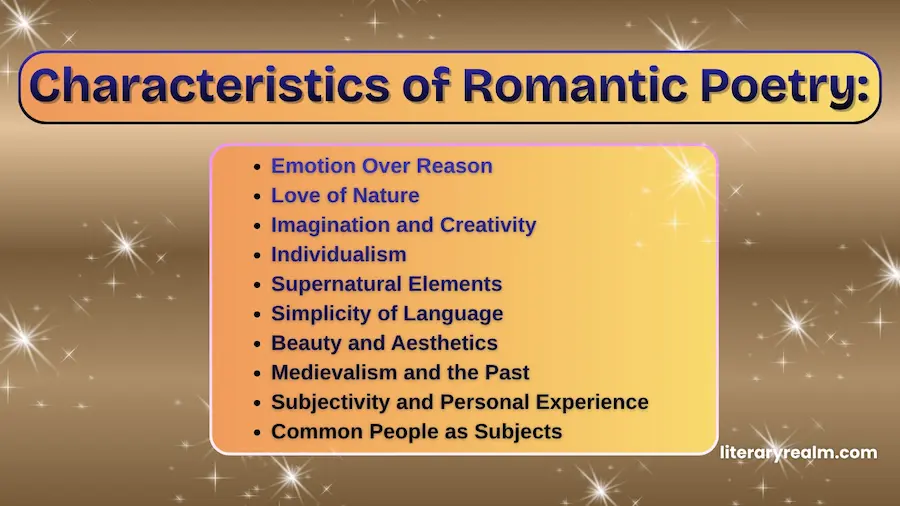
The Characteristics of Romantic Poetry distinguish it from every earlier literary movement. Romantic poets rejected rigid artistic conventions and instead embraced emotion, imagination, freedom, and nature as the foundations of poetic expression. Rather than writing to impress readers with complex language or strict forms, they sought to inspire genuine feelings and reveal the beauty of ordinary life.
These characteristics did not exist independently. Instead, they worked together to create a new poetic vision that celebrated human individuality, emotional authenticity, and the power of creativity. Whether exploring breathtaking landscapes, supernatural mysteries, childhood innocence, or personal struggles, Romantic poets consistently placed the human heart at the centre of their works.
Understanding these defining features helps readers appreciate why Romantic poetry continues to influence literature, art, philosophy, and modern culture. Below are the most important characteristics that define Romantic poetry.
Emotion Over Reason
One of the most fundamental characteristics of Romantic poetry is its emphasis on emotion over reason. Romantic poets believed that genuine feelings reveal deeper truths than cold logic or intellectual analysis. While earlier Neoclassical writers valued order, discipline, and rational thinking, Romantic poets argued that poetry should originate from sincere emotions and personal experiences.
This shift allowed poets to explore love, sorrow, joy, loneliness, hope, fear, and spiritual wonder with remarkable honesty. They viewed emotions as universal experiences that connected people across different cultures and generations. Rather than suppressing feelings, Romantic poets celebrated them as essential aspects of human nature.
The importance of this characteristic lies in its ability to create an emotional bond between the poet and the reader. Readers often relate to Romantic poems because they express feelings that are deeply human and timeless.
A famous literary example appears in William Wordsworth’s definition of poetry:
“Poetry is the spontaneous overflow of powerful feelings.”
This statement, from the Preface to Lyrical Ballads, perfectly summarizes the Romantic belief that authentic emotion is the true source of poetry.
Representative poet: William Wordsworth
His poems, such as Lines Composed a Few Miles above Tintern Abbey and Ode: Intimations of Immortality, demonstrate how emotional experiences become profound poetic reflections.
Love of Nature
Nature occupies a central position among the Characteristics of Romantic Poetry. Romantic poets viewed nature as far more than beautiful scenery; they regarded it as a living force capable of teaching wisdom, healing emotional pain, and revealing spiritual truths.
Unlike industrial society, which many poets believed alienated humanity, nature represented harmony, purity, and peace. Forests, rivers, mountains, flowers, birds, and changing seasons frequently appear throughout Romantic poetry as symbols of beauty and renewal.
Nature also became a source of inspiration for imagination and self-discovery. Romantic poets believed that spending time in natural surroundings allowed individuals to reconnect with their inner selves and better understand the universe.
William Wordsworth’s I Wandered Lonely as a Cloud beautifully illustrates this love of nature. The sight of dancing daffodils brings lasting happiness even after the poet leaves the landscape.
A well-known quotation from the poem states:
“A host of golden daffodils.”
This simple image demonstrates how ordinary natural beauty can produce extraordinary emotional experiences.
Representative poet: William Wordsworth
Wordsworth’s lifelong devotion to nature earned him the title of the “Poet of Nature,” making him one of Romanticism’s defining figures.
Imagination and Creativity
Another defining characteristic of Romantic poetry is its celebration of imagination and creativity. Romantic poets considered imagination one of humanity’s greatest gifts because it enabled people to perceive truths beyond ordinary observation.
Rather than merely describing reality, poets transformed everyday experiences into imaginative visions filled with symbolism, emotion, and philosophical meaning. Creativity became a means of exploring dreams, spirituality, mythology, and the mysteries of existence.
This emphasis on imagination encouraged originality. Romantic poets rejected imitation and believed every artist should create a unique voice based on personal inspiration rather than established literary rules.
Samuel Taylor Coleridge’s Kubla Khan serves as one of the finest examples of imaginative poetry. The poem presents an extraordinary dreamlike world filled with magical landscapes and mysterious imagery that continues to fascinate readers.
Coleridge famously described the imagination as a creative force capable of shaping reality through artistic vision.
Representative poet: Samuel Taylor Coleridge
His works demonstrate how imagination can transcend ordinary experience and transport readers into entirely new worlds.
Individualism
Individualism is another essential characteristic of Romantic poetry. Romantic writers celebrated the uniqueness of every individual and encouraged people to trust their own thoughts, emotions, and imagination rather than blindly following society’s expectations.
Instead of focusing primarily on kings, political leaders, or mythological heroes, Romantic poets explored personal identity, private emotions, and individual freedom. They believed that every person’s experiences were worthy of artistic expression.
This emphasis reflected broader political and philosophical ideas of liberty that emerged during the late eighteenth century. Romantic poetry promoted independence, creativity, and self-expression while challenging rigid social traditions.
William Blake’s Songs of Innocence and of Experience explores the individual’s journey through life while examining society’s influence on personal development.
Representative poet: William Blake
Blake’s visionary poetry consistently celebrates the freedom of the human imagination and criticizes institutions that suppress individuality.
Supernatural Elements
Romantic poetry frequently incorporates supernatural elements that create mystery, wonder, and psychological depth. Ghosts, spirits, magical landscapes, prophetic dreams, mysterious voices, and unexplained events often appear throughout Romantic literature.
Rather than using supernatural elements merely to frighten readers, Romantic poets employed them to explore imagination, morality, guilt, faith, and the unknown aspects of human existence. These mysterious experiences often symbolize deeper emotional or spiritual truths.
This characteristic broadened the possibilities of poetry by moving beyond ordinary reality into symbolic and imaginative worlds.
Samuel Taylor Coleridge’s The Rime of the Ancient Mariner provides one of the greatest examples. The poem includes supernatural punishments, ghostly ships, spectral figures, and mysterious forces that reflect the mariner’s spiritual transformation.
Representative poet: Samuel Taylor Coleridge
His mastery of supernatural storytelling established him as one of the leading imaginative poets of the Romantic era.
Simplicity of Language
Unlike earlier literary traditions that often favoured elaborate vocabulary and artificial expressions, Romantic poets believed poetry should use simple, natural language that ordinary readers could easily understand.
William Wordsworth argued that poetry should reflect “the real language of men.” He believed that genuine emotions are communicated most effectively through clear, accessible language rather than ornate poetic diction.
This simplicity made Romantic poetry more inclusive and emotionally powerful. Readers could immediately connect with the poet’s thoughts without struggling through unnecessary complexity.
Many poems in Lyrical Ballads deliberately employ everyday speech while maintaining remarkable beauty and emotional depth. This approach transformed English poetry by proving that ordinary language could express extraordinary ideas.
Representative poet: William Wordsworth
His poetic philosophy permanently changed literary style by demonstrating that simplicity often creates greater emotional impact than excessive ornamentation.
Beauty and Aesthetics
Romantic poets possessed an extraordinary appreciation for beauty and aesthetics. Beauty was not limited to physical appearance but extended to emotions, imagination, nature, art, music, and spiritual experiences.
They believed beauty nourishes the human soul and elevates everyday life. Through beautiful imagery and musical language, Romantic poetry encourages readers to appreciate the wonders surrounding them.
John Keats became the greatest poetic champion of beauty. His poems celebrate artistic perfection while exploring the relationship between beauty and truth.
One of the most famous quotations in English literature appears in Ode on a Grecian Urn:
“Beauty is truth, truth beauty.”
This enduring statement reflects the Romantic belief that beauty possesses profound philosophical significance.
Representative poet: John Keats
His richly descriptive poetry remains one of the finest examples of aesthetic excellence in English literature.
Medievalism and the Past
Romantic poets often looked back to the Middle Ages, ancient legends, folklore, mythology, and national history for inspiration. This fascination with the past is known as medievalism.
Rather than viewing history merely as a record of events, Romantic poets saw it as a source of imagination, mystery, heroism, and cultural identity. Medieval castles, knights, legends, and ballads frequently appear throughout Romantic literature.
The past provided an escape from industrial society while preserving values such as honour, courage, spirituality, and imagination.
Sir Walter Scott’s narrative poems and historical writings revived widespread interest in medieval traditions and inspired later generations of writers.
Representative poet: Sir Walter Scott
His works successfully blended historical settings with Romantic imagination, making medieval themes popular throughout nineteenth-century literature.
Subjectivity and Personal Experience
Romantic poetry places great importance on subjectivity and personal experience. Instead of presenting objective observations, Romantic poets explored their own thoughts, memories, dreams, and emotional journeys.
Poetry became an intimate reflection of the poet’s inner world. Personal experiences often served as the starting point for universal insights about life, nature, faith, love, and mortality.
This characteristic allows readers to experience the poet’s emotions directly, creating empathy and emotional connection.
William Wordsworth’s The Prelude is one of the greatest autobiographical poems in English literature. It traces the development of the poet’s own mind and illustrates how personal experiences shape artistic identity.
Representative poet: William Wordsworth
His introspective poetry established personal experience as a legitimate and powerful subject for serious literature.
Common People as Subjects
One of the most revolutionary Characteristics of Romantic Poetry is its focus on ordinary people. Romantic poets believed that shepherds, farmers, children, labourers, villagers, and humble individuals possessed lives worthy of poetic celebration.
Earlier literary traditions often centred on aristocrats, rulers, or classical heroes. Romantic poets deliberately shifted attention toward everyday individuals, believing genuine human experiences could be found in common life.
This democratic approach reflected the movement’s broader ideals of equality and respect for individual dignity. It also allowed poets to portray authentic emotions using familiar situations and accessible language.
William Wordsworth’s “Michael” and “The Solitary Reaper” beautifully portray ordinary rural people with sympathy, respect, and emotional depth.
Representative poet: William Wordsworth
His poetry demonstrated that the experiences of common people could possess the same artistic value and emotional richness as those of kings or legendary heroes, fundamentally transforming the subjects considered worthy of poetry.
Major Romantic Poets and How They Reflect These Characteristics
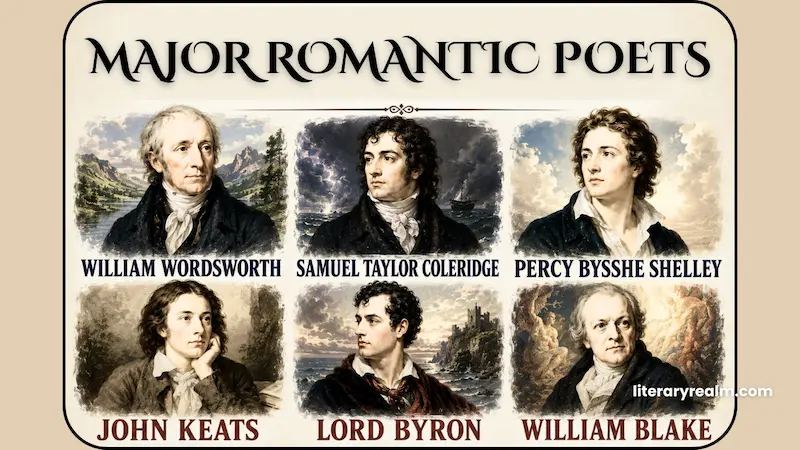
The defining Characteristics of Romantic Poetry become even clearer when examining the works of its leading poets. Although each writer developed a distinctive poetic voice, they collectively shared a commitment to emotion, imagination, individuality, and the transformative power of nature. Their contributions established Romanticism as one of the most influential movements in English literature.
William Wordsworth
William Wordsworth is widely regarded as the central figure of English Romanticism. His poetry celebrates nature as a source of wisdom, comfort, and spiritual growth. He believed that poetry should arise from genuine emotions and be written in the language of ordinary people. His poems, such as “Lines Composed a Few Miles above Tintern Abbey” and “I Wandered Lonely as a Cloud”, perfectly illustrate the Romantic ideals of emotional sincerity, simplicity, and humanity’s deep connection with nature.
Samuel Taylor Coleridge
Samuel Taylor Coleridge expanded the scope of Romantic poetry through his extraordinary imagination and fascination with the supernatural. Unlike Wordsworth, who focused primarily on the natural world, Coleridge explored mysterious landscapes, dreams, and symbolic experiences. Poems such as Kubla Khan and The Rime of the Ancient Mariner demonstrate how imagination can transcend ordinary reality while exploring profound psychological and spiritual themes.
Percy Bysshe Shelley
Percy Bysshe Shelley represents the Romantic ideals of freedom, revolution, and hope. Deeply inspired by political change and human liberty, Shelley often used natural forces as symbols of transformation. In Ode to the West Wind, the powerful wind is both destructive and creative, expressing the poet’s belief that change ultimately leads to renewal. His poetry combines emotional intensity with visionary imagination.
John Keats
John Keats devoted much of his poetry to beauty, art, and the richness of sensory experience. His works reveal the Romantic belief that beauty possesses lasting emotional and philosophical significance. Poems such as Ode to a Nightingale and Ode on a Grecian Urn explore themes of mortality, imagination, and the relationship between beauty and truth. Keats’s vivid imagery and lyrical style remain hallmarks of Romantic aesthetics.
Lord Byron
Lord Byron brought passion, rebellion, and powerful individualism to Romantic poetry. His works frequently feature strong, independent protagonists who challenge social conventions and pursue personal freedom. This literary figure, often called the “Byronic Hero,” became one of Romanticism’s most enduring contributions. Through poems such as Childe Harold’s Pilgrimage, Byron celebrated emotional intensity, adventure, and resistance to authority.
William Blake
William Blake combined poetry, philosophy, and visionary symbolism to challenge political oppression, organised religion, and social injustice. His collections, Songs of Innocence and Songs of Experience, examine the contrasts between purity and corruption, hope and suffering. Blake’s imaginative symbolism and emphasis on individual spiritual freedom make him one of the earliest and most original Romantic poets.
Together, these six poets shaped the Romantic Movement by expressing its core values in unique yet complementary ways. Their works continue to influence literature by celebrating universal human experiences through emotion, imagination, and artistic freedom.
Examples of Characteristics of Romantic Poetry in Famous Poems
Studying famous Romantic poems provides the clearest understanding of how the Characteristics of Romantic Poetry operate in practice. Each masterpiece highlights different aspects of the movement while demonstrating its shared emphasis on emotion, imagination, nature, and individuality.
Ode to the West Wind — Percy Bysshe Shelley
Shelley’s Ode to the West Wind is a powerful example of Romantic idealism and imagination. The west wind symbolises both destruction and renewal, representing the continuous cycle of change in nature and human society. The poem also reflects the Romantic belief that nature possesses immense spiritual and creative power. Shelley’s passionate, emotional voice and desire for political and personal transformation embody the movement’s celebration of freedom and hope.
Ode to a Nightingale — John Keats
In Ode to a Nightingale, Keats explores beauty, imagination, mortality, and the limitations of human existence. Inspired by the nightingale’s song, the speaker imagines escaping the hardships of life through the creative power of imagination. The poem beautifully illustrates Romantic aesthetics, emotional depth, and the search for eternal beauty beyond the physical world.
Lines Composed a Few Miles above Tintern Abbey — William Wordsworth
Often simply called Tintern Abbey, this poem exemplifies Wordsworth’s profound relationship with nature. Rather than merely describing scenery, Wordsworth explains how nature shapes memory, morality, emotional well-being, and spiritual understanding. The poem perfectly demonstrates the Romantic belief that nature is humanity’s greatest teacher and lifelong companion.
Kubla Khan — Samuel Taylor Coleridge
Kubla Khan showcases Romantic imagination at its most extraordinary. Inspired by a dream, the poem presents an exotic landscape filled with mystery, supernatural imagery, and symbolic meaning. Rather than depicting ordinary reality, Coleridge invites readers into a visionary world where imagination becomes the primary source of artistic creation. The poem remains one of the finest examples of Romantic creativity and symbolic expression.
Together, these poems reveal how Romantic writers transformed poetry into a powerful medium for exploring emotions, nature, imagination, beauty, and the limitless possibilities of the human spirit.
Romantic Poetry vs Neoclassical Poetry
Although Romanticism developed directly after Neoclassicism, the two literary movements differ significantly in their themes, style, and artistic philosophy. While Neoclassical writers admired order, reason, and adherence to established rules, Romantic poets emphasized emotion, imagination, individuality, and creative freedom.
The following comparison highlights the major differences between these two influential literary traditions.
| Aspect | Romantic Poetry | Neoclassical Poetry |
| Primary Themes | Nature, imagination, freedom, emotions, individuality | Reason, order, morality, society, classical ideals |
| Language | Simple, natural, conversational, emotionally expressive | Formal, refined, elevated, carefully structured |
| View of Nature | Nature is a spiritual guide, healer, and source of inspiration | Nature is admired but often viewed through reason and balance |
| Role of Emotion | Emotions are central to poetic expression | Emotions are controlled by logic and restraint |
| Importance of Reason | Imagination and intuition are valued above reason | Reason is considered the highest human faculty |
| Poetic Style | Creative, spontaneous, symbolic, imaginative | Disciplined, balanced, rule-based, classical |
| Subject Matter | Ordinary people, personal experiences, rural life, supernatural elements | Kings, heroes, public life, social order, classical history |
In summary, Romantic poetry represents a dramatic shift from intellectual restraint to emotional freedom. By replacing strict literary conventions with imagination, personal experience, and an appreciation of nature, Romantic poets revolutionised English literature and created works that continue to inspire readers around the world. Understanding these differences helps readers appreciate why Romanticism is known as one of the most significant turning points in literary history.
Why Are the Characteristics of Romantic Poetry Still Important Today?
Although the Romantic Movement began more than two centuries ago, the Characteristics of Romantic Poetry remain remarkably relevant in the modern world. Its core ideas continue to shape literature, inspire artists, and influence the way people think about nature, emotions, and creativity.
One of Romanticism’s greatest legacies is its impact on modern literature. Many contemporary poets and novelists still emphasize personal experiences, emotional honesty, and imaginative storytelling—principles first championed by the Romantic poets. Their focus on individuality has encouraged writers to develop unique voices rather than conform to rigid literary conventions.
Romantic poetry is also highly significant in promoting environmental awareness. At a time when climate change, pollution, and deforestation threaten ecosystems worldwide, the Romantic celebration of nature reminds readers to appreciate, respect, and protect the natural environment. The movement’s portrayal of nature as a source of beauty, peace, and spiritual renewal remains especially meaningful today.
Equally important is Romanticism’s encouragement of emotional expression. In an increasingly fast-paced, technology-driven society, Romantic poetry reminds us that emotions, empathy, and self-reflection are essential to human well-being. Its celebration of imagination also continues to inspire creativity in literature, music, visual arts, and filmmaking.
The influence of Romanticism extends to contemporary poetry, where themes such as identity, memory, nature, freedom, and personal experience remain central. By encouraging readers to value both emotion and imagination, the characteristics of Romantic poetry continue to enrich artistic expression and deepen our understanding of the human experience.
The Characteristics of Romantic Poetry transformed English literature by placing emotion, imagination, individuality, and nature at the heart of poetic expression. Rejecting the strict rules of Neoclassicism, Romantic poets created works that celebrated personal freedom, creative originality, spiritual reflection, and the beauty of the natural world. Their poetry demonstrated that ordinary experiences, sincere emotions, and everyday language could communicate profound truths just as effectively as grand classical subjects.
These defining characteristics including emotional depth, love of nature, imaginative vision, individualism, simplicity of language, appreciation of beauty, fascination with the past, supernatural elements, subjectivity, and sympathy for common people—continue to resonate with readers across cultures and generations. They have shaped countless literary movements and continue to influence modern poetry, fiction, and other creative arts.